Ben Shelton Calls for Change in Tennis Second Serve Rules
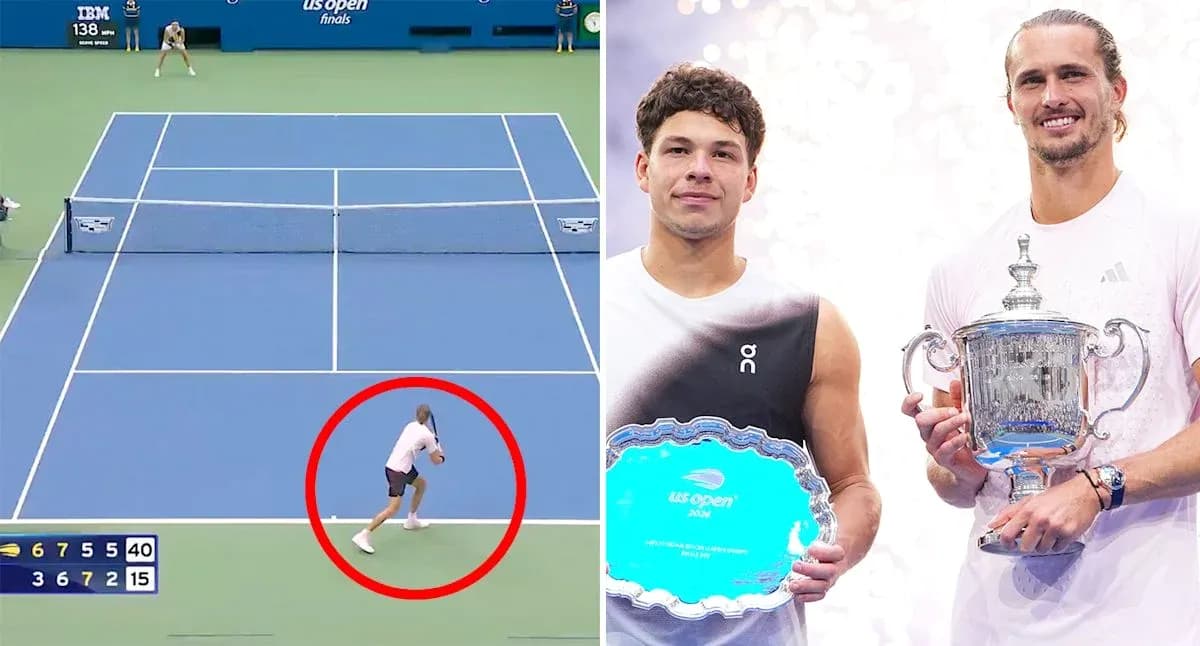
Ben Shelton had just walked off court from the biggest match of his life, a US Open final lost to Alexander Zverev, but his mind was already on something else: the clock.
Not the scoreboard. The service clock.
Across four sets on Sunday night, Zverev collected his second straight grand slam title with a 6-3 7-6 (7-2) 5-7 6-2 win. He also collected a wave of irritation from fans, commentators and opponents as he inched, bounced and paused his way through countless service routines that pushed patience – and the current rules – to their limits.
The tennis was high quality. The tempo was not.
A rule with a gaping hole
On paper, the regulations look clear. Players have 25 seconds from the end of one point to start the next. Miss that window and they risk a time violation.
But the rule has a loophole big enough to drive a night session through. The clock only governs the start of the point and the first serve. Once that first delivery misses, the second serve lives in a grey area: no shot clock, just the umpire’s judgment that it should be taken “without delay”.
Zverev has turned that grey area into a comfort zone.
He drew time violations in both his semi-final and the final, yet still repeatedly bounced the ball over and over before pulling the trigger. Umpires could do little once the first serve had been struck. The second-serve routine became a slow ritual, and the match’s rhythm sagged.
Shelton, who had to stand and wait through it all on the other side of the net, did not sugarcoat his view.
Shelton: ‘There shouldn’t be unlimited time’
Asked in his post-match press conference how the sport should deal with the issue, the American went straight to the heart of the problem: the absence of a second-serve clock.
“For a first serve you should be able to do whatever you want and use the full 25 seconds every time,” Shelton said.
“There should be some sort of rule limiting time on second serves. There shouldn’t be unlimited time. It’s tough to be sitting there for that long for the next action to happen.”
That last line cuts to the core. Tennis sells tension, not stagnation. When a returner is left staring across the net, waiting through 20-plus bounces and aborted tosses, the tension drains away and frustration takes its place – in the stands as much as on court.
Shelton is not alone.
Roddick: ‘The rules should change’
Andy Roddick, a man who built a career on fast, ferocious serving, had already called for reform. Speaking on his “Served” podcast, the former US Open champion said the sport has to close the loophole.
“The rules should change,” Roddick said. “As long as he’s doing it within the 25-second shot clock, yeah, what are you going to say? There needs to be a shot clock for the second serve.
“You cannot bounce the ball 20-something times between first and second serve. And then act shocked when we finish at 3 in the morning. Like, we just can’t do it.”
That last point echoes around every late-night grand slam finish. Tournament organisers talk about player welfare and TV windows, but as long as players can stretch the gaps between points, the sport is fighting itself.
McEnroe wants the toss to cost you
In the ESPN commentary box, John McEnroe watched Zverev repeatedly toss the ball, pause, catch it, reset and start again. For him, the issue was not just time; it was accountability.
“This should be over the serve clock. It was at two (seconds left) when he tossed it. Should be a fault,” he said on air.
In McEnroe’s view, once the server commits to the toss with the clock running down, there should be a consequence if they abort and time expires. No more endless mulligans. Get the toss right, or pay for it.
Patrick McEnroe, alongside him, looked at it from the returner’s side. If a server slows the game to a crawl with long ball-bounce routines, he argued, the returner should have more freedom too.
“As a returner, when a guy’s doing this (bouncing the ball so many times) you should be able to step away, just before he serves,” he said.
It was a small suggestion, but it spoke to a wider frustration: right now, the server controls not only the point, but the pace of the entire match.
‘It takes so much time’
Karen Khachanov felt that control in the semi-final, where he also lost to Zverev and also endured the endless bouncing.
“Zverev’s bouncing annoys not only me but other players on tour,” the Russian said after that defeat. “It takes so much time.
“At the end of the day, if it’s within the rules with the time between points, I cannot say anything against that. If he extends the time, then he gets a time violation, so it’s as simple as that.”
That is the crux of the debate. Zverev is operating inside the law, exploiting a gap the rule-makers left open. The irritation is not really about one player, even if he has become the lightning rod. It is about a sport that has modernised in some areas – electronic line-calling, shot clocks, roof technology – but still allows crucial moments to be dragged out by routine rather than drama.
Shelton, Roddick, the McEnroes, Khachanov: they are all, in different ways, pointing at the same problem. The current rulebook gives the illusion of urgency with a 25-second clock, then hands back control with a second serve that can stretch on and on.
The question now is whether the governing bodies will move as slowly as the routines they are being asked to fix, or whether tennis finally puts a clock on the one part of the game that still lives in the shadows between points.