Caleb Wilson: Chicago Bulls' New Hope for a Bright Future
On an August afternoon outside the United Center, the old Chicago mythology stares down at the new. Michael Jordan, frozen in bronze mid-flight, looms above a sea of red jerseys and phone cameras. At his feet, a 20-year-old screams into a camera, tongue out, hyping a crowd that has waited a decade for someone worth lining up around an atrium to see.
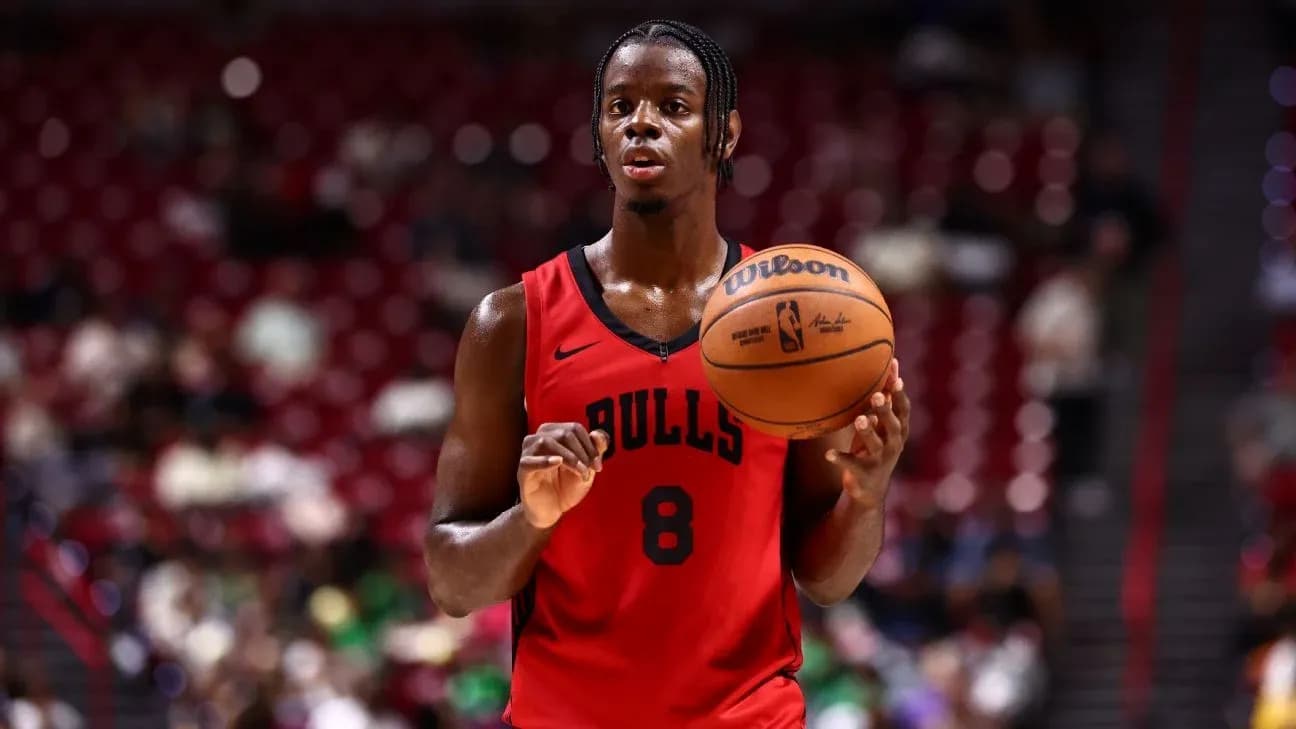
This is Caleb Wilson’s first real day as a Bull. Chicago has already decided it wants him to be much more than that.
The line for his meet-and-greet at Bulls Fest snakes through the building. The slam dunk contest in the parking lot can wait; fans want autographs, selfies, a glimpse of the kid drafted No. 4 overall in June, the kid they’re already treating like a savior for a franchise that has missed the playoffs in eight of the past nine seasons.
The image is impossible to miss: Jordan’s statue behind him, Wilson in front of it, the franchise’s past literally towering over its intended future.
A summer league debut that changed the temperature
The buzz started in June on draft night. It detonated in Las Vegas.
Wilson’s first professional game in summer league didn’t just go well; it rewrote the scouting report. Thirty-five points, the second-highest scoring debut for a rookie in summer league history. Seven made 3-pointers — more than he hit in his entire freshman season at North Carolina.
Teams usually roll their eyes at summer league overreactions. This one felt different.
“He looks,” one Bulls source told ESPN, “like we got a dude.”
In Game 2, Wilson rose over 6-foot-11 Jazz center Jonas Aidoo and detonated a dunk that lived on highlight reels for the rest of July. By Game 4, Kevin Garnett was courtside, watching a 6-foot-10, wiry 215-pound forward whose frame and ferocity had already drawn comparisons to his own.
On his podcast, Draymond Green went even further.
“I actually think his floor is Kevin Garnett,” Green said. “And man, if that's your floor, oh my god. Do you know how great KG was? I actually think with Caleb Wilson, Kevin Garnett could be his floor. That's how special I think Caleb Wilson is.”
The league noticed. So did Chicago’s new regime.
Wilson averaged 23.5 points, 7.3 rebounds, 1.3 steals and 2.5 blocks over four games, earning all–summer league first-team honors. When told his 35-point debut ranked among the best in event history, he barely reacted.
They lost. That’s what he cared about.
From broken thumb to 2,500 threes a day
For all the fireworks in Vegas, Wilson’s rise came out of a quieter, more stubborn place.
His freshman year at North Carolina ended in February with a broken thumb and a left wrist fracture. A cast locked his thumb straight. He couldn’t move it. He couldn’t play in the NCAA tournament. He could, however, hold a ball.
So he did. Every day. Repping his shooting form over and over, even when the only thing he could really do was set his hand and follow through.
The biggest knock on him entering the draft was the jumper. He’d averaged just 1.1 3-point attempts per game in Chapel Hill and made fewer total 3s all season than he hit in one night in Vegas. His answer was blunt.
He pointed to North Carolina’s system, which didn’t ask him to shoot from deep. Then he pointed to the work.
Wilson estimates he’s been taking between 2,000 and 2,500 3-pointers a day since the college season ended.
“I’m glad I didn't shoot 3s in college,” Wilson said after a summer practice. “Because if I did, I wouldn't be here. I don't know where I'd be. I don't think I'd be a Bull.”
The Bulls have noticed the obsession. He cried before his professional debut — five months to the day since his college season ended — because he’d been waiting for that moment for so long. When other top picks shut it down after two or three games, Wilson pushed to keep going, texting the front office to play the second night of a back-to-back in Chicago’s third game.
Since the draft, he’s barely left the city. Mornings at the practice facility. Back again around 8 or 9 p.m., often with fellow first-rounder Dailyn Swain, the No. 15 pick, for late-night sessions that bleed toward midnight.
“Everybody highlights his athleticism, which is generational,” Swain said. “But he can do a lot of things. He's really good facing up at the elbow, jab. He has a really good midrange shot. He's been knocking down 3s, so he's widening his arsenal.”
The Bulls, a franchise that has spent years trying to shortcut its way back into the conversation, finally see a different kind of path.
A new front office, a new coach, a new pillar
The overhaul started at the top.
Chicago hired Bryson Graham to run basketball operations, a talent evaluator known for building through the draft and betting on young players. His first major move: hiring Tiago Splitter as head coach.
Splitter arrives with a résumé built less on glitz and more on growth. In Portland last season, he stepped in as interim coach and took the Trail Blazers to a surprise playoff berth as the No. 7 seed in the West. Before that, he carved out a reputation as a player-development specialist — helping Deni Avdija become an All-Star with the Blazers and working with Jarrett Allen in Brooklyn and Alperen Sengun in Houston.
“The first thing you do is connect,” Splitter said. “That's the foundation of everything you do, especially at this level. If you don't have that, it's really hard to demand and make them respect you. The foundation is connect with the players in different ways.”
With Wilson, that connection started early and unexpectedly, through music. The 19-year-old picked up the guitar this summer and bounced from hip-hop to classical to country. Splitter, intrigued, saw how wide his rookie’s mind ranged.
“Very interesting young guy,” Splitter said. “You see how his brain functions and the variety of things he can have a conversation about.”
On the court, Splitter stepped in to coach Chicago’s first two summer league games, wanting to lay down the foundation himself. He made Wilson the primary ball handler, essentially the point guard, a responsibility Garnett never had in his Hall of Fame career.
Wilson embraced it, even if that role will shrink once the real games start. With Josh Giddey, Norman Powell and third-year forward Matas Buzelis — who started 77 games last season — sharing creation duties, Wilson will have more freedom to attack rather than orchestrate.
“He's really detailed,” Wilson said of Splitter. “He knows what he wants you to do and he's pretty serious. Most coaches, you have coaches that are joking around and stuff like that. Tiago's pretty serious and he knows what he wants.
“I’d rather have someone who's serious and straightforward with me, so I know what I can do better.”
Graham wanted that edge.
“It builds a healthy environment,” Graham said. “It gives the younger guys confidence, too, because they know that, when it is going bad, they have some guys that have done it, some guys that have won and had success and they can learn. It's just really important for the overall development of our younger players and the health of our team.”
Splitter has shown he can win in different ways. In France, with Paris Basketball, he pushed a fast-paced attack all the way to the EuroLeague playoffs. With Portland, he leaned into defense as the team’s identity.
Chicago is his first true blank canvas.
“You have to adapt your system to the players you have,” Splitter said. “Yes, I have a vision. I have a certain way I want to play, but you also have to explore what they do best. That's what we're going to do here.”
Patience in a city tired of waiting
For once, the Bulls aren’t pretending they’re one move away.
The Eastern Conference is loaded. Internally, there’s no mandate to chase a play-in berth or a low playoff seed this season. After years of trying to skip steps, the organization is finally preaching patience.
“We just want to see internal growth from our young guys and even from our veteran players,” Graham said. “We just want to see a team that's going to go out there, represent this city well, play hard and obviously continue to grow and continue to develop.”
The roster reflects that balance. Wilson is the centerpiece. Around him, Chicago added veterans like Powell and Nic Claxton to stabilize the locker room and the rotations, to give the kids examples of what an NBA career actually looks like up close.
The message is clear: development first, shortcuts last.
Wilson hears the league-wide expectations. He doesn’t shy away from his own.
“I expect to have Rookie of the Year, honestly,” he said. “I'm going to work hard. I'm going to do what it takes. I feel like the team is really good for me and how I envision to play.”
He’s not talking about numbers. He’s talking about impact. About winning.
The work before the real work
As training camp approaches, the Bulls have kept one tradition intact. Players gathered in Miami last week for a player-run minicamp, a chance to start building chemistry before the drills and film sessions become official.
Wilson, for all the hype swirling around him, has narrowed his focus.
“I do expect to win,” he said. “Whatever it takes to win is what I'm going to do.”
That’s the promise. The reality is harsher. The Bulls are coming off a lost decade, trying to rebuild in a conference stacked with established contenders and rising powers. Wilson is 20, still learning how to be a pro, still learning the league, still learning his own limits.
But on a late-summer day in Chicago, with fans wrapped around the United Center and a statue of the greatest Bull of all time looming above, the franchise finally has something it hasn’t had in years.
A kid who doesn’t just talk about bringing the Bulls back. A kid who shows up at 9 p.m. to shoot until midnight, who cried before his first summer league game, who looks at Rookie of the Year as a starting point, not a ceiling.
If this is the floor — if Kevin Garnett really is the baseline, as Draymond Green suggested — then the question hanging over Chicago isn’t whether Wilson can lift the Bulls out of irrelevance.
It’s how high this thing can go once he does.