Carlos Alcaraz's Impressive Comeback After Injury
Carlos Alcaraz didn’t just return. He announced himself all over again.
Four and a half months since he last played a singles match, the Spaniard walked back into grand slam combat with no warm‑up tournament, no gentle easing-in period, and a wrist that has dominated every conversation about his future. Ninety minutes later, he walked off with a 6-4, 6-4, 6-4 win over Roman Safiullin and something even more valuable: confirmation that his game, and his instincts, are still very much intact.
The shot that said everything
At 5-4, 30-15 in the opening set, the match produced the kind of moment that has always separated Alcaraz from his peers. He slid a wide serve into the corner, saw Safiullin’s backhand dip low at his feet, and in one smooth motion cushioned a half-volley over the net for a clean winner.
No grinding rally. No safety-first percentage tennis. Just touch, imagination and nerve.
It was the sort of improvisation that has been missing from the tour during his injury layoff, and the grin that followed told its own story. The smile, the quick hold, the tightening of his grip on the match – it all felt familiar again.
Questions answered, at least for a day
This comeback was loaded with unknowns. No best-of-five since the injury. No competitive singles since early spring. A wrist that has been prodded, scanned and debated for months. And across the net, a dangerous first-round opponent with heavy, penetrating groundstrokes in Safiullin – exactly the kind of ball-striker who could test that joint to its limit.
The response from Alcaraz was emphatic. He didn’t tiptoe into the match; he tore into it. From the baseline, his forehand – still the most feared shot in the sport – was unleashed without visible restraint. He finished with 20 winners off that wing against just nine unforced errors, repeatedly dictating rallies and hammering his way out of any brief moments of trouble on serve.
When the scoreboard hinted at pressure, he hit through it. The doubts he had spoken about in recent weeks never appeared in his swing.
“It’s pain-free right now,” he said afterwards of the wrist. “I felt great. I don’t know how it looked from outside but, from inside, my feeling was that I was hitting normal. I was playing pretty normal, playing my style, and the arm, the wrist, everything felt great. I’m going to still take care of it, obviously, these days and before the matches and everything, but I’m just really happy it’s pain-free finally.”
For a player whose game relies so heavily on explosive acceleration through the ball, that assessment matters as much as the scoreline.
The one red flag
Not everything was back at full power.
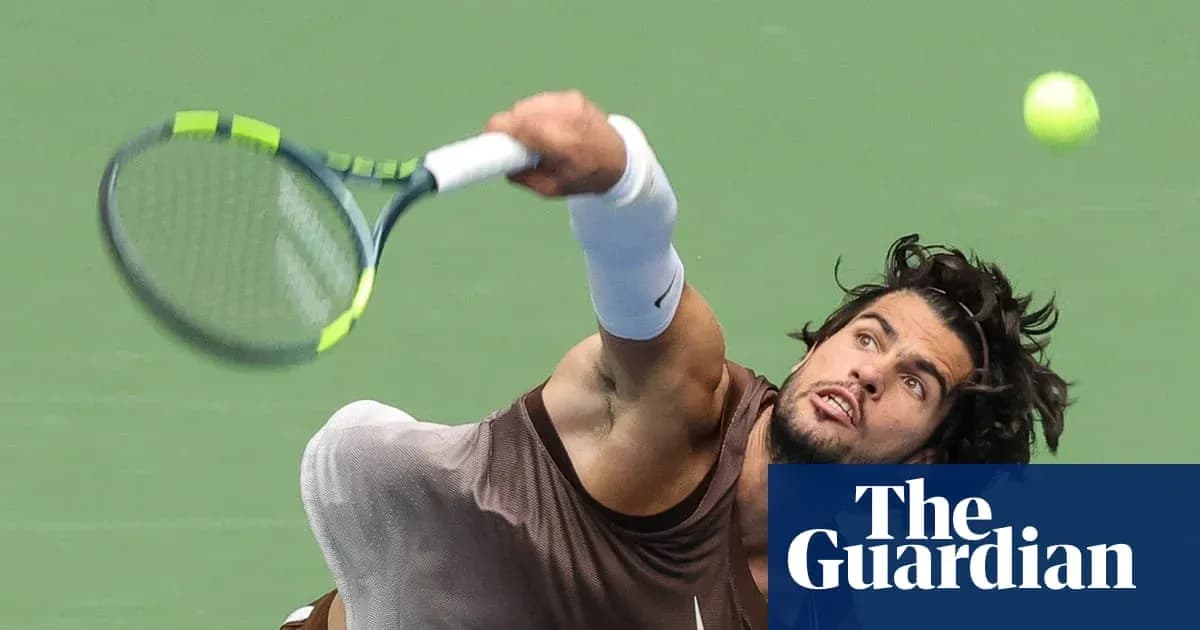
The serve, usually an increasingly important weapon in his arsenal, told a more cautious story. Alcaraz kept his speeds down, averaging just 113mph on first serves. The tape under his arm sleeve, visible in practice and now in competition, underlined the reality: he and his team are not ready to let him go full throttle on that motion.
In the short term, the strategy makes sense. After months out, there is no logic in chasing aces at the risk of re-aggravating the wrist. But the lack of free points will matter as the tournament wears on. Holding serve the hard way, game after game, round after round, is a different physical and mental test from cruising behind a big delivery.
For now, it’s a trade-off he has to accept. The forehand is firing. The movement looks sharp. The wrist feels good. The serve can wait.
Nerves, family, and a familiar buzz
If the tennis looked serene, the day itself was anything but. This was not a routine first round in his own mind.
“It was a difficult day for me, to be honest, but at the same time, a really beautiful one,” Alcaraz admitted. “[I] started the day really nervous. Really, really nervous, thinking: ‘I’m going to make it, I’m going to compete again.’ I had more nerves than usual, but just happy, because for me, my goal here is to compete, to enjoy, and let’s see how my body’s going to react after the matches, after the competition again.”
His box reflected the significance of the occasion. Parents. Brothers. His full team. Even rapper Travis Scott among the faces watching his every move. This was not just a physical test; it was a checkpoint in a young career already packed with expectations.
Alcaraz didn’t hide from the uncertainty. He embraced it.
“I don’t know how far I’m going to go in the tournament,” he said. “I didn’t know if I was going to lose this one, if I’m going to make the second round, final. I don’t know how far I’m going to go. But what I just really want to do is enjoy every time that I’m going to walk into the court feeling the energy from the people, feel the competition, walking up, I’m thinking, all right, it’s match day. That’s what I’m going to do this tournament.”
That mindset strips away the usual grand declarations. No talk of titles. No bold predictions. Just a simple target: to feel like a competitor again, every time he steps through the tunnel.
A return with edges
So where does this leave him?
On the evidence of this first outing, the core of his game has survived the layoff untouched. The forehand is savage, the creativity is still there in the tightest corners of the court, and the competitive fire hasn’t dimmed. The serve remains a question mark, and the grind of a full fortnight will expose any lingering weakness.
But on day one, under the gaze of his family, his team and a curious tennis world, Carlos Alcaraz walked back into the arena, trusted his instincts, and played like himself.
For a player of his age and ambition, that might be the most important win of all.