Carlos Alcaraz Dominates in US Open Return
Carlos Alcaraz walked back into Arthur Ashe Stadium with four months of doubt strapped to his right wrist and walked out looking every inch a defending champion.
No rust. No drama. No sets dropped.
The Spaniard, playing his first competitive singles match since April, dismissed Russia’s Roman Safiullin 6-4 6-4 6-4 in the opening round of the US Open, a quietly ruthless performance that sent a clear message across Flushing Meadows: injured, yes; diminished, no.
Alcaraz answers the only question that mattered
The last time Alcaraz swung freely in a tour match, it ended with a grimace in Barcelona and a wrist injury that wiped out his clay and grass seasons. No French Open. No Wimbledon. No tune-up events. Just rehab, uncertainty and the nagging thought that a five-set grind in New York might be a step too far, too soon.
He admitted as much.
“There were some doubts in the match, I'm not going to lie. Thinking about if I would last the match, best of five, playing four or five sets,” he said after booking a second-round meeting with Portugal’s Jaime Faria. “I had a little bit of doubt, but I tried to forget everything and focus on the things I needed to improve. I thought about what would happen in the match and physically I felt really well.”
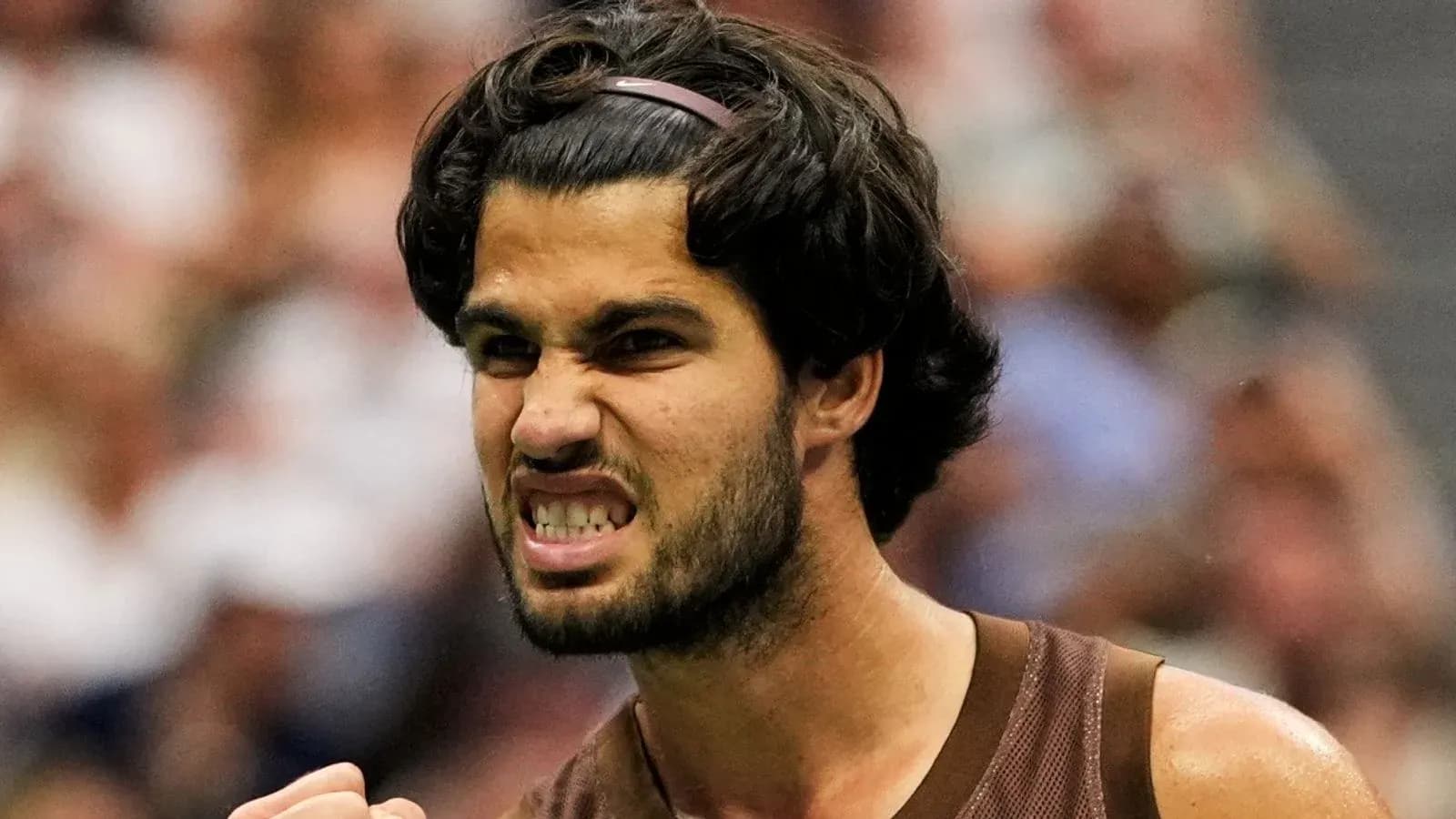
The questions followed him onto court. So did the cameras. Rapper Travis Scott watched from the stands, having helped design Alcaraz’s striking brown outfit for this fortnight, but the real scrutiny fell on the radar gun and the Spaniard’s movement.
Early on, Safiullin probed both.
Alcaraz had to dig out of two break points across his opening three service games, the Russian stepping inside the baseline and testing the forehand side that had been on ice for more than four months. Each time, Alcaraz found enough first serves and enough bite on his groundstrokes to wriggle clear.
Then the pressure flipped.
At 4-3, Alcaraz pounced. He broke in the eighth game, the first real crack in Safiullin’s resistance, and that single break was enough to lock away the opening set. The shot tolerance was there. The acceleration off both wings was there. The wrist, so far, was behaving.
Safiullin landed his only real punch at the start of the second set, breaking immediately and momentarily silencing the buzz around Ashe. Alcaraz’s response was immediate and emphatic. He broke straight back, raised his intensity and once again waited for the Russian to blink in the eighth game. When the chance came, he took it, surging ahead two sets to love with the same 6-4 scoreline.
By the third set, the contest felt less like a comeback test and more like a fitness check.
Alcaraz secured an early break, then slammed the door. His serve, shaky in those opening exchanges, settled into a reliable groove. Safiullin never saw another break point. The Spaniard continued to glide into the corners, changing direction with the familiar snap that has defined his hard-court success, and closed out a third straight 6-4 set without fuss.
For a player who hadn’t played a best-of-five match since last year’s US Open final, it was exactly the kind of clean, controlled outing he needed.
A shifting men’s draw
One of the major threats in Alcaraz’s half looked to be Arthur Fils, fresh from lifting the Cincinnati Open title last week and riding a wave of form into New York. That wave crashed early.
Stefanos Tsitsipas sent the Frenchman out in four sets, 4-6 7-6 (7-3) 6-1 6-4, ripping open a section of the draw that had suddenly become very dangerous. With Fils gone, the path for Alcaraz on paper eases slightly, though the defending champion knows New York rarely follows a script.
His first step, at least, was assured. The wrist held. The legs ran. The title defence is officially underway.
Sabalenka starts with a statement
On the women’s side, Aryna Sabalenka walked into this US Open carrying a different kind of burden: not injury, but expectation and a slipping grip on the No 1 ranking.
She answered with power.
The two-time defending champion opened her campaign with a 6-2 6-4 win over Colombia’s Camila Osorio, a straight-sets scoreline that doesn’t fully capture the tension of a second set played on a tightrope.
“Camila is a tough opponent but I was ready to do whatever it takes to get the win,” Sabalenka told Sky Sports Tennis. “I really enjoyed the atmosphere and support. A fun and tough match but happy to get through in straight sets.”
For a set and a half, Sabalenka looked like the force who has ruled New York for the last two years, bullying Osorio with heavy returns and first-strike tennis on a surface that has always suited her game. Then the Colombian dug in, extending rallies, dragging Sabalenka into the corners and testing both her patience and her recent form.
Those questions are real. Sabalenka has exited in the last 16 at her previous three events – Wimbledon, the Canadian Open and Cincinnati – a wobble significant enough that Elena Rybakina, Coco Gauff and Jessica Pegula all arrive in New York with a chance to unseat her as world No 1 for the first time since October 2024.
Osorio pushed, but Sabalenka’s hard-court pedigree told. All four of her Grand Slam titles have come on this surface. When she needed it, the raw power returned, and the Belarusian slammed the door before a deciding set could materialise.
If the ranking is in play, the title defence is very much alive.
Muchova and Anisimova make their move
Behind the marquee names, several familiar threats slipped quietly but efficiently into the second round.
Wimbledon runner-up Karolina Muchova, still one of the most elegant problem-solvers on tour when healthy, delivered a sharp 6-3 6-0 win over Austria’s Sinja Karus. After a controlled first set, Muchova accelerated, reeling off games with a mix of variety and precision that will have seeded players glancing nervously at that section of the draw.
Last year’s US Open runner-up Amanda Anisimova also made a confident start, overpowering fellow American Ashlyn Krueger 6-1 6-3. Her ball-striking has always looked made for hard courts, and on Monday it clicked again.
They were part of a strong day for home hopes. Emma Navarro, Taylor Townsend and Cate McNally all joined Anisimova in the winners’ column, giving the US crowd plenty to cling to as the first round unfolded.
British grit under the lights
The British challenge in New York began not with straight-sets strolls but with comebacks that demanded nerve.
Harriet Dart trailed a set and a break to American Peyton Stearns before flipping the match on its head, roaring back to win 3-6 6-3 6-2. The turnaround owed as much to stubborn belief as it did to tactics, something her coach – and Sky Sports Tennis pundit – Marion Bartoli underlined.
“I'm really pleased for her. Such a great effort and mentally it's so hard to come back but she fought so hard. It's absolutely brilliant,” Bartoli said.
If Dart’s recovery was impressive, Jacob Fearnley’s escape bordered on audacious.
The Briton, in the main draw as a Lucky Loser after falling in qualifying, stared down defeat against Spain’s Martin Landaluce and refused to blink, winning 4-6 6-2 4-6 7-5 6-3 in a five-set scrap that swung wildly before settling in his favour.
Landaluce served for the match in the fourth set. Fearnley stole three games in a row to snatch it away, then rode that surge into the decider. Even when he fluffed a routine smash on match point – the kind of miss that can haunt a player – he steadied himself, regrouped and closed it out to reach the second round at Flushing Meadows for the second straight year.
“I saw it like I had nothing to lose and was playing on house money a little bit. That's what I told myself to ease the nerves and give my best effort,” he told Sky Sports Tennis. “Super grateful for the second chance and glad I could make good use of it.”
A second chance, taken. A ranking on the rise – he could edge back towards the world’s top 100 – and another shot on one of the sport’s biggest stages.
On a day when a returning champion looked whole again, a reigning No 1 fought to keep her crown, and underdogs cashed in on opportunity, the US Open reminded everyone why the first round is never just a warm-up.