Elena Rybakina's Grand Slam Season: Triumphs and Setbacks
Elena Rybakina is building a Grand Slam season for the ages. Seventeen wins, just two defeats, three major titles. The numbers are brutal. The story is richer.
The latest chapter came in New York, where she outgunned Aryna Sabalenka to lift the US Open trophy, adding a hard-court crown to the Australian Open title she claimed in January and the Wimbledon triumph that first announced her on the biggest stage back in 2022. In 2026, she has become the standard at the majors.
But even a dominant year carries its scars.
The Roland Garros shock
Clay has always been the surface where Rybakina looks most human. The ball doesn’t fizz through the court quite as violently, the points drag, the margins narrow. Yet she arrived at Roland Garros this year with genuine authority on the dirt: a Stuttgart title, her fifth on clay, and a quarter-final run at the Italian Open suggested a player rounding out her game, not one heading for an ambush.
Her opening match in Paris backed that up. She brushed aside Veronika Erjavec 6-2, 6-2, a clean, businesslike start that hinted at a deep run.
Then Yuliia Starodubtseva walked onto Court Suzanne-Lenglen and ripped up the script.
Ranked 55 in the world at the time and without a single appearance beyond the second round of a major, the Ukrainian produced the performance of her career. She recovered from a set down to beat Rybakina 3-6, 6-1, 7-6(4), handing the Kazakh her earliest exit at a Slam since the 2024 US Open, when a back injury forced her to withdraw.
It was not just an upset. It was a jolt. Rybakina, the player who had turned Grand Slam draws into predictable pathways, was out in round two.
Starodubtseva’s rise – and the rematch
For Starodubtseva, that win was supposed to be a springboard. Instead, the months that followed were rough. A six-match losing streak dragged her outside the top 70, the momentum from Paris seemingly gone.
Then the hard courts of North America offered a reset. At the US Open, she pieced together another encouraging run, reaching the third round of a major for only the second time in her career. Waiting there, inevitably, was Rybakina.
This time, the favourite did not blink.
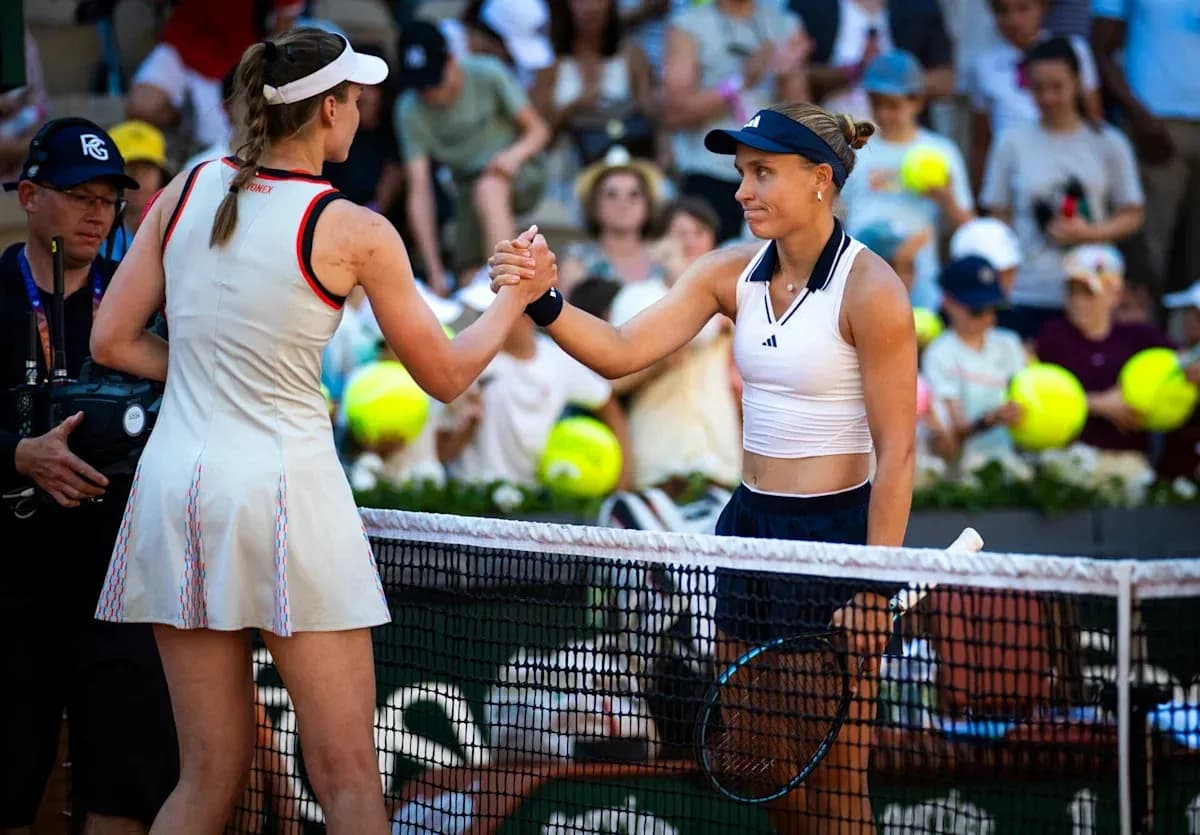
The first set in New York was tight, tense, and edged by Rybakina in a tiebreak, 7-6(6). The revenge, once secured, turned ruthless. She closed the door 6-3 in the second, a composed, controlled win that helped propel her all the way to the title at Flushing Meadows.
Starodubtseva did not leave empty-handed. Her joint-best Slam performance earned her a significant rankings reward: she will crack the top 50 for the first time, rising to a career-high of No. 43. From a shock win in Paris to a respectable defeat in New York, she has forced her name into the wider conversation.
The other blemish: Wimbledon and Elise Mertens
Starodubtseva may have been the first player to beat Rybakina at a major in 2026, but she was not the last.
The other came on grass, the surface where Rybakina usually looks untouchable. A former Wimbledon champion and a perennial favourite at the All England Club, she arrived in London as one of the names to beat. The draw gave her a familiar opponent in the third round: Elise Mertens, the 25th seed and a player Rybakina had dominated in the past, winning seven of their eight previous meetings.
History suggested a routine passage. Wimbledon had other ideas.
In a match that flipped expectation on its head, Mertens seized the key moments. She edged a tight first-set tiebreak 7-6(4), then ran away with the second 6-1, turning what looked on paper like a mismatch into one of the shocks of the tournament. Rybakina, so often the one dictating terms on grass, was out before the second week.
The response was emphatic. She parked the disappointment, reset, and then stormed through the US Open draw to close her Grand Slam year at 17-2, the best major record of her career.
Three titles, two painful losses, one clear message: in 2026, Elena Rybakina has become the benchmark. The only question now is how long she intends to stay there.