Elena Rybakina Claims First US Open Title and Becomes World Number One
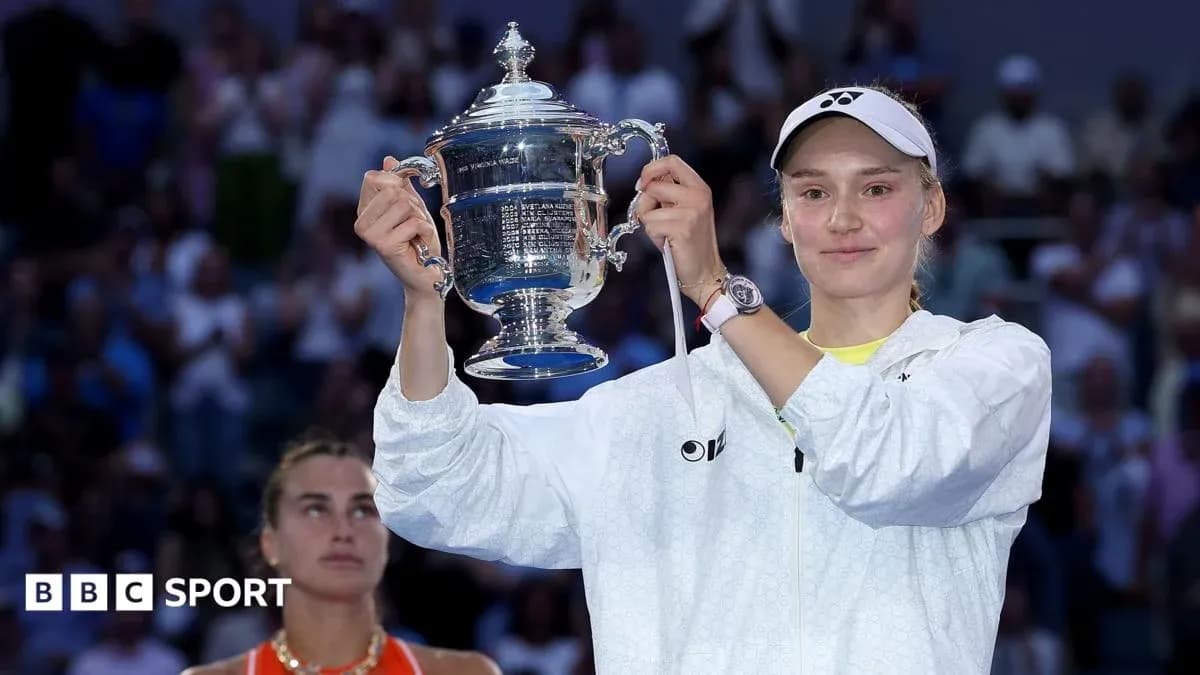
Elena Rybakina walked into Arthur Ashe Stadium on Saturday night already knowing the rankings story: whatever happened, she would wake up as the new world number one. She walked out with something far more precious – her first US Open title, and a statement win over the woman she is replacing at the top.
The 27-year-old from Kazakhstan subdued two-time defending champion Aryna Sabalenka 6-4 5-7 6-2, adding New York to a collection that already includes Wimbledon in 2022 and the Australian Open earlier this year. Three majors, three different surfaces, and now a season that belongs to her.
Ice against fire
This rivalry has always felt like a clash of elements. Sabalenka, all snarl and adrenaline, playing with visible fury. Rybakina, almost unreadable, her expression barely changing even as the stakes rise.
On this night, that contrast decided the championship.
Rybakina’s first serve misfired in the opening set, her biggest weapon sputtering just when she usually leans on it most. It didn’t matter. She stayed calm, built points with depth and precision, and turned Sabalenka’s pace back on her. The Belarusian’s frustration grew with every punishing return that landed near her shoelaces.
Sabalenka’s game flickered into life in the second set. Her groundstrokes finally found their range, and as Rybakina’s level dipped slightly, the defending champion pounced. The 12th game summed it up: Sabalenka charging at second serves, stepping inside the baseline, ripping returns. On her third chance, she broke to force a decider, roaring to her box as if she had turned the night around.
For a few minutes, it felt like the momentum had shifted.
Then it vanished.
Breaking point
The loose errors that have always lurked in Sabalenka’s game crept back in at the start of the third set. So did the negativity. Gestures to her team. Shakes of the head. A racket swing in anger.
Rybakina saw the crack and drove straight through it.
Her returns once again landed brutally deep, pinning Sabalenka behind the baseline and stripping her of the initiative. A break for 2-1 gave the incoming number one the platform she needed. From there, she grew taller with every point, her footwork sharper, her shot selection colder.
Sabalenka, who came to New York hoping to cushion the blow of losing the top ranking with a third straight US Open crown, suddenly looked miles away from it. Rybakina, by contrast, looked exactly like what the numbers will say on Monday: the best player in the world.
Serving for the title at 5-2, Rybakina blinked for the first time. A double fault on her opening championship point drew a collective gasp from the crowd. Nerves? Perhaps. But they lasted one point.
She reset, tossed the ball again, and drilled an ace down the middle.
Match. Title. Number one.
For once, the mask slipped. Rybakina allowed herself a brief, unmistakable smile as she sealed her second major of a glittering 2026 campaign. It was small, but it said everything.
A city that never loved her back – until now
This was not the slam most people circled next to Rybakina’s name. Her game – a penetrating serve, heavy first-strike groundstrokes, ruthless efficiency – should translate perfectly to the hard courts of Flushing Meadows. Yet the results never quite matched the theory.
By her own admission, New York has been a puzzle. The noise, the chaos, the relentless energy of the city has never seemed a natural fit for her understated personality.
"I was coming here for the last 10 years and it was never successful. I'm falling in love with New York more and more," she said afterwards.
This fortnight changed everything.
What makes the title even more striking is that, not long ago, it was unclear if she would even make it to the starting line. An ankle injury in the Cincinnati Open quarter-finals left her unable to walk for several days. Her US Open campaign sat on a knife edge.
She not only played. She dominated.
Her first four matches were almost routine, her serve so imposing that opponents barely had a foothold in rallies. The points were short, the message clear: if you can’t touch the serve, you can’t touch her.
The real test came later. Against Zheng Qinwen and home favourite Coco Gauff, Rybakina dropped the opening set, then ground her way back both times. Those comebacks mattered. They showed she could suffer, adjust, and still finish stronger – the hallmark of a champion who can win in more than one way.
Against Sabalenka, she had to blend both versions of herself. The bully from the baseline. The fighter who hangs in and refuses to crack. She did both, often in the same game.
By the end, she had not just beaten the two-time defending champion. She had moved to within one title – a French Open crown – of completing the career Grand Slam.
"Some magic is happening. I was unlucky with injury and just going day by day," she told Sky Sports. "We didn't know how it was going to be so I'm super happy and still can't believe it."
Magic, perhaps. Or simply the logical next step for a player whose calm hides a ruthless edge.
New York finally belongs to Elena Rybakina. The rest of the tour now has to decide how, and where, they plan to stop her next.