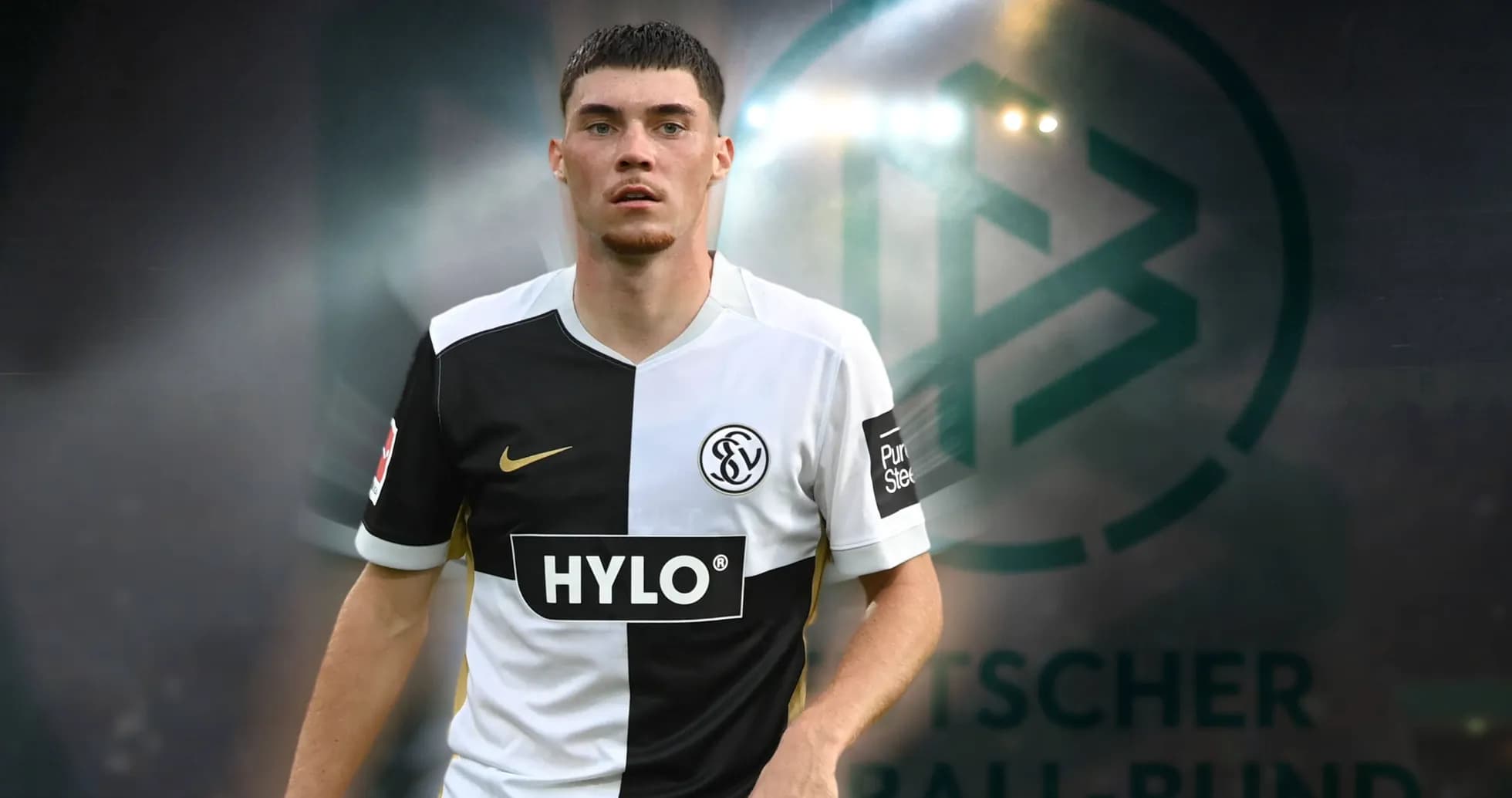
Felix Keidel: The Versatile Right-Back Germany Needs
Jürgen Klopp walked into the Germany job promising a reset, not a gentle transition. Reputation would no longer guarantee a seat on the plane. Only form, intensity and work rate would count.
He backed that up with numbers. Fifty-seven players on his initial shortlist, many of them unknown quantities at international level, some not even regulars in the Bundesliga. After three World Cup failures, the message was blunt: nobody is safe, and nobody is too small.
Out of that sprawling pool, one name stands out precisely because almost nobody expected it.
Felix Keidel.
From Ingolstadt’s academy to Klopp’s radar
Keidel is not the usual DFB story. No glamour academy, no early hype, no conveyor belt rise through the youth national teams. His path runs through FC Ingolstadt, through the grind of the 3. Liga, through the kind of fixtures that rarely make the highlight reels.
He joined Ingolstadt’s U19s in 2012 and never left the club’s system for a decade. Step by step, age group by age group, he climbed until the summer of 2022, when he finally broke into the first team. At 20, he did not just sneak minutes; he nailed down a place. Thirty-seven appearances in the 3. Liga, one goal, four assists, and – more importantly for coaches – a reliability that made him one of the first names on the teamsheet.
That season put him on the map inside German football, if not yet in the wider public eye. The next move changed that.
In 2025, Elversberg came calling. Fresh from the heartbreak of narrowly missing out on promotion against 1. FC Heidenheim, they needed energy and flexibility, not big names. For around €400,000, they bought Keidel out of his Ingolstadt contract. It was not a headline fee, but it was a statement of trust.
Again, he settled instantly. Again, he played. Twenty-five appearances, 13 of them starts, and a key role in a promotion campaign that stunned the country. Elversberg, the club from Saarland, punched their ticket to the Bundesliga, and Keidel had climbed from the third tier to the top flight in a little over two years.
Then came the real jolt: the Bundesliga itself did not intimidate him either.
Three league matches so far – against Leverkusen, Gladbach and Bayern – and already a goal to his name. Add one DFB Cup outing against MSV Duisburg, where he set up two goals, and the numbers remain modest. Yet that small sample has been enough to convince Klopp to bring him into the national-team fold.
For a player with just three Bundesliga games on his CV, that is a leap of faith. It is also entirely in keeping with Klopp’s promise to judge what he sees now, not what a player did five years ago.
The Swiss Army knife who might fix Germany’s problem position
The attraction is obvious once you trace Keidel’s role over the years. He is not a specialist in the narrow sense. He is a problem-solver.
At Ingolstadt, coach Sabrina Wittmann used him wherever the team needed balance. Right-back, left-back, central midfield, attacking midfield, drifting into the half-spaces – there was barely a line on the tactical board he did not cover at some point. His natural position is right-back in a back four, but his game intelligence and engine allowed him to slide across zones without losing his bearings.
Elversberg initially pushed him a little deeper. In the promotion season he mostly operated at right-back, shuttling up and down the flank, but this year Vincent Wagner has often dropped him into defensive midfield alongside Lukasz Poreba. From there, Keidel protects, recycles, presses, and plugs holes. He reads danger, then snuffs it out.
For a national coach assembling a new group, that kind of versatility is gold. One player, multiple solutions. One call-up, several tactical options.
Yet there is a more specific reason why his name matters for Germany.
Right-back.
Since Philipp Lahm retired and Joshua Kimmich moved permanently into the middle, Germany have wrestled with that position. Hansi Flick and Julian Nagelsmann both threw different ideas at the problem. Benjamin Henrichs and Ridle Baku in Leipzig, Josha Vagnoman in Stuttgart, Kimmich himself shunted back there again at the 2026 World Cup. None of those experiments truly stuck. None convinced enough to be the long-term answer.
The result: a top football nation still searching for a reliable, high-level right-back in a back four.
That is where Klopp’s interest in Keidel becomes more than just a quirky outsider story. He is not coming in as a luxury squad filler or a novelty pick. On current evidence, he is under serious consideration for the very role that has caused Germany headaches for years.
Is he ready to dominate at international level from day one? That remains an open question. He has barely tasted the Bundesliga, let alone the pressure of a major tournament. The jump in tempo, in scrutiny, in expectation will be brutal.
But Klopp has never been afraid of backing a player on the way up rather than waiting until he has plateaued. Keidel’s rise – from Ingolstadt’s academy to 3. Liga regular, from Elversberg promotion hero to Bundesliga newcomer – has followed a clear pattern: each time the bar moves, he clears it quickly.
Now the bar is higher than ever. The DFB team needs a right-back. Klopp needs fresh energy and tactical flexibility. And Felix Keidel, the quiet climber from Ingolstadt and Elversberg, suddenly stands at the edge of the biggest stage in German football.
If he seizes it, the search on that flank might finally be over.