Harriet Dart's Comeback Victory at the US Open
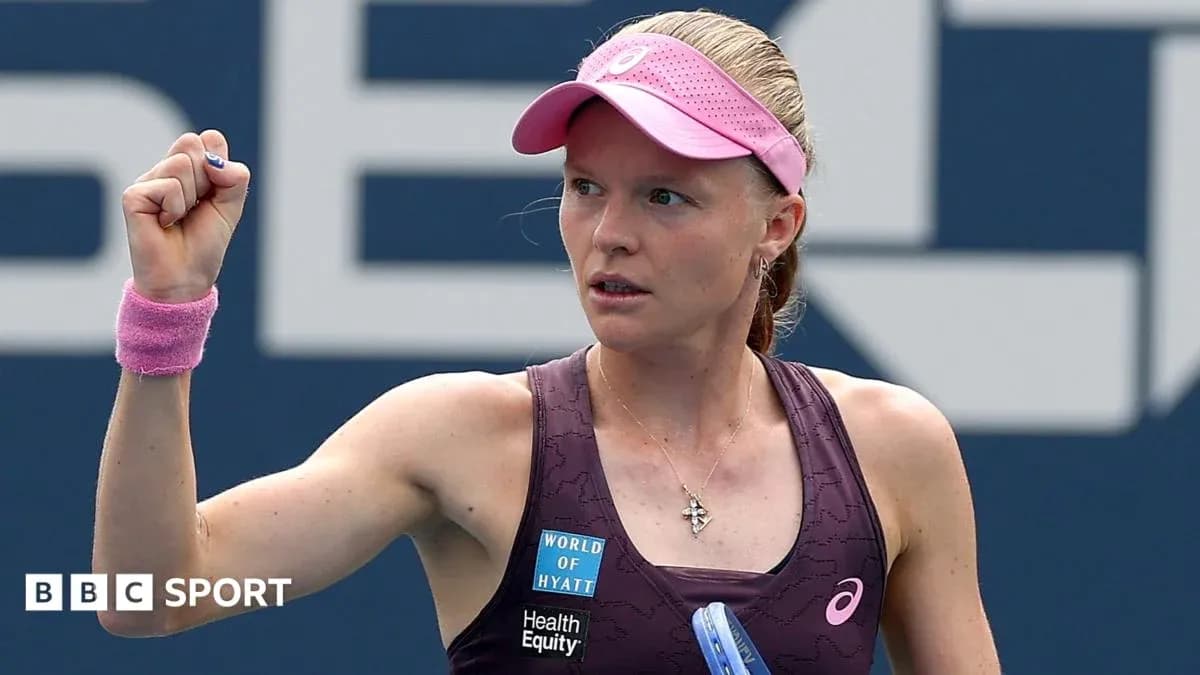
Harriet Dart had waited 19 long months for this feeling. Under the lights of New York, with family voices cutting through the Flushing Meadows noise, she finally found it again.
The 30-year-old Briton came back from the brink to beat American Peyton Stearns 3-6 6-3 6-2 and reach the US Open second round, ending a barren Grand Slam run that stretched back to the 2025 Australian Open.
A comeback built on nerve and noise
This was not a routine win. It was a scrap, and Dart had to drag it towards her.
She opened the match with four break points in Stearns’ first service game. Four chances. Four misses. Stearns escaped, steadied, and then started to swing freely. The American, ranked more than 75 places above Dart, locked down her own serve and cranked up the pressure on the Briton’s.
The break came in the eighth game. Dart’s serve cracked under the weight of Stearns’ aggression, and the set slipped away 6-3 without another look at a break point. For a player who has stumbled at the first hurdle in her last two Wimbledons and missed four of the past six majors entirely, it felt like a familiar, unwelcome pattern.
Then the hole got deeper. Dart was broken again to start the second set. Down a set and a break, up against a higher-ranked American on US soil, it could easily have unravelled.
It didn’t.
Stearns unravels, Dart refuses to
Stearns’ power never left her – she finished with 40 winners – but the control did. The errors began to flow, 47 of them by the end, and Dart sensed the shift.
She dug in on return, lengthened rallies, and forced Stearns to hit one more ball, then another. The American’s level lurched, and Dart pounced, breaking twice to turn the set on its head and take it 6-3. Suddenly, the match belonged to the player who had already survived three qualifying marathons just to reach this stage.
Those qualifying rounds had been anything but straightforward. Dart went to three sets in all three, dropping opening sets to Kristina Penickova and Heather Watson along the way. The scenic route had become a habit. In New York, it became a weapon. When this match stretched into a decider, she looked like the one who knew how to suffer there.
The decisive push
The third set turned into a test of nerve as much as shot-making. Breaks came in a flurry, three in a row, neither player quite able to clamp down.
Then Dart found a hold when she needed it most.
Serving at 3-2, having traded breaks, she produced a crucial, gritty hold to end that chaotic run of three consecutive breaks. It steadied everything – her game, her body language, her grip on the contest. From there, she tightened her patterns, kept the ball deep, and let Stearns’ inconsistency do the damage.
Dart broke again, moved clear, and with the match on her racquet she needed four match points to finally close it out. Two and a half hours of tension ended with a roar, a clenched fist, and a sprint to the people who have carried her through the lean months.
A new team, a familiar stage
Waiting for her at the side of the court was a face that knows Grand Slam pressure better than most: Marion Bartoli. The 2013 Wimbledon champion joined Dart’s team in January, and this win slots neatly into a season that has quietly started to rebuild the Briton’s confidence – a quarter-final run at the Challenger in Vancouver, qualification for the Cincinnati Open, and now a main-draw win in New York.
“From her experience, she knows what I'm going through, how I'm feeling, how the day starts, how it finishes – everything from the little things to the big things,” Dart said of Bartoli. Every conversation, she added, feels like a lesson. Every small improvement feeds the motivation to keep going.
The support system extends beyond the player box. Dart’s “home away from home” really did feel like one. Her uncle and cousins, based in New York, were in the stands. Another cousin had flown over from the UK. Her mother had been there from the start of qualifying; her father arrived on the eve of this match.
“New York always feels like a home away from home,” she said. “It feels like a community for me and I really felt the support out there.”
You could see it in the way she turned to the crowd after the key points, in the way the noise swelled as she closed in on the finish line.
A tougher test ahead
This win does not bring any guarantees. What it does bring is a second-round meeting with 25th seed Marie Bouzkova, a step up in consistency and craft from the erratic Stearns.
Dart will go into that match as the underdog again, ranked 131 in the world, still rebuilding, still trying to turn flickers of form into something more permanent. But she will walk onto court having finally snapped that Grand Slam drought, with a major win in her pocket and her “community” behind her.
She also walks into the next round as part of a growing British presence in New York, joining Toby Samuel and Katie Boulter in the last 64.
After 19 months of waiting, Dart has her foothold back on the Grand Slam stage. The question now is how far this surge of belief – and that noisy New York support – can carry her.