Ireland Squad Selection: A Moral Dilemma
The naming of an Ireland squad has rarely carried this kind of weight.
When Heimir Hallgrímsson reads out his list on Thursday for the games against Israel, the debate will not centre on form, tactics or shape. It will centre on conscience. Every name called is a footballer; every omission not explained by injury will be examined as a moral decision.
Representing your country is supposed to be the pinnacle of a career. For some, this window will twist that pride into something far more complicated. The FAI board’s refusal to take a definitive stand has pushed the burden down the line, onto individual players who should never have been left to carry it. That is not leadership. It is evasion.
A fixture drenched in politics
The old line that “politics has no place in sport” collapses instantly under the weight of this fixture. Politics is embedded in every part of public life. Football does not sit in some hermetically sealed dome, untouched by the world outside the stadium gates.
Those insisting there are comforting precedents for all this are ignoring the scale of what is unfolding. The article’s author frames Israel’s assault on Palestine as genocide, backed by western powers, and argues that the evidence of a deliberate campaign of terror already meets that charge. The point made is stark: this is not about waiting years for legal processes to grind to a conclusion. It is about acting on what is known now.
When an organisation faces a decision of this magnitude, those in charge are expected to inform themselves, weigh the facts and then take a stand. Genocide is the gravest of international crimes. On that basis, the argument runs, the only reasonable position is to refuse, outright, to play a nation viewed as guilty of it. The very notion of lining up for a football match against Israel, in this context, is presented as something that should be unthinkable.
From principle to retreat
Last November, the FAI board seemed to agree. It formally asked Uefa to ban Israel. That move carried a clear message: no team, no group of players, should be asked to fulfil a fixture against Israel while State-backed atrocities continued. The association was praised for it. Irish football, briefly, looked prepared to place principle above everything else.
That was then. The moment Ireland were drawn against Israel, that principle was quietly boxed up and stored away.
The decision to proceed cannot be viewed in isolation. It sits within a broader pattern. The Government’s long delay on the Occupied Territories Bill set a tone, suggesting that when the stakes are highest, moral clarity can wait. Other sporting bodies have followed that drift. The GAA is singled out in the piece for refusing to sever commercial ties with Allianz, a stance that has drawn sharp criticism.
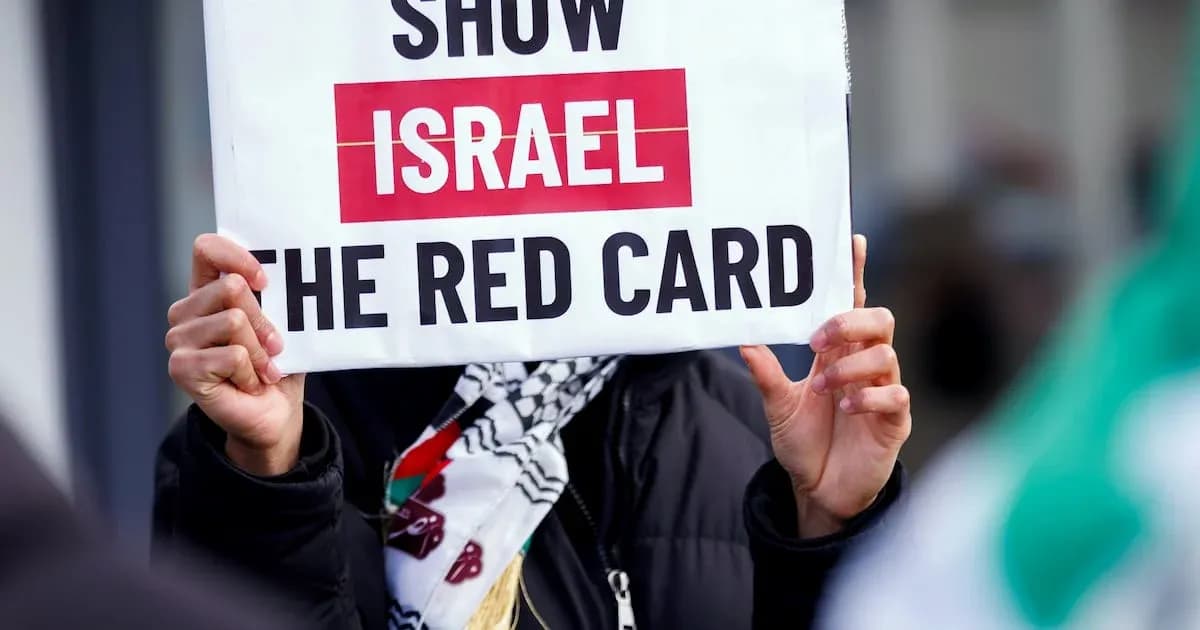
Yet it is Irish football, with competitive fixtures looming, that offers Israel the most visible form of normalisation. The games will go ahead. That is now beyond doubt. Once the whistle blows on September 27th and again on October 4th, the result on the scoreboard will be secondary to the fact the fixtures took place at all. The article’s verdict is blunt: once the games are played, there is only one winner, and it is not Ireland.
Players left in the line of fire
Protesters, the piece argues, have pushed as hard as they can. The FAI board has held its line. Israel, in practical terms, “has won the day”. That leaves Hallgrímsson’s players standing in the spotlight, each one forced into a choice that should have been settled at boardroom and government level.
The Government does not escape. Its broader response since the start of the war is condemned as a failure to match rhetoric on human rights with meaningful action. That failure, the argument goes, offers cover to others who wish to avoid difficult decisions. The FAI, in that reading, found political shelter easily.
Even the language around the national team has jarred. In February, Taoiseach Micheál Martin publicly backed the matches going ahead and spoke about the team’s “rejuvenation” and “journey ahead”, offering routine good wishes. In the context of the death toll in Gaza, those comments are described as inane and wildly out of place.
The cost of playing on
Now the countdown is on. Ireland edges towards two games in which points and prize money are set against the lives of tens of thousands of civilians, including more than 25,000 children, according to the figures cited in the piece. That is the scale against which this football decision is being measured.
The conclusion is cutting. In Irish public life, principle is portrayed as an inexpensive commodity, easy to brandish in statements and speeches, easier still to discard when fixtures, finances and potential sanctions come into view.
The squad list will drop on Thursday. Names will be read, shirts will be assigned, preparations will begin. The question that lingers is not how Ireland will line up, or whether Hallgrímsson will get the balance right in midfield.
It is whether a nation that once vowed not to play would rather take the field than live with the cost of saying no.