Manchester United's Dilemma: Keeping Gabriel Amid Elite Interest
Manchester United are staring at the kind of mistake that haunts clubs for decades.
Gabriel, the prodigy many inside Carrington quietly describe as a once-in-a-generation talent, is being courted by Real Madrid, Barcelona, Paris Saint-Germain and Bayern Munich. The European elite are circling. United, for their part, are refusing to even contemplate a sale – and are scrambling to change the teenager’s mind before it is too late.
A 15-year-old at the centre of a storm
INEOS chairman Sir Jim Ratcliffe has already felt the heat from supporters over unpopular calls in his short time fronting United’s football operation. Letting Gabriel walk away for nothing would be a different level of fury. The optics are brutal: a club that has struggled to produce a true superstar since Marcus Rashford losing their brightest academy light before his 16th birthday.
Gabriel is under contract until next summer, but he is not a full-time scholar. That status matters. Under the current rules, he will technically be free to leave when he turns 16 on October 16, provided he holds a European passport.
United are now digging into that detail. His father, Joe O’Cearuill, played twice for Ireland. His mother is of Greek Cypriot heritage. If Gabriel qualifies as a dual national, Brexit regulations open a door: he could move to a club in the European Union before he turns 18.
The big guns know it. So do United.
A missing teenager and a worrying silence
United beat Manchester City to Gabriel last year. That felt like a coup. This feels like a fight they might not win.
There are already signs his head may have been turned. He was due to join first-team training on Saturday. He did not show. He has not been seen at Carrington all week. For a club on high alert, that absence rings louder than any statement.
Michael Carrick had planned to include him in the squad for Wednesday night’s Carabao Cup third-round tie against Brighton at Old Trafford. Had he stepped onto the pitch, Gabriel would have become the youngest player ever to feature for United’s senior side. That historic debut is now off the table.
For a fanbase desperate for something – someone – to believe in, it is a gut punch.
The talent United cannot ignore
Gabriel has been the beacon in a gloomy academy landscape. Since arriving as an 11-year-old, he has looked like the outlier: a two-footed forward with electric agility, able to twist out of the tightest pockets and punish any lapse in concentration with ruthless finishing.
The Messi comparisons do him no favours. The Neymar ones make more sense. There is that same slaloming style, that same sense of mischief in one-v-one situations. He even laces up in the same model of Nike boots as the Brazilian, after signing a lucrative extension with the sportswear giant in March 2025.
The numbers back up the hype. Last season he broke into United’s Under-18s at just 14, another record. He scored 20 goals in 21 league games, collected the first-ever Premier League U18s Player of the Year award and became the youngest winner of United’s Jimmy Murphy Young Player of the Year.
In August he jumped to the U21s and treated the step up like a formality. On debut against Ipswich he produced two assists and a delicate chip in a 5-0 rout. A week later, he was on the scoresheet again as United’s youngsters thrashed Leicester City 4-1.
This is not a kid ahead of schedule. This is a kid tearing the schedule up.
The Dowman and Yamal effect
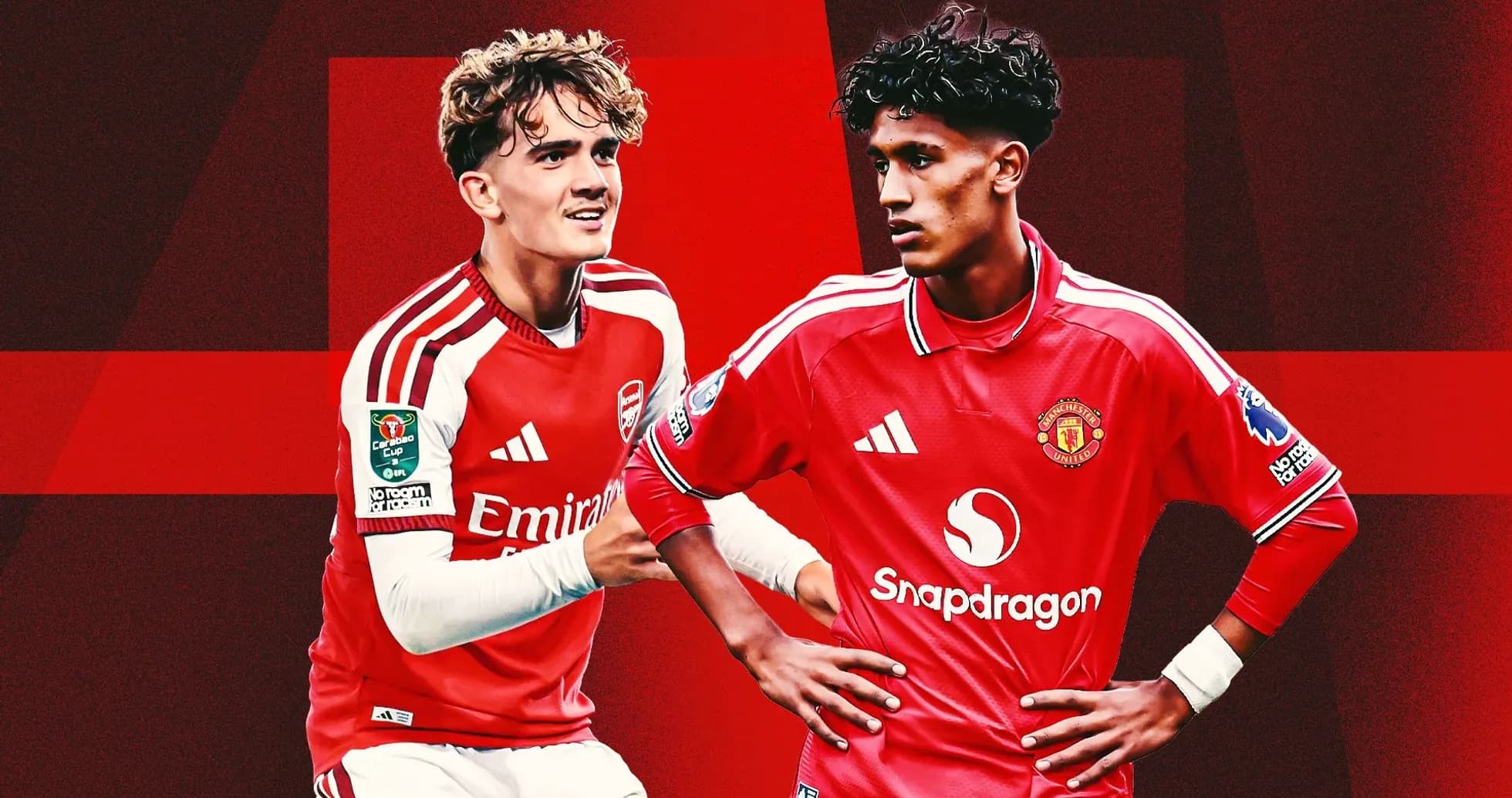
So the clamour grows. United lack spark in the final third, and supporters look enviously at Max Dowman’s rapid rise at Arsenal.
The precedent is clear. In September 2022, Ethan Nwaneri became the youngest player in Premier League history at 15 years and 181 days, coming on for Arsenal at Brentford. His path since has been uneven – loans to Marseille and Borussia Dortmund, inconsistent minutes – but he already has over 50 appearances for the Gunners and remains only 19.
Arsenal doubled down on the “if you’re good enough, you’re old enough” mantra with Dowman. He became the league’s second-youngest player when Mikel Arteta threw him on against Leeds in August 2025. By March, Dowman had broken James Vaughan’s record as the youngest Premier League scorer, dancing through Everton to net at 16 years and 139 days.
In May he became the youngest title-winner in Premier League history. This week he joined Wayne Rooney in a tiny club: only the second 16-year-old to score a brace for a Premier League side in a major competition, as Arsenal beat Ipswich 4-2 in the Carabao Cup.
Fourteen senior games already. Flair, power, composure. Arteta has even mentioned him in the same breath as Messi – and yet has handled him with care, picking his moments, easing him in and out of the firing line.
“We have to look after him. He's 16 years old. You don't see that in this league,” Arteta said after the Ipswich tie, stressing the unique physical demands of English football and the need to protect such a young player.
Gabriel watches all of this. How could he not?
Then there is Lamine Yamal at Barcelona. Another slender teenager, thrown into senior football at 15 years, nine months and 16 days. Another example of a club trusting outrageous talent early, knowing La Liga’s rhythm – more tactical, more possession-based, less relentlessly physical than the Premier League – gives technicians a little more breathing space.
From Manchester, the view is intoxicating. Arsenal, Barcelona, Real Madrid: they are showing the path, and Gabriel can see players his age, or barely older, already living the life he craves.
The physical question – and the United reality
There is a crucial difference. Dowman is physically advanced. Gabriel is not.
He is often the smallest player on the pitch. His courage and stubbornness close some of that gap, but not all of it. Throwing him into the Premier League meat grinder too early could backfire badly.
If he comes in and shines, Carrick will be under intense pressure to start him every week, piling strain onto a still-developing body. Arteta can rotate Dowman because Arsenal’s squad is stacked. They win games with or without him. United do not enjoy that luxury.
This is a side that lurches from performance to performance. Drop Gabriel after a few cameos and Carrick gets accused of being cautious. Keep playing him if he struggles and the narrative flips: overhyped, not ready, another false dawn.
So far, Carrick has resisted the noise. Danny Simpson, a United academy graduate who broke through in the final years of Sir Alex Ferguson’s reign, believes that restraint is smart.
Speaking to GOAL via Free Bets, Simpson drew a stark contrast between his own pathway and the current climate.
He remembered coming on for 10 minutes in teams that were already 2-0 or 3-0 up, sometimes alongside what he called a “second XI” good enough to win the Premier League. Dowman, he argued, is stepping into a similarly dominant environment at Arsenal, surrounded by “top, top talent” brimming with confidence.
“It’s easy to come on and have an impact and play well,” Simpson said. “I think maybe United at the minute is a bit different. I know we all want to see Gabriel play and it's exciting, but it's just a very different situation to Max Dowman at Arsenal.”
Simpson’s verdict on Carrick was clear: the manager “will know what to do and when to,” pointing to the careful handling of another gifted youngster, Shea Lacey. For now, he believes Gabriel should train with the seniors, live around the group, and wait.
Temptation abroad – and a brutal reality check
Patience is not fashionable. Especially when your peers are making headlines across Europe.
Gabriel can look at Yamal’s rise and imagine himself in blaugrana, gliding across the Camp Nou turf. He can picture Madrid, the Bernabeu lights, the roar that greets a new galáctico. He might feel that Barcelona or Real can fast-track him to stardom.
It is an alluring thought. It is also a dangerous one.
When Yamal broke through, Barcelona were on their way to the La Liga title under Xavi but had crashed out of the Champions League in the group stage. Raphinha, Ousmane Dembele and Ferran Torres were not the forces they are now. There was space in the hierarchy, a window Yamal could smash through.
That window is narrower now. Barca have Yamal established, a peak Raphinha, plus Anthony Gordon, Karim Adeyemi and Gabriel Jesus in the attacking mix. At Real Madrid, Jose Mourinho can already call on Kylian Mbappe, Vinicius Junior, Jude Bellingham and Yan Diomande.
Where, exactly, does a 16-year-old Gabriel fit into those rotations? How many minutes does he really get?
At United, the path is clearer. The first team is crying out for creativity and incision. The academy staff know him, have shaped him, believe in him. If he stays, the chances of becoming a regular are far higher than they would be in a star-studded dressing room abroad.
Yet the modern game feeds impatience. “I want it all right now” is not just a mindset; it is a business model.
United’s line in the sand
United cannot bend to that. They cannot be held hostage by a player who is still 18 months away from sitting his GCSEs, no matter how dazzling his highlight reel looks.
Carrick and the academy coaches have handled Gabriel properly so far. They have pushed him without breaking him, rewarded him without indulging him. That will continue – if he is willing to listen.
If not? Then there is little sense in a protracted saga that drags over months, sucking oxygen away from a team trying to claw back a poor start to the season.
The concern, from those watching closely, is that Gabriel is moving like a teenager emboldened by a false sense of privilege, whether encouraged by those around him or not.
United’s history offers a stark counterpoint. George Best, Sir Bobby Charlton, Ryan Giggs, David Beckham, Paul Scholes, Gary Neville – none of them had anything handed to them. They fought through setbacks, criticism, brutal standards. The bar at Old Trafford has always been set high, on and off the pitch.
Ruben Amorim, the much-criticised former United manager, understood that much. Shortly before his sacking in January, he spoke of a “feeling of entitlement” creeping through the club, warning that constant praise and instant gratification were doing young players no favours.
“Sometimes, difficult moments is not a bad thing for the kids,” he said. “We don't always need accolades in everything. We are not helping. Nowadays, they speak and go against the club because they feel entitled. Let's stay. Let's fight. Let's overcome. That is the way we can solve things.”
Amorim failed in many areas. On this, he was right.
With his current stance, Gabriel will not transform United. Talent alone is not enough in a shirt that heavy. The first great lesson for any academy star is simple: no one is bigger than the club.
If that truth does not land, United may be better off letting him chase his brand elsewhere – and trusting that the next Gabriel, the one who understands the weight of the badge, is already lacing up his boots somewhere in their academy.