Novak Djokovic Faces Unexpected Defeat in U.S. Open First Round
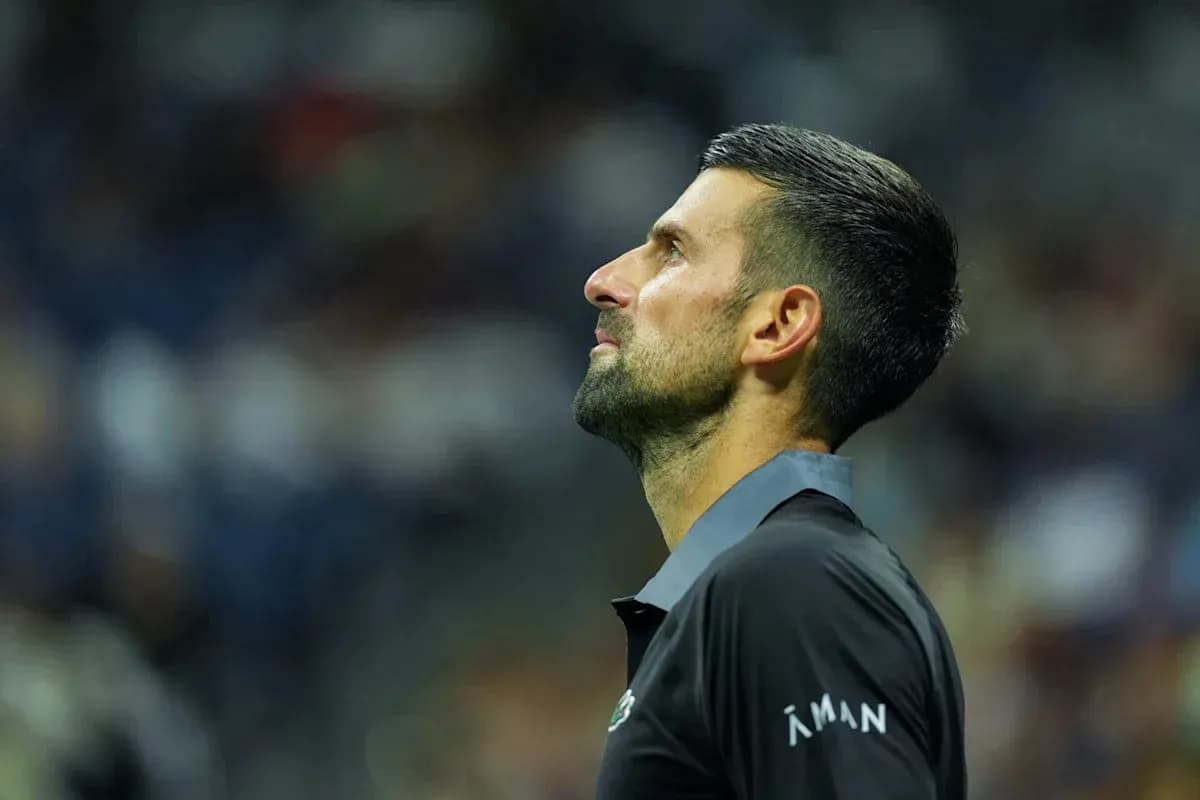
NEW YORK — Novak Djokovic has survived almost everything this sport can throw at a champion. Sunday night in Arthur Ashe Stadium, something finally caught up with him.
Not a wonderkid. Not a Big Three rival. A 39-year-old body that would no longer obey.
Across the net stood Mariano Navone, a rugged Argentine grinder ranked inside the top 50, a man with solid wins but no great scalps, a clay-court worker dropped into the bright, air-conditioned glare of Ashe. Four hours and 36 minutes later, he walked off with a five-set win and the biggest upset of this U.S. Open: 7-6(5), 5-7, 4-6, 6-2, 6-1.
Djokovic walked off with something else — the end of a streak that had come to feel eternal.
A first-round wall finally breaks
He had not lost a first-round match at a Grand Slam since the 2006 Australian Open, back when he was world No. 76 and barely a footnote in men’s tennis. Seventy-seven straight opening wins at majors followed. It became a given: Djokovic shows up, Djokovic advances. The real story always started later.
This time, the story ended on night one.
The numbers barely explain it. They rarely do with Djokovic. He is the best hard-court player of the modern era, a four-time champion in New York, almost untouchable at night and under a roof. Navone, by contrast, earns his living on clay, where he claimed his only ATP title. This was only his third main-draw appearance at the U.S. Open. He had won a single match here before. He had never set foot on Ashe in a main-draw match.
On paper, this was the kind of opponent Djokovic might have chosen if he could have scripted a gentle start.
The script burned within an hour.
The body starts to betray him
For 20 minutes, it looked familiar. Djokovic opened like a man in a hurry, rifling three aces in his first two service games and racing to a 3-0 lead. The ball flew off his strings. Navone struggled to breathe in the rallies.
Then the points started to stretch. Navone dug in, lengthening exchanges, forcing Djokovic to hit one more ball, then another. The night was heavy and humid but not oppressive. Still, the world No. 2’s energy began to sag.
Rain arrived seven games in. The roof closed. The air conditioning kicked on. Conditions tilted toward Djokovic’s comfort zone — indoor, controlled, loud. The momentum did not follow.
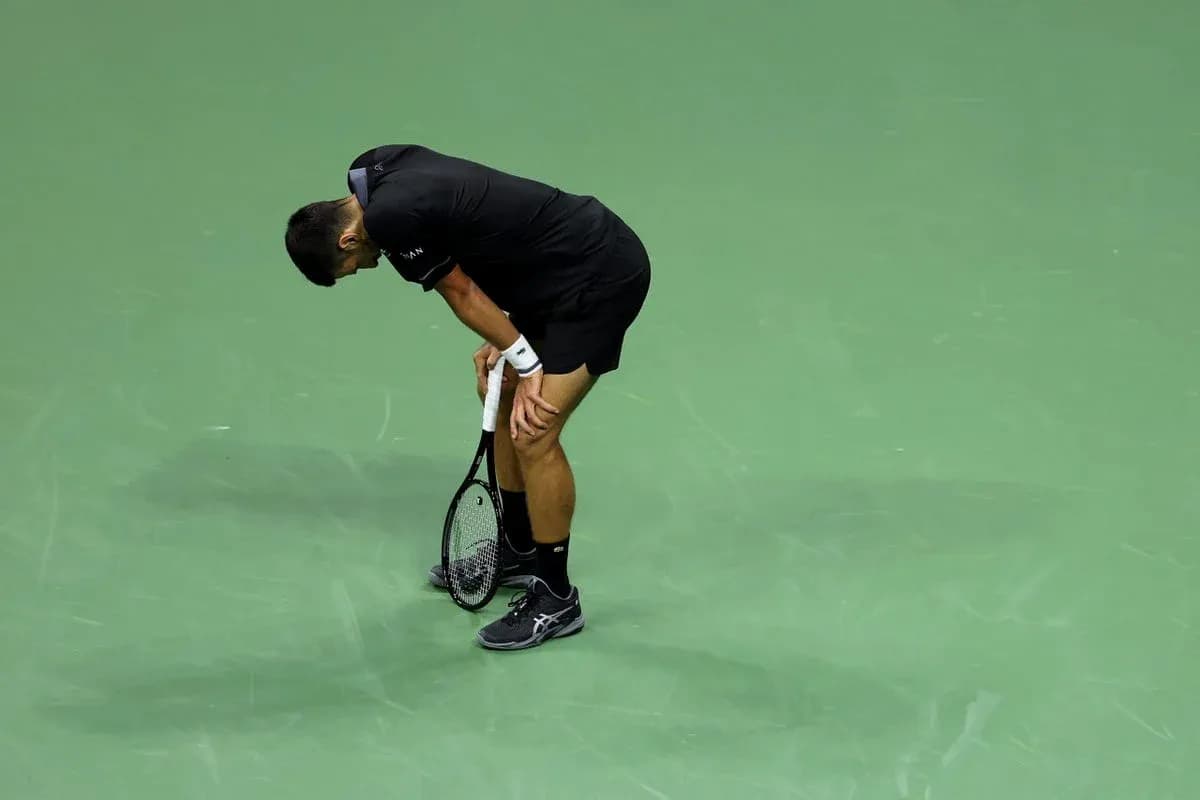
He gave back the early break and, from that moment, something in his movement and posture told a different story. Between longer points, he bent over, hands on knees. When rallies stayed under four shots, he dominated. When they stretched beyond that, Navone owned them, dragging Djokovic into exchanges that drained him with every step.
The first set slipped away in a tiebreak. Once, beating Djokovic in a breaker felt like climbing a sheer wall with no rope. Navone found a way over it.
Vomiting, cramping, collapsing
By the third set, the match turned raw.
In the seventh game, Djokovic walked to the side of the court mid-game and vomited into a courtside bin. The stadium fell into a hush that had nothing to do with tennis etiquette and everything to do with concern. When he returned to the baseline, he was slower between points, slower into corners, slower to rise from his crouch.
The pattern hardened: short points or bust. He swung harder, flattened out his groundstrokes, hunted free points on serve. It worked just enough. He clawed out the second set 7-5. He somehow stole the third 6-4, saving key points, leaning on his serve, living on instinct and experience.
But each time a rally ran long, Navone chipped away at him. Djokovic sat on changeovers rolling ice bags across his head. He winced, stretched, shook out his arms. The cost of survival mounted.
By the fourth set, his body began to revolt. Cramping crept in. The back tightened. The shoulder followed. He took a medical timeout before the fifth, a trainer kneading his lower back in a bid to squeeze one last stand out of a frame that has carried him to 24 major titles and 101 career trophies.
This time, there was nothing left to squeeze.
Navone smells blood
The decisive blow came early in the fifth, in a rally that felt like a closing argument.
At 1-0, 15-40, Navone pushed Djokovic from sideline to sideline, then feathered a ball that drew him forward. Djokovic moved in, heavy-legged, trying to improvise a half-volley. Navone sent a backhand down the line. Djokovic couldn’t lift the reply over the net. As he turned away, his legs seemed to buckle. He staggered, then limped through the next points.
The stadium sensed it. The mood shifted from tension to something closer to a wake.
Navone did not blink. He kept sending Djokovic on the run, kept testing the corners, kept making him pay for every attempt to shorten the point. The last set raced away 6-1, a scoreline that will sit on the page with none of the agony it took to write it.
A champion facing his limits
Courtside, Jelena Djokovic watched with their children, Stefan and Tara. Their faces darkened game by game as the match slipped and their father’s body unraveled.
Afterward, outside the locker room, Djokovic stood drained and honest.
“An awful feeling on the court for me,” he said. He spoke of vomiting, of throwing up “pretty much every match this year,” of a “serious issue” that triggers a cascade — cramping, pain, a back that “gave up in the end,” a shoulder that followed. He said he had been struggling since the fourth game of the match.
He tried not to strip Navone of credit, calling him “a nice guy, a fighter.” But the larger picture was impossible to ignore. His body is betraying him in ways he cannot yet control.
“I’m trying, man, I’m trying,” he said. “Let’s, let’s see.”
Those are not the words of a man in denial. They are the words of a champion who knows time is finally leaning on him.
Wimbledon echoes and Cincinnati warning signs
The collapse felt jarring because of what came just seven weeks earlier. At Wimbledon, Djokovic had reached the semifinals with a vintage five-set win over Félix Auger-Aliassime, a reminder of his ability to suffer and survive across five sets on grass.
Then came the semifinal loss to Jannik Sinner, straight sets to a one-time protégé. The defeat seemed to cut deeper than most. Late in that match, when a fan tried to reassure him he could still hang with the world No. 1, Djokovic muttered, “Maybe 10 years ago.”
He disappeared after that. Vacation. Family. Tennis reduced to hitting balls with his wife and children. The grind of a hard-court summer could wait.
When he finally returned at the Cincinnati Open, the warning lights flashed. He lost his first match to Thiago Tirante, labored in the heat and humidity, and hinted at a medical condition he has been managing for a couple of years, without offering details.
In New York, on the eve of the tournament, he sounded cautiously optimistic. That early Cincinnati exit, he said, had gifted him two full weeks to train, to “get my body and mind into the right state.” He spoke about the difference between practice and playing best-of-five on Ashe, and admitted that opening rounds had become a particular challenge.
“Hopefully I can overcome, you know, the first hurdle and build from there,” he said.
He never cleared it.
The shrinking window of best-of-five
For two seasons now, Djokovic has been unusually candid about the toll of best-of-five tennis. He talks about energy in finite terms. There are only so many hours his body can give him in a fortnight. Spend too many in week one, and week two becomes a cliff.
On Sunday night, even had he found a way past Navone, the cost was obvious. By the middle of the third set, his 2026 U.S. Open already looked compromised. Every lung-busting rally was a withdrawal from a bank account that no longer offers overdraft protection.
By the fifth game of the fifth set, as Navone closed in, tears slipped from Djokovic’s eyes. The emotion recalled another night in Ashe, five years ago, when he walked onto the court one win from a calendar-year Grand Slam and played one of his worst matches of the season in the final. Then, too, the New York crowd wrapped itself around him as he broke down on the sideline.
This time, the stakes were smaller, but the symbolism cut deeper.
A heart sign to the night
As the final point ended and the upset became official, Djokovic stood, gathered himself, and turned slowly to all four sides of the stadium. He raised his hands and formed a heart with his fingers, a gesture he has made so often in triumph. On this night, it looked more like gratitude than celebration.
Earlier this summer, he had released a documentary, “The Wolf in Winter,” a portrait of a champion refusing to bow to the oncoming cold of the end. The title spoke of defiance, of a predator who still believes he can hunt when the snow sets in.
Sunday in New York, the winter he has tried so hard to push back felt a little closer. The wolf is still there. The question now is how long the body will let him roam.