Team USA Prepares for 2026 FIBA World Cup in Berlin
Berlin braces for a takeover.
The best women’s basketball players on the planet descend on Germany’s capital this week as the 2026 FIBA World Cup tips off on Friday, Sept. 4. Sixteen nations, expanded from the 12-team field in 2022, will chase one trophy. One team, as always, carries the weight of history.
Team USA.
Nine titles in the last 12 World Cups. Four straight championships. A standard so high that anything less than gold feels like failure. Yet Kara Lawson, the woman now trusted with the keys to this dynasty, sounds less like someone guarding a legacy and more like a coach eager to walk straight into the fire.
A tougher world, a narrower margin
Lawson has seen this rise coming. She lives it every day as Duke’s head coach, and she tracks it in the FIBA age groups.
"There's no question that the world is improving at a rapid rate," she said this week. She talked about teenage prospects from around the globe, about the skill level exploding in those youth tournaments, and about what that means when they grow into senior national team players.
The result? Depth. Real depth.
Now, when she scans World Cup rosters, she doesn’t just see one or two stars per country. She sees lineups stacked with “high quality players,” groups that can punish any lapse. That’s why she calls this “the most difficult World Cup to win” that the U.S. has faced.
And she welcomes it.
"It should be hard to win. It's a World Cup, you know?" Lawson said. Best teams. Brutal schedule. Short window. No margin. "At the end of the day, every team's job is to try and win this. And so we're hungry, and we're focused on trying to put our best performances on display and see if we can get the job done."
The message is clear: the rest of the world has closed ground. Team USA expects to stay in front anyway.
The Caitlin Clark variable
One of the biggest reasons for that confidence is new.
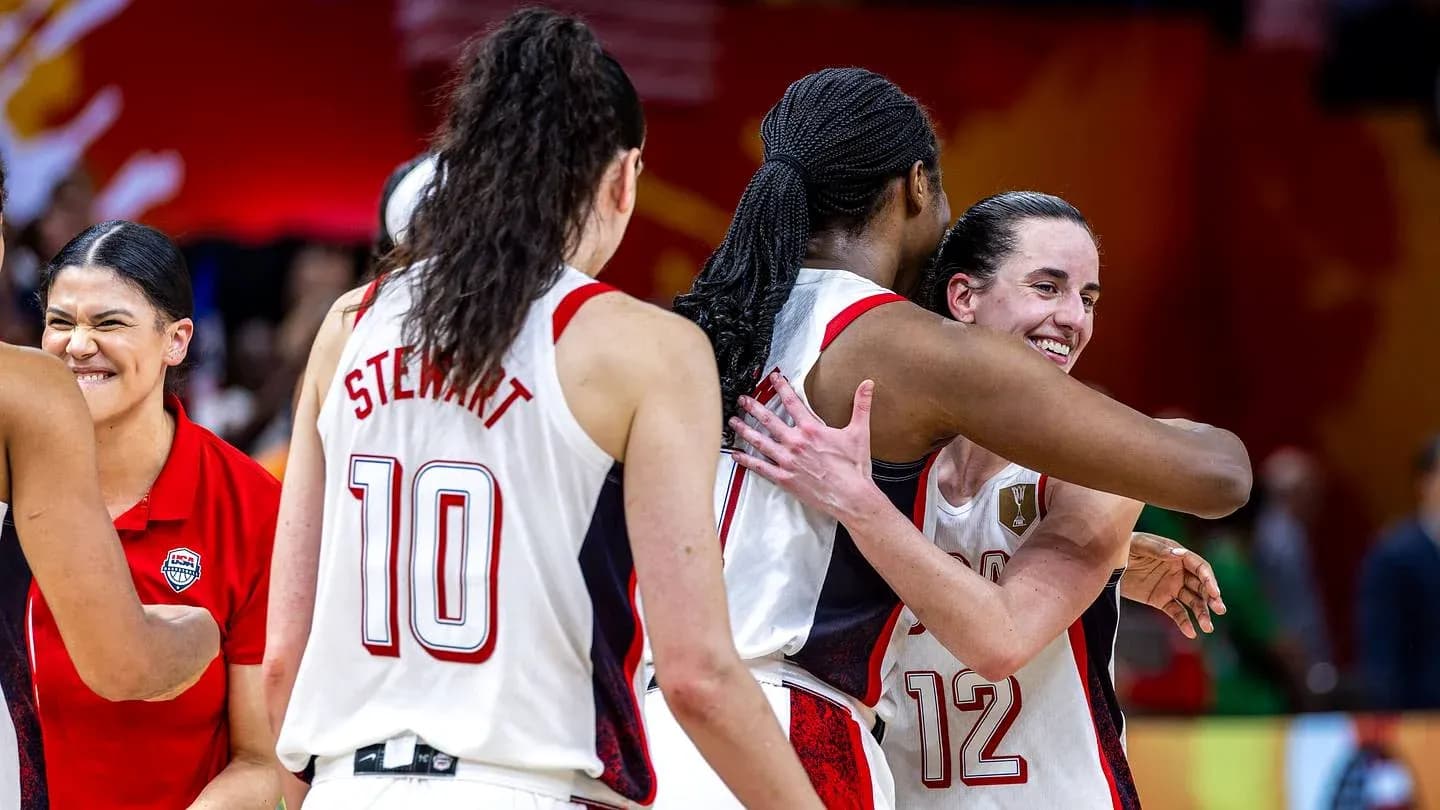
Caitlin Clark arrives in Berlin as a rookie on the global stage, but hardly an unknown. Her first WNBA season with Indiana has unfolded under a spotlight few players ever experience, and Lawson has been courtside for much of it.
"Caitlin's focused. She's had a great campaign with Indiana. I've gotten to watch her a lot in person this summer. So she's locked in and ready to go," Lawson said.
Clark brings something different to this USA group: a gear-shifting, game-warping presence with the ball. Lawson sees a guard who can change tempo on command, stretch the floor to absurd distances and bend defenses with both her shooting and passing.
"She's somebody that can change games with her ability to create pace, her ability to score, playmaker," Lawson said, calling that skill set “a great fit” with the roster around her.
The intrigue lies in the unknown. In the WNBA, Clark already commands defensive schemes built around her gravity. In FIBA play, she’s a rookie again.
"The attention that she generally draws in the WNBA ― we'll see if that's the same," Lawson admitted. Different rules, different scouting, different style. "Since it's her first time here, is how people defend her. Is it similar to what we see in the United States, or is it a little bit different? So, we're still in fact-finding mode in some of those areas ... but we're excited about having her on the team, and expecting her to make an impact for us each game."
The world has watched Clark light up college arenas and WNBA floors. Now it gets its first look at her in a USA jersey with a world title on the line.
New generation, same expectations
Clark is not walking into Berlin alone. A wave of fresh American talent is about to get its first taste of senior World Cup pressure.
- Angel Reese
- Paige Bueckers
- Kiki Iriafen
- Sonia Citron
will all make their World Cup debuts, part of a new core being woven into a program built on medals and memory. They were on court Tuesday, getting their first feel for the event in practice, learning each other in real time.
Lawson’s task is to turn that raw talent into a functioning machine in a matter of days.
On Day 1 of World Cup practice, she kept things light.
"We had a good day today ... It was great to get out on the court with them," she said. "It was a light day for us today. Just wanted to get a light sweat and get some things installed. Tomorrow, we'll do a little bit more."
The early focus is simple: chemistry, spacing, roles. There’s no luxury of a long training camp. The U.S. will have to grow into this tournament on the fly.
No time to look back
Team USA will do it without two of its most decorated stars.
A'ja Wilson and Kelsey Plum, pillars of recent USA dominance, are out of this World Cup. Lawson didn’t detail a timeline with Wilson and said she hadn’t had conversations with her before the tournament.
"We'll miss being around them ... We wish them both a speedy recovery... but we don't have time to be worried about who's not here," Lawson said.
That line cuts to the core of this campaign. The program’s past is glittering. The present is what counts. The staff’s energy is locked on the players in Berlin, not the ones rehabbing at home.
Lawson’s full-circle moment
For Lawson, this isn’t just another coaching job. It’s personal.
She wore this jersey herself. In 2008, she stepped onto the Olympic stage with Team USA and delivered in the biggest game, scoring 15 points on a perfect 5-of-5 shooting in the gold medal win over Australia, adding three rebounds, two assists and a steal. She knows exactly what it means to chase a title with USA stitched across your chest.
"The opportunity is an amazing one, and as a player that played for the federation ... there's a lot of pride that comes into representing our country and representing all the legends before us that played the game," she said on Aug. 22. "Now to be able to be a head coach and take the helm of the program, there's not a higher honor in our sport."
Since 2020, she’s turned Duke into a force again, stacking back-to-back ACC championships and consecutive Elite Eight trips. That success, paired with her USA pedigree, brought her to this moment: leading the most scrutinized team in women’s basketball into a World Cup that feels more open, more dangerous, than any in recent memory.
On Friday in Berlin, the questions start to get real. Can a roster blending established stars and fearless newcomers keep the rest of the world at arm’s length? Can Clark’s shooting, Reese’s edge, Bueckers’ poise and Lawson’s steady hand extend a dynasty that every other nation is desperate to break?
The answers will not come in press conferences or light practices.
They’ll come when the ball goes up and the world tries, once again, to knock the United States off its throne.