Team USA Claims Fifth Straight World Cup Title After Rallying from 14-Point Deficit
BERLIN — For 15 jittery minutes, the dynasty looked vulnerable. France was flying, the crowd sensed a story, and the United States — the United States — trailed by 14 in a World Cup final.
Then the veterans took over, the game flipped on its head, and order was restored with ruthless clarity.
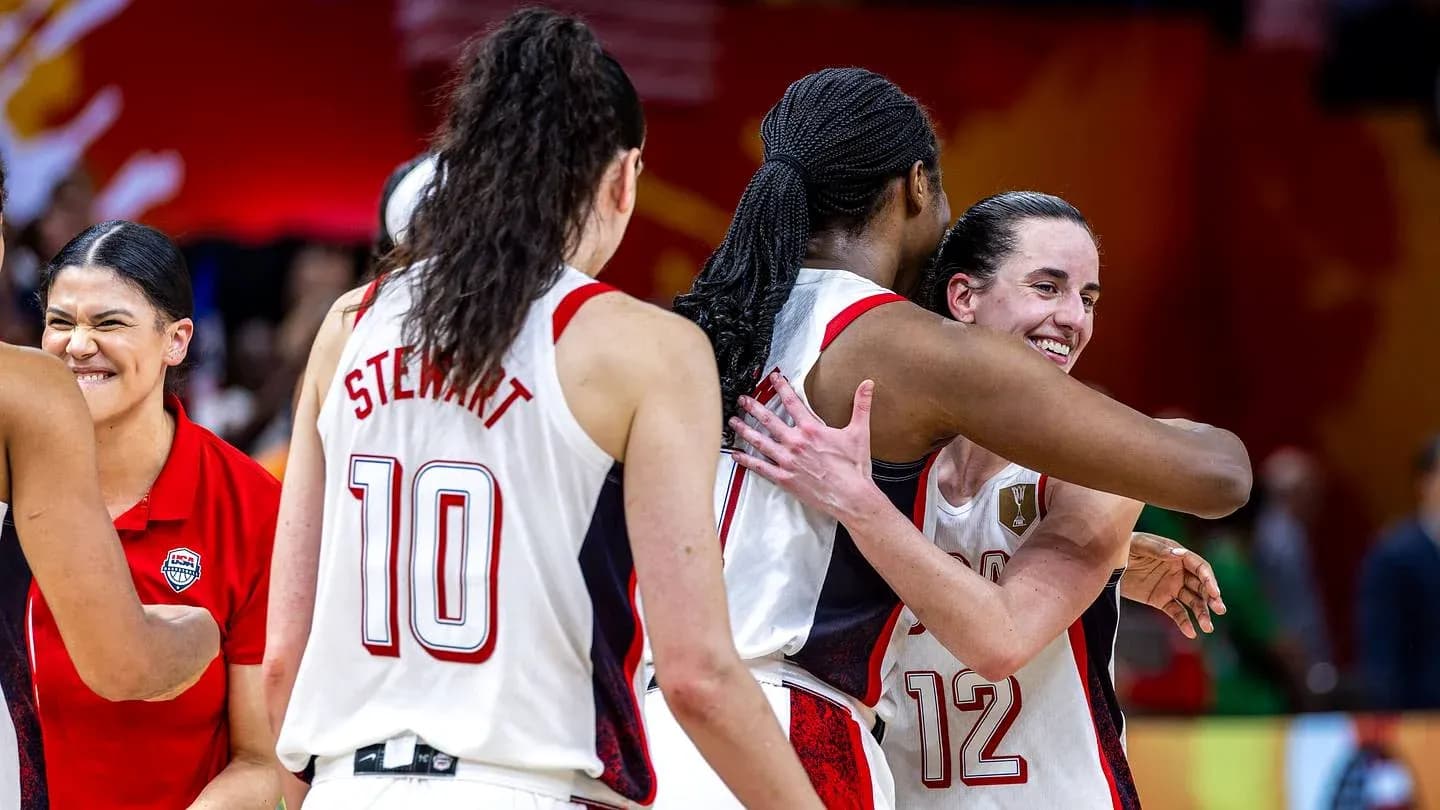
By the final buzzer on Sunday night, Team USA had turned that early crisis into a 97-79 win and a fifth consecutive FIBA Women’s World Cup title, another golden chapter written in a city that knows a thing or two about history.
At the center of it all, again, stood Breanna Stewart.
Stewart’s era, Stewart’s stage
Stewart didn’t just lead the way. She owned the night.
Twenty-two points. Ten rebounds. Four assists. Thirty minutes of control in a game that, for a stretch, looked like it might spin away from the Americans. She walked off with the MVP of the tournament, becoming the first player ever to win that award twice, and with a fourth World Cup gold medal, tying Sue Bird for the most in USA history.
Four World Cups. Three Olympic golds. And now, a performance that made her the first USA player to post a 20-point, 10-rebound double-double in a World Cup final.
Across Berlin, she averaged 12.8 points, 7.3 rebounds and 2.8 assists. On Sunday, those numbers became something sharper: leadership under fire. When the U.S. deficit ballooned to 14 — their largest of the tournament — it was Stewart who steadied the ball, steadied the huddle, and began to carve into France’s belief.
This is her era, and she played like it.
Veterans drag USA back from the brink
Team USA arrived with a shiny label: a blend of “Young and Turnt” rising stars and a hardened veteran core. When the World Cup was on the line, the kids watched, and the vets went to work.
Stewart, Chelsea Gray, Jackie Young and Kahleah Copper carried the offense, combining for 65 points. All four logged at least 27 minutes in a game that demanded experience more than potential.
Gray, the surgeon at point guard, chipped in 12 points and kept the offense humming when possessions grew tense. Copper, relentless as ever, slashed her way to 15. Young poured in 18. Stewart did everything.
That group didn’t just close the gap. It changed the temperature of the night. The 14-point French cushion shrank, then disappeared, then turned into a deficit as the third quarter broke open and the Americans rolled up a lead that swelled to 27.
Behind them, the future waited. Paige Bueckers played fewer than three minutes. Sonia Citron and Kiki Iriafen saw under two minutes each. Their time is coming. On this night, the veterans made it clear the present still belongs to them.
Jackie Young, record-breaker and relentless winner
Every tournament has a player who quietly refuses to have an off night. In Berlin, that was Jackie Young.
She reached double figures in every USA game and saved her sharpest work for the final: 18 points, six rebounds, five assists, 7-of-14 from the field, 4-of-7 from deep. She was named player of the game, and the numbers backed it up.
Young became the first player in Women’s World Cup history to post at least 15 points, five rebounds and five assists in a final. That’s not a quirky stat; that’s all-court dominance in the biggest game.
Her résumé now borders on absurd. High school state champion. NCAA champion. WNBA champion. Olympic 5x5 gold. 3x3 Olympic gold. World Cup gold. Every level, every stage, the same result.
Call it what it is: she wins.
France’s first final, and a brutal third quarter
For France, this was uncharted territory. A first-ever appearance in a World Cup gold-medal game, a chance to topple the sport’s giant, and for a while, they swung hard.
Gabby Williams and Dominique Malonga were superb, combining for 41 points and giving the Americans more trouble than most teams manage in a decade of these tournaments. France’s physicality and confidence pushed them into that 14-point lead, and for a moment, the upset didn’t feel impossible.
Then came the third quarter.
The U.S. pressure climbed, the ball moved faster, and France’s composure cracked. Missed shots turned into American transition. Fouls piled up. The 14-point lead became a deficit in a blur of red, white and blue.
No moment summed up the frustration more than Marine Johannes’ night. She arrived as the tournament’s premier long-range threat, leading the field with 19 made threes heading into the final. Against the U.S., she finished with just five points, 1-of-6 from beyond the arc, and an unsportsmanlike foul in the third quarter after smacking Copper in the face.
France had “nothing to lose,” as Johannes said beforehand. They left with a harsh lesson in what it takes to actually finish the job against this program.
Angel Reese, meme machine on the world stage
Angel Reese’s stat line won’t define this tournament, but her presence might live longer than most box scores.
As the U.S. avalanche buried France in the second half, Reese’s reactions became instant social currency — the gritty face as the Americans stormed out of halftime, the unfiltered joy on the bench as teammates hit shot after shot.
She has already built a reputation in the WNBA for viral moments without trying. Now she’s added a World Cup chapter to that catalog, a reminder that personality travels just as well as talent.
Lawson and Bird pass the first big test
All of this unfolded under heavy scrutiny for the two people tasked with steering the future of USA Basketball: head coach Kara Lawson and managing director Sue Bird.
They entered the tournament with pressure from every angle. A home Olympics in Los Angeles looms. A’ja Wilson, the expected anchor, pulled out with an injury. Seven players were making their major-tournament debuts for the senior national team. The margin for error, at least in public perception, felt thin.
Bird’s job was to pick the right mix. Lawson’s was to make it work when the games tightened. Both delivered.
Lawson leaned hard on the veterans when the final teetered, then used the younger players in targeted roles where they could succeed rather than be exposed. Bird’s roster balance — star power up top, energy and length in reserve — held up under real stress.
Had the U.S. stumbled here, the noise heading into 2028 would have been deafening. Wrong coach? Wrong architect? Wrong direction for a storied program?
Instead, those questions are muted. For now.
The grind resumes, and the gap remains
For the players, there’s barely time to exhale. The World Cup ends Sunday. The WNBA season snaps back into focus on Thursday, Sept. 17. Sun-Dream, Mystics-Sky, Sparks-Wings early, then a Mercury-Fire and Storm-Aces double-header to close the night. On Sept. 18, Indiana faces Toronto, New York meets Minnesota, Portland plays Golden State.
Bodies will be tired. Flights will be long. The schedule doesn’t care.
As for the rest of the world, the picture is both encouraging and unforgiving. Spain pushed the U.S. on Saturday before fading late. France built a double-digit lead in the final before collapsing under the third-quarter wave. The depth of talent is clearly growing, the margins are narrowing, and yet the same team keeps climbing the podium.
Fans who craved chaos, who wanted an upset, who maybe even backed someone other than the Americans, left Berlin with the same outcome they’ve seen for a decade.
The question isn’t whether Team USA still rules women’s basketball. That was answered again on Sunday night.
The real question is this: with a home Olympics on the horizon and a new generation already waiting in the wings, how much longer can anyone else afford to wait for the crown to slip?