VAR Controversy: The Manchester Derby's Offside Blunder
The soundtrack to one of the Premier League’s great VAR calamities was a man shouting into a headset.
“Quick, quick, quick, quick! Go, go, go, go, go!”
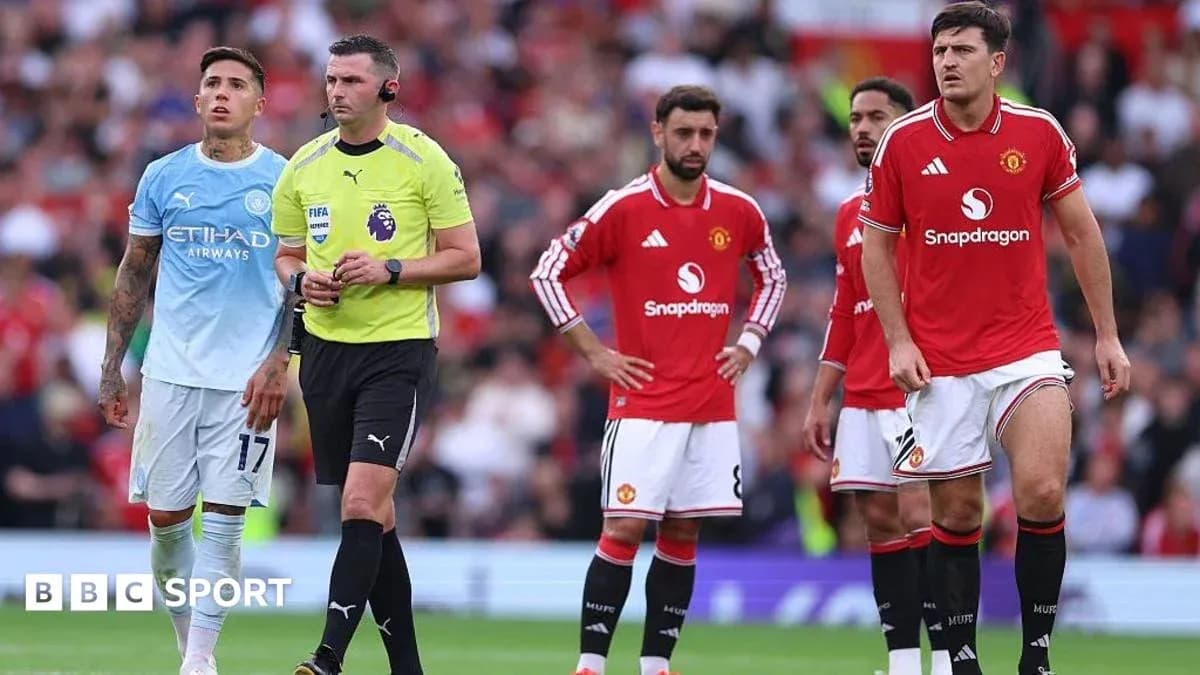
In the Stockley Park bunker, video assistant referee Matt Donohue barked the words as he hurtled through the review that would rubber-stamp Erling Haaland’s winner in the Manchester derby. On the pitch, Manchester City celebrated a 1-0 victory over Manchester United. On the replays, clear as daylight, Enzo Fernandez stood three yards offside before attacking the ball.
Nobody in the booth saw it. Or at least, nobody acted on it.
The goal stood. The fallout began.
Speed kills
Refereeing has always lived under a microscope. VAR merely swapped the old magnifying glass for an HD camera and a forensic zoom. Every angle, every frame, every touch is now examinable in slow motion, yet the noise around the system has been dominated by one complaint: it takes too long.
The Premier League leaned into that criticism. A “more efficient application of VAR to reduce delays” became one of its guiding principles for the season. Managers, players, pundits, supporters – and crucially, the league’s own stakeholders’ survey – all hammered the same theme: make it quicker.
On Sunday, we saw what happens when the pendulum swings too far.
The urgency in Donohue’s voice told its own story.
“Let’s go, let’s go, let’s go, let’s go!”
This was not the cold, methodical process VAR is supposed to embody. It sounded frantic. A rush. The exact opposite of the detached, clinical review the technology is designed to provide.
Yes, there is pressure. Yes, delays irritate fans and broadcasters. But shaving seconds off a check is no defence when a decision of this magnitude goes so badly wrong.
The mistake before the rush
The obsession with speed did not just trim the review. It distorted the process.
The critical error came even before Donohue tried to race through the attacking phase. On the first replay, as Josko Gvardiol delivered the cross, Donohue told the replay operator to stop the video. From there, he went straight into the semi-automated offside technology.
That should never have been the starting point.
The VAR team should have watched the entire move unfold – from the cross leaving Gvardiol’s boot to Haaland’s header – to understand every player’s position and influence, including Fernandez’s. That wide-angle awareness is the foundation of any offside check.
Instead, they narrowed their focus too early. By the time the attacking phase was properly considered, the only question in Donohue and assistant VAR Blake Antrobus’ minds was whether Fernandez had touched the ball. A touch would have triggered a new phase and placed Haaland offside.
The larger, far more obvious problem – Fernandez’s original offside position as he attacked the cross – never entered the conversation.
This was not a single missed frame. It was a failure of process.
Where was the safety net?
Donohue has taken most of the public criticism, but Antrobus’ role – or lack of one – was just as significant.
The AVAR exists to act as a second pair of eyes, a check against tunnel vision, the person who spots what the VAR has missed. On this review, his entire audible contribution amounted to a brief “no, yeah” when asked about a possible touch by Fernandez.
One second later, Donohue declared: “final decision is goal, check complete.”
That was it. No challenge. No pause. No insistence on a wider look at the penalty area. The safety net simply wasn’t there.
Antrobus’ recent history adds another layer. He was AVAR in the season’s only major VAR delay, a four-minute review in Brentford v Sunderland that led to Dan Ballard’s goal being ruled out for a subjective offside against Kevin Danso. The length of that delay drew heavy criticism in some quarters.
Did that experience nudge him towards silence on Sunday? Did the fear of another long stoppage play on his mind? Only he knows. The irony is brutal: in that Brentford game, Antrobus helped guide VAR Tim Wood to the correct offside call. Patience delivered accuracy.
At Stockley Park, there was another potential line of defence. The support VAR, stationed in the operations room next to the match hub, has the authority to step in on protocol. Watching events unfold, they could have intervened.
They did not.
Even after the goal, the situation was still recoverable. VAR protocol allows a review up until the moment of kick-off. The error could have been caught in that window. It wasn’t.
Specialists under fire
For Pro Ref, the body responsible for elite officiating, this is not just a bad day at the office. It is a direct challenge to the system it has built and sold as the future.
Significant investment has gone into VAR training, with an emphasis on both efficiency and accuracy. There have been calls for dedicated VAR specialists, officials who live in the booth rather than on the pitch. In theory, that should reduce errors.
In practice, Sunday’s mistake came from exactly that profile.
Three seasons ago, Pro Ref invited referees to apply for a specialist video role. Candidates went through aptitude tests, with around 15 reaching the final training phase. Ten have since worked as VARs in the Premier League.
Donohue is one of them. Sunday was his 65th Premier League appointment as a video official. His progress has been such that he now appears on the international list and took charge of Uefa club competition qualifying ties in the summer.
He has made errors before – almost all officials have – but his record had been strong enough to justify that rise. Two of his fellow graduates, Nick Hopton and Neil Davies, remain the only VARs without a clear error on their record over the past two seasons.
Specialisation, then, is no magic shield. Lee Mason and Mike Dean, the league’s only full-time VARs appointed after retiring from on-field duties, both lost their positions under Howard Webb after a series of high-profile mistakes.
The message is stark: moving referees into a room full-time does not automatically make them better.
A global problem, not just an English one
England is not alone in wrestling with VAR’s contradictions. Spain’s La Liga and its second division use a full team of officials who work exclusively as VARs and never take charge on the pitch. The theory is identical: focus breeds expertise.
The reality? Controversy rages just as fiercely.
At the start of last season in Spain, VAR completely missed that a goalscorer was in an offside position when the ball was played. Different country, same technology, same human frailties.
The pattern is clear. The system is only as good as the people operating it – and the pressures they work under.
The cost of shaving seconds
Webb has listened to the calls for quicker decisions. Statistically, the response has worked. VAR delays, including the time taken for the referee to announce decisions to the crowd, have dropped from an average of 46 seconds per game to 36 seconds this season.
On paper, that looks like progress.
On the pitch, Arsenal’s unawarded penalty at Aston Villa and Haaland’s derby winner tell a different story. Both errors carry the same accusation: the incident was cleared too quickly.
Contrast that with West Ham’s stoppage-time equaliser at Arsenal last season. That VAR check took more than four minutes. The decision was unpopular with one fanbase, but the process was thorough and the outcome correct. Nobody accused the officials of rushing.
The lesson is as old as refereeing itself: the right decision matters more than the time it takes. The Premier League’s own data may show faster reviews, but when one of those reviews misses a player standing three yards offside in one of the season’s marquee fixtures, the numbers feel hollow.
Pro Ref will now have to explain how a VAR could be heard desperately urging speed in a moment that demanded calm. It will have to justify how a process designed to be meticulous became so narrow that an obvious offside never entered the frame.
The game wanted quicker answers. On Sunday, it got one – and paid the price.