Barcelona and Arsenal Set for Women’s Champions League Rematch
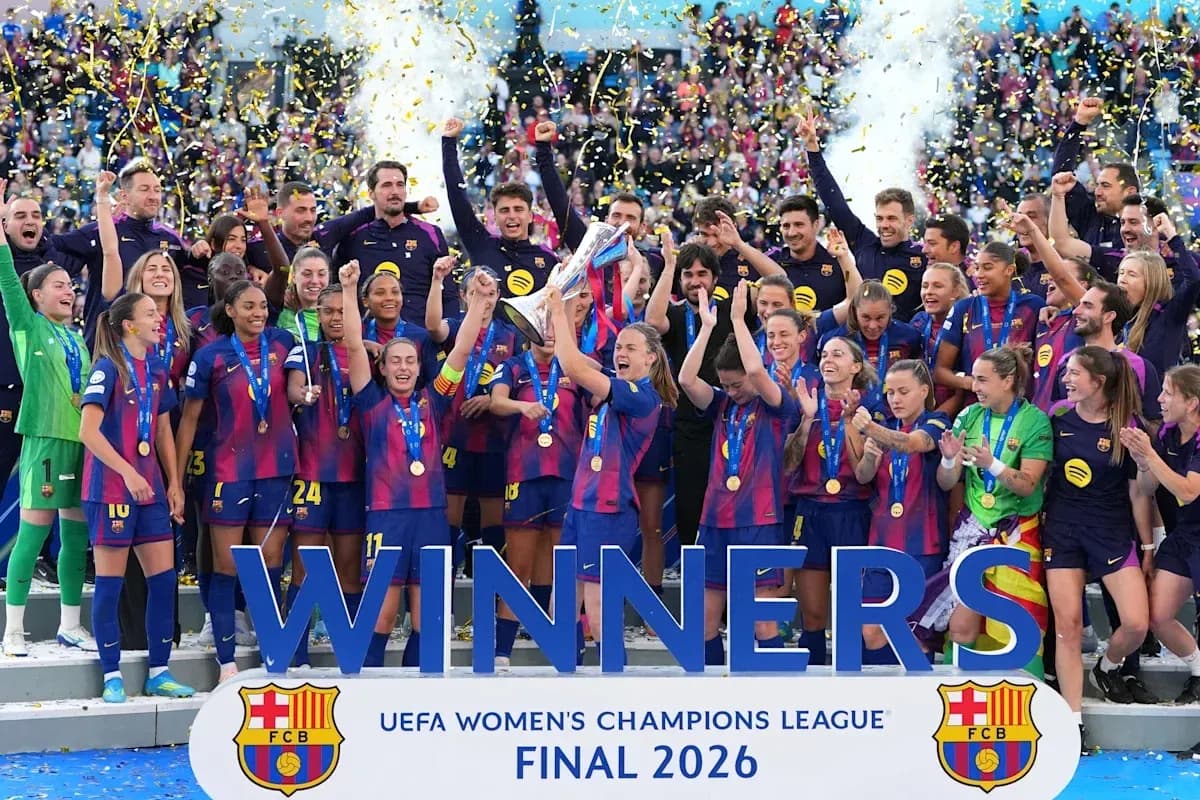
NYON, Switzerland — The draw spilled its first real drama the moment Barcelona and Arsenal dropped into the same section. The holders against the team that took their crown in the 2025 final. A rematch, this time stretched across a league phase, not a single night.
It comes at a moment of upheaval for Barcelona. The champions enter a season of transition, stripped of two-time Ballon d'Or winner Alexia Putellas and several of the club’s most decorated Spain internationals who departed in the offseason. The core that defined an era has shifted. The expectations have not.
What they received on Friday, though, was a manageable path through the new-look 18-team league. Barcelona will welcome Arsenal back to Catalonia and also host Paris FC and Servette. Their away schedule sends them to Bayern Munich, Roma and HB Køge of Denmark — demanding, but far from brutal for a side still packed with quality.
Arsenal, buoyed by that 2025 triumph, now carries the weight of being the team everyone wants to beat. The London club’s home nights will be heavy with history and jeopardy: eight-time champion OL Lyonnes, Benfica and Køge all come to England. Arsenal’s road map is no easier, with trips to Paris FC and Inter Milan promising tense, tactical evenings.
Lyon, beaten in last season’s final and desperate to reassert its old dominance, finds itself crisscrossing the continent. The French powerhouse travels to Arsenal, Juventus and Servette, while its home fixtures are loaded with intrigue: Chelsea arrive, as do Europa Cup winner Häcken and Inter. For a club built on European pedigree, this is a schedule that demands a response, not nostalgia.
The English champion, Manchester City, has its own gauntlet to run. City will host Paris Saint-Germain, Real Madrid and Austria Vienna — three very different tests, three very different atmospheres. On the road, they must navigate Bayern, Häcken and Inter. Every misstep in this league phase will carry a price.
Real Madrid, still shaping its identity in the women’s game, lands a draw that offers both opportunity and risk. The Spanish club will host both Paris clubs — PSG and Paris FC — plus Inter, nights that will test their maturity and ambition. Away days at Bayern, Roma and Manchester City will quickly reveal how far they have come, and how far there is still to go.
New format, new pressure
This season’s Women’s Champions League keeps the stakes high from the opening kick. The league phase runs across six rounds, beginning Sept. 22 and concluding Dec. 16, compressing the drama into a tight autumn window.
By mid-December, the table will be ruthless. Only the top four of the 18-team standings advance straight to the quarterfinals in March. Finish anywhere from fifth to 12th and the route becomes longer and nervier: a knockout playoff in February just to reach the last eight. Fall below that line and Europe is over before spring even starts.
The final itself will unfold in late May at Poland’s national stadium in Warsaw, a stage built for a club ready to seize the shift in power that is quietly underway.
Money and momentum
Behind the football sits a financial structure that still trails the men’s game, but continues to grow. UEFA has set aside 18.2 million euros in prize money for the 18 Champions League clubs, with each side guaranteed 505,000 euros simply for reaching this phase. For many, that baseline figure shapes budgets, signings and long-term planning.
There is more on the table across the continent. The Women’s Europa Cup, the second-tier competition introduced last year and won by Häcken, carries a prize fund of 5.6 million euros. It is smaller, but it marks another step in building a genuine European pyramid.
For now, though, the spotlight sits firmly on Barcelona, Arsenal and the familiar giants circling around them. A champion in transition, a challenger defending its greatest modern triumph, and an old dynasty in Lyon refusing to accept a supporting role.
By the time Warsaw comes into focus, one question will linger over this draw in Nyon: did we just see the start of a new order, or the last stand of the old one?