Daniil Medvedev's Critique of Tennis Balls: A Focus on Wilson
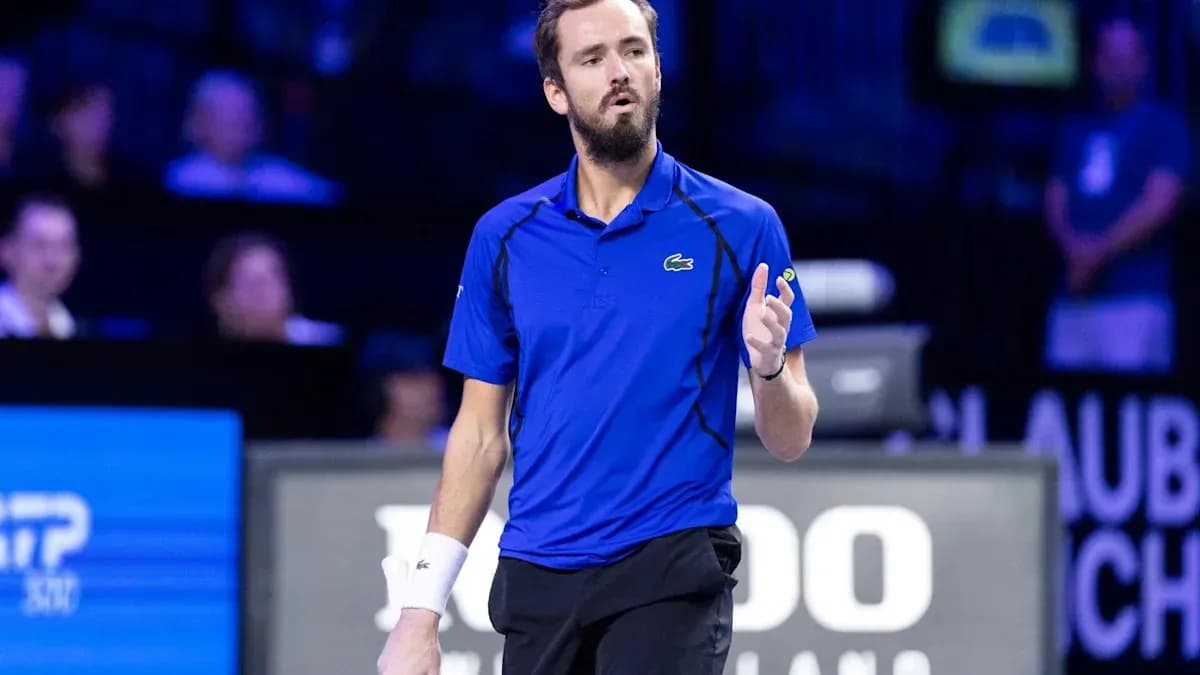
Daniil Medvedev has never been shy about saying what he thinks. This time, his verdict is aimed not at rivals or organisers, but at the very thing every point depends on: the ball.
Fresh from winning the Almaty Open, the Russian sat down with Russian outlet Bolshe and was presented with a curious statistic. This season, he has held serve in 81.4% of his service games with Wilson balls, and 87.1% when using other brands. The numbers opened the door to a subject that has been simmering in the locker room for years: how the ball affects both tennis and the players’ bodies.
“Probably the worst ball”
Medvedev drew a clear line between the Wilson balls used at the US Open and those used at Roland Garros. Same manufacturer, very different feeling.
“Wilson balls are different. The Wilson US Open ball is completely different from the Wilson Roland Garros ball and I think there aren't any other Wilsons, if I'm not mistaken. Maybe I'm wrong,” he said.
Then came the punchline.
“Wilson Roland Garros, in my opinion, is probably the worst ball, worse than the Head ball in Rotterdam. That's just my opinion, of course. I played a quarter-final with them, so it's not like I've never won a single match with them. I reached the Roland Garros quarter-final with them, but for me they're just terrible.”
He didn’t hide behind poor results. He has gone as far as the last eight in Paris with those balls. But he still prefers what came before.
“Before that they were Babolat. I always lost with them in the first round, I think I didn't win a match, but in my opinion they were much better balls. You can play better tennis with them.”
It is a striking contrast: better tennis, worse results. For Medvedev, that underlines how much feel matters to a player, beyond the scoreboard.
US Open balls, a “longer story”
His relationship with the Wilson US Open ball is more complicated. He doesn’t lump all Wilson products into the same category.
“Wilson US Open is a different, longer story. In general, I liked them more than not. Whether they've changed over the years, I don't know,” he admitted.
The uncertainty has spread among the players. In China, ahead of Hangzhou, he and Andrey Rublev found themselves dissecting that very question.
“We talked about it this year with Andrey Rublev. We were in China, practicing before Hangzhou, where we both reached the final and it just felt better than how it felt in America for those six weeks. We were just playing well.
“I said to him, ‘Listen, we used to play fine, so it's probably something that changed in us, not the balls.’ He said, ‘Listen, I don't know, it seems to me that the balls have changed.’ I was like okay I hope that's the case, because it means it wasn't just me who played badly in America, the balls also contributed to that.”
For a player built around one of the game’s most reliable backhands, what he described next was damning.
“You showed the serving stats, but in America I couldn't hit a backhand in the court, it just flew straight into the net no matter what I did and when I can't hit a backhand, I can't win tournaments. It's not going to happen. When the ball flies into the net on the backhand, I get lost. I start thinking about playing pickleball, curling, and so on.”
It is a line delivered with humour, but the frustration is real. At the elite level, a few grams of felt and rubber can be the difference between contending for titles and questioning your sport.
The Roland Garros puzzle
His criticism of the Roland Garros ball lands in a broader context. Paris remains the only Grand Slam where Medvedev has never gone beyond the quarter-finals. It is also the only major where he failed to win a single match this year.
That alone doesn’t prove the ball is the culprit. Surface, conditions, confidence – all play their part. Yet the fact that the Russian singles out the Wilson Roland Garros ball as “terrible” adds another layer to his complicated history on clay.
It also reopens an old debate. When Roland Garros switched from Babolat to Wilson in 2020, the move sparked immediate controversy. Record champion Rafael Nadal voiced his displeasure. Many players grumbled about the change in feel and flight.
Medvedev, though, sounded very different back then.
From optimism to open criticism
At the time of the switch, he actually welcomed the idea that the new balls and cooler autumn conditions in Paris might work in his favour.
“Maybe it can help me that it's a bit colder, so the balls don't fly as much, don't go as spinny,” he said in 2020. “So maybe I can play some flat tennis in practices. I think it can be an opportunity for me actually, an advantage.
“I like the balls because, yeah, tennis is a funny and interesting sport…It's normal that when one player doesn't like something, second one maybe is going to like it. So far I like it. I think it suits me not bad.”
Four years on, the tone has flipped. The optimism has been replaced by blunt criticism, shaped by more time with the product, more matches, and a body that has felt the grind of an ever more demanding calendar.
His comments also tap into a wider concern in the sport. Players have repeatedly linked certain balls to a rise in wrist and elbow injuries, questioning how often brands and tournaments tweak specifications and how much input the locker room really has.
Medvedev, never afraid to challenge the status quo, has now drawn his own line in the clay of Paris. The courts at Roland Garros may be iconic, the trophies timeless. For him, though, the ball they use has become the real problem.