British Basketball Enters New Era of Competition
British basketball has talked about potential for decades. This autumn, it feels like the sport has finally stopped talking and started swinging.
Paul Blake has seen almost everything the domestic game can throw up. Thirty years around Newcastle Eagles and the top flight gives you perspective. His verdict on the current landscape is blunt.
"It's definitely the most competitive it's been, pretty much in all those 30 years."
He’s not selling a dream. He’s describing a league that suddenly has teeth.
Lions chasing history at home – and an NBA moment
The men’s Super League Basketball season, the third since the old British Basketball League gave way in 2024, tips off on Friday with champions London Lions travelling to Bristol Flyers. The Lions do not just arrive as favourites. They arrive as a benchmark.
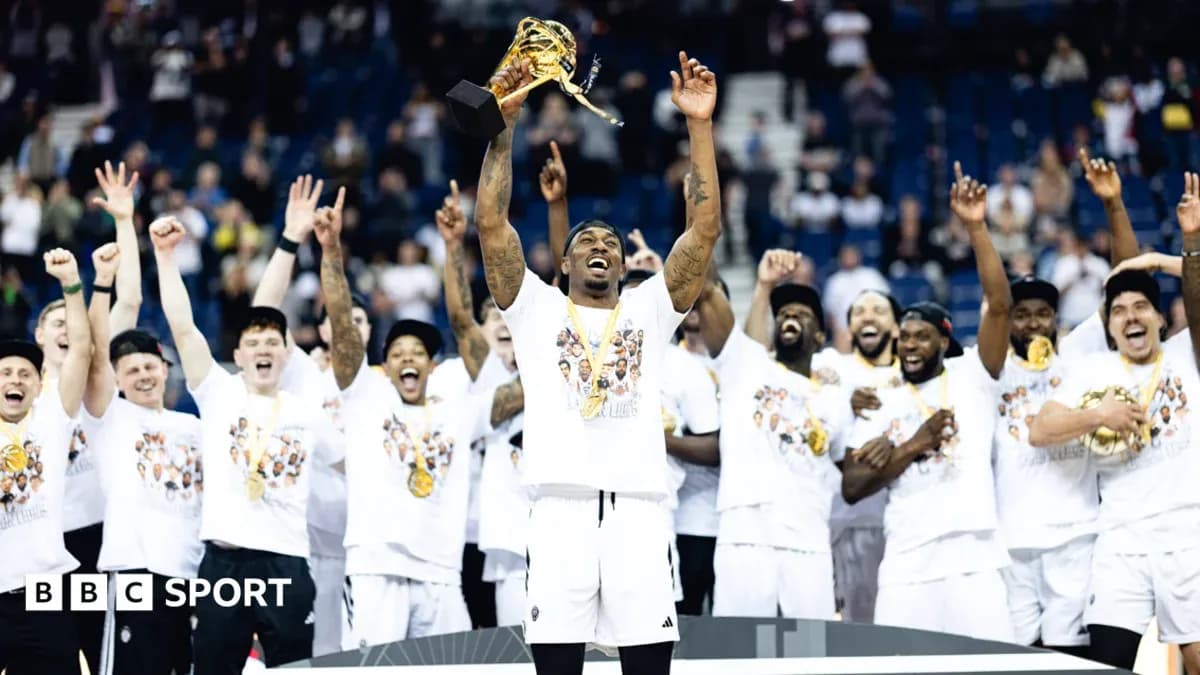
Last season they hoarded every domestic honour in sight: SLB Championship, SLB Playoffs, SLB Cup, SLB Trophy. A clean sweep. A quadruple. They will start this campaign with a target on their backs and a date circled in red on their calendar.
On 12 October, London will become the first British club to face NBA opposition when they meet Portland Trail Blazers in a friendly in the United States. For a franchise that wants to be more than just big in Britain, this is more than a novelty fixture.
"I've wanted to be in the NBA since I was six years old. This is the closest I've ever been," says Lions CEO Lenz Balan. The line sounds like a confession from a kid who never quite let go of the dream.
For Balan, the game in Portland is a statement as much as a spectacle.
"It's a really important signal in the basketball world, in the sporting world. This is the ambition. We are absolutely trying to be one of the best clubs in the world."
The ambition stretches across Europe as well. The Lions are back in the EuroCup, EuroLeague’s second-tier competition, for a second straight season. They showed flashes last year, beating eventual runners-up Besiktas Gain in the group stage, but still finished eighth of 10 teams.
That is not enough for a club talking about global relevance.
Balan is banking on a stronger roster, highlighted by the loan arrival of 2025-26 EuroLeague winner Keenan Evans, to close the gap.
"We have ambitions to definitely outperform last year," he says. "It's going to be tough, but these are some of the best players in the world - and I think most people in London and the UK recognise the level of competition that they're playing.
"We're just really focused on executing that vision, getting better and if we keep doing that, I think we're going to get some good results."
The domestic grind will test that vision quickly. The league has grown to 10 teams with the addition of Liverpool Basketball, and the sense from inside boardrooms and locker rooms is that the gap between top and bottom is shrinking.
"The league is just getting more and more competitive all the time, so we know we'll be in for a fight again this season," says Blake, now also an SLB director. "The quality of players that are now in the league across the teams top to bottom is, for me, pretty much the highest level it's been. It's extremely competitive."
Manchester and Bristol carry the European flag
The Lions are not the only ones pushing the ceiling.
Manchester Basketball delivered a landmark result this week, becoming the first British side to win a qualifying round game in Fiba's Basketball Champions League by beating German outfit Wurzburg Baskets. It was the kind of victory that used to belong in “what if” conversations. Now it sits in the record books.
Bristol Flyers, London’s opening-night opponents, continue to stretch themselves in Europe too. They return to the European North Basketball League, the competition in which Manchester finished runners-up last season. British clubs are no longer just making up the numbers on continental schedules; they are starting to shape them.
For the first time in a long time, the sport here feels aligned – domestic storylines feeding into European ones, and vice versa.
Women’s game steps into the spotlight
Fifteen days after the men get under way, it will be SLBW’s turn.
On Saturday, 3 October, Cardiff Met Archers host B Braun Sheffield Hatters, the defending champions and play-off winners, in the women’s league opener. It’s a fixture that captures the unique fabric of the women’s game in Britain: part high-performance programme, part balancing act.
At Cardiff, four players draw a salary while also studying masters degrees at the university. Around them, the roster is a patchwork of scholarship athletes, postgraduate and undergraduate students, and others juggling full-time jobs with elite basketball.
Archers head coach Stef Collins, a Great Britain Olympian from London 2012, sees opportunity in that blend.
"I think there's an opportunity to build something that people genuinely want to watch and follow," she says. "Women's basketball has shown what is possible internationally, particularly with the growth we're seeing in leagues like the WNBA, NCAA College Basketball."
The recent Women's World Cup in Berlin underlined that point. The United States claimed a fifth straight title by beating France in the final, but the bigger number sat in the stands: more than 230,000 fans attended across the tournament, the highest figure in the modern era.
"It was the most-attended World Cup in the modern era with over 230,000 fans in attendance," Collins notes, and her mind jumps quickly from Berlin back to Britain.
For her, the next phase is not just about tactics or talent. It is about storytelling.
"For me, it's also about telling the stories of the players. They're not just basketball players - they're students, they're professionals, they're international athletes, they're role models. If we can showcase that properly, I think there's an exciting future for the Super league."
Learning from the WNBA playbook
The WNBA has already sketched out a route map for women’s leagues across the world. It stands as the independent women’s equivalent of the NBA, and its reach is now undeniable. In 2025, WNBA clips drew more than one billion views on Instagram, making it the most-followed women's sports league on the platform.
Those numbers matter to Collins. Not as something to copy wholesale, but as proof of concept.
"The WNBA is a really good example of what happens when you give women's basketball a platform and make the players and their stories visible," she says.
Then she pushes the idea one step further.
"But I think there's also a lesson beyond the basketball itself. Women's sport has shown that fans want to connect with the athletes, their personalities and their stories.
"We shouldn't be afraid to market women's basketball differently and allow our players to be themselves."
So the new season arrives with a different kind of tension. On one side, Lions, Manchester, Bristol and others trying to drag British clubs deeper into the European conversation and, in London’s case, onto an NBA floor. On the other, SLBW fighting to carve out its own space, armed with role models who clock off from lectures or office jobs before tip-off.
The question now is not whether British basketball has potential. It is whether this generation can turn this rare alignment of talent, ambition and visibility into something lasting – before the moment passes.