Champions League 2023: Can PSG Complete a Historic Treble?
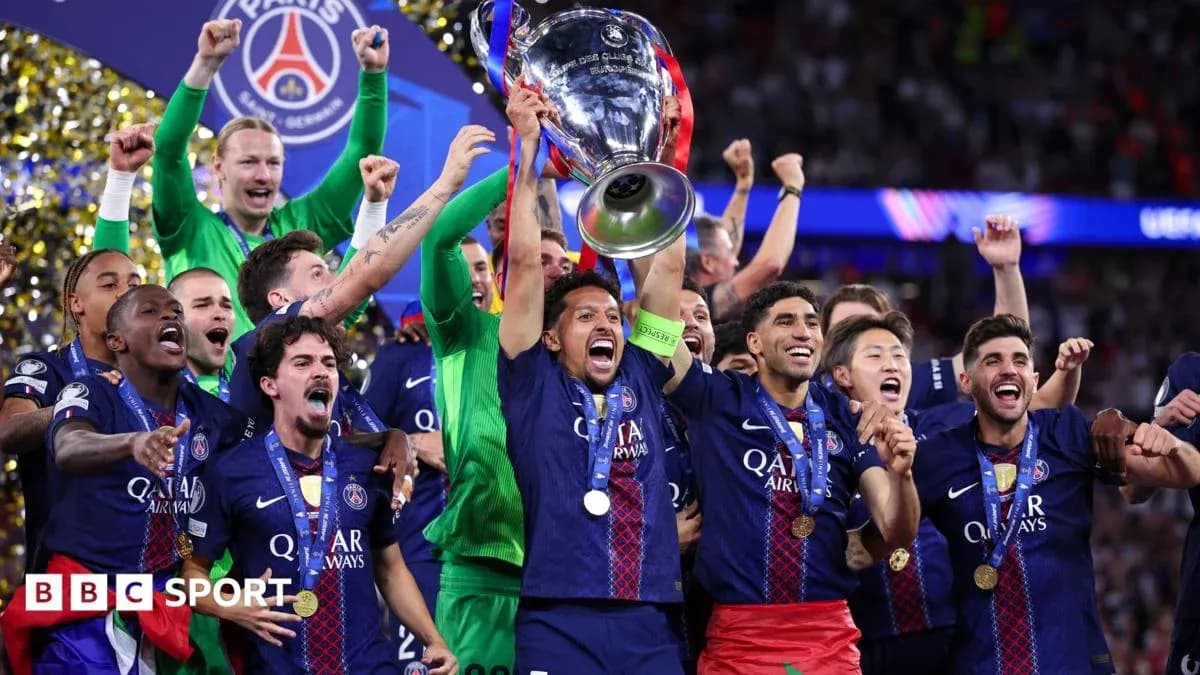
The anthem is back, the lights are about to dim, and on 5 June in Madrid someone will lift the most coveted trophy in club football. The Champions League returns with a new league phase, familiar giants and one glaring question: can anyone stop Paris St-Germain from completing a historic treble?
PSG chase three in a row as England load up
PSG arrive as back-to-back champions, but they do not look untouchable. The standard they’ve set is brutal; sustaining it might be even harder.
“If PSG do the three-peat, it would be an incredible achievement. I don't think they will do it,” says Julien Laurens. Two in a row is rare air. Three demands something close to perfection – or, as Laurens puts it, “unless you've got Cristiano Ronaldo in your team, which they don't.”
Luis Enrique’s side have started the domestic season in fits and bursts. The idea is bold, as always: high tempo, high line, high risk. The reality? An “irregular start”, as Guillem Balague calls it, and a reminder of how draining it is to live on the edge for nine months.
Enrique is likely to treat the league phase as a laboratory. Tactical tweaks, rotating stars, the odd strange result. The real PSG, the one that hunts trophies, tends to appear after January. Balague still expects them to “get very close to winning it again”. Laurens sees at least a semi-final. Both agree: the champions remain in the inner circle of favourites, but they no longer stand alone.
Arsenal, Bayern and a sceptical eye on Madrid
The Premier League sends five contenders, but one English club carries the weight of expectation. Arsenal, beaten finalists last season, are no longer just a romantic pick. They are a serious, calculated choice.
“To win it, I'll go for Arsenal,” Laurens says. “They have the best defence in Europe by far and that's what wins you titles.” It’s not a throwaway line. Mikel Arteta’s side have learned to suffer, to close games down, to win without the fireworks. That, in this competition, is currency.
Balague sees something similar: a team that has “found a way to win regularly” and, with that burden lifted, players who feel a release. A group that now expects to go deep rather than hopes to. Martin Odegaard, after an injury-hit year, has started this season sharply. Balague believes the Norwegian “can dominate games” and must do exactly that if Arsenal are to finish the job they left half-done last June.
Bayern Munich sit in the same bracket. Laurens tips them to reach the final. Balague goes further on an individual level: Harry Kane is “in a campaign to win the Ballon d'Or”, thriving in a system that flatters his movement and finishing. If Bayern click around him, they become the nightmare draw no one wants in the knockouts.
Real Madrid, under Jose Mourinho, draw more doubt than usual. Laurens is blunt: “I don't believe fully in the Jose Mourinho-Real Madrid project.” That’s a rare line about a club that normally starts every Champions League season on the shortlist by default. This time, they feel more like part of a chasing pack that also includes Manchester City and a resurgent Barcelona.
Barcelona rising under Flick
If there is a side carrying momentum into Europe, it is Barcelona. Balague says they are “flying”. Hansi Flick still wants a centre-back and a number nine to push them up another tier, but he already sees a team “on the way to the top anyway”.
His blueprint is clear: defend high, defend aggressively, and let talent flourish in the chaos. That suits Lamine Yamal, the teenager who has made the leap from promise to expectation. He is “hungry for more” and has set his sights on this competition. Under Flick, he will get the platform and the ball in the right zones to hurt elite defences.
For Balague, Barcelona belong alongside PSG and Arsenal in the semi-final picture, “unless they meet before”. The fourth spot, draw permitting, will fall to one of Bayern, Real Madrid or Manchester City. The margins at that level are thin. One injury, one bad night, one piece of brilliance.
The stars to watch
This season is not short on headline acts.
Laurens puts Jude Bellingham at the top of his list. The England midfielder steps into a defining year, operating as a number 10 for Mourinho’s Real Madrid. Laurens feels the role “suits him well” and expects the energy from his “very good World Cup” to carry into Europe. Goals, leadership, decisive moments: Bellingham is being asked to be the face of a new Madrid, not just a part of it.
In Italy, Como arrive on the big stage for the first time, led by Cesc Fabregas on the touchline and Nico Paz on the pitch. The number 10 is “at the heart of everything they do with the ball”. Laurens calls him “a special player – very much in the making – but he will be a top player very soon.” For neutrals, Como promise entertainment and a fresh story.
Then there is Khvicha Kvaratskhelia. Laurens dubs him “Mr Champions League” after two outstanding seasons at PSG, terrorising full-backs from the left wing. Right foot, left foot, inside, outside – he scores spectacular goals and plays with a swagger that puts people on “the edge of your sofa”. Both Laurens and Balague see him in the Ballon d'Or conversation, with Balague convinced he has “another level” to reach and will again “rescue the team and win big games” as PSG push deep into the tournament.
Lens return to the Champions League with a jewel of their own: Ismaelo Ganiou. At 21, the centre-back is “strong… good on the ball, very quick and physical,” says Laurens, who expects a Premier League move at season’s end. Roma, back in the competition under Gian Piero Gasperini, bring a different kind of threat. Donyell Malen, reborn since leaving Aston Villa, is now scoring “almost a goal per game” as a lone striker and looks “back to his best level”.
Balague’s eye is also drawn east. Shakhtar, long known for polishing Brazilian talent, might have their next big export in 20-year-old Kaua Elias. He fits the club’s familiar pattern: raw, technical, potentially very expensive in a few years.
And then there is Odegaard. After a stop-start campaign, the Arsenal captain has opened this one with purpose. Balague sees a player ready “to take that leadership” and carry a more confident team into the latter stages.
Fabregas’ Como and the outsiders’ map
Not all the intrigue sits at the top. Some of it lies with clubs just happy to be here, trying to bend the script in their favour.
Balague is fascinated by Fabregas and Como. He loves “what Fabregas is doing” and the fact the Spaniard stayed despite “interesting offers” over the past two years. The relative lack of pressure gives Fabregas room to experiment, to push ideas without fear. He has, as Balague puts it, “swum against the tide” and now finds himself not just on the train of modern football “but at the front.” The expectation? A run to the knock-out stages, which would be a statement for a debutant.
LASK, who knocked out Celtic, have already shown their edge. Their first Champions League campaign will likely be about respectability: a home win, a competitive points tally. Balague does not see them qualifying, but they look far from passengers.
Sabah, from Azerbaijan, face a brutal draw: away days at Arsenal and Manchester United, home ties with Barcelona and Borussia Dortmund. Organisation is their strength, but this is a trial by fire. Balague believes they can deliver “one or two surprising results”, just not enough to survive the league phase.
Then there is Viking. Bayern, Atletico, Napoli, Aston Villa – the names on their schedule are daunting. Yet Norwegian football, Balague points out, is full of “clever, competitive coaches, players and teams.” He can see a path, however narrow, to the knock-outs.
The stage is set
So the cast is assembled. PSG chasing history, Arsenal hunting redemption, Bayern and Barcelona circling, Real Madrid and Manchester City lurking, newcomers like Como and Viking daring to dream.
On 5 June in Madrid, one of them will stand on the podium with the trophy in their hands. The question that hangs over this season is simple, and it will echo from now until the anthem plays for the last time: is this the year the old order bends, or the year a new one takes control of Europe for good?