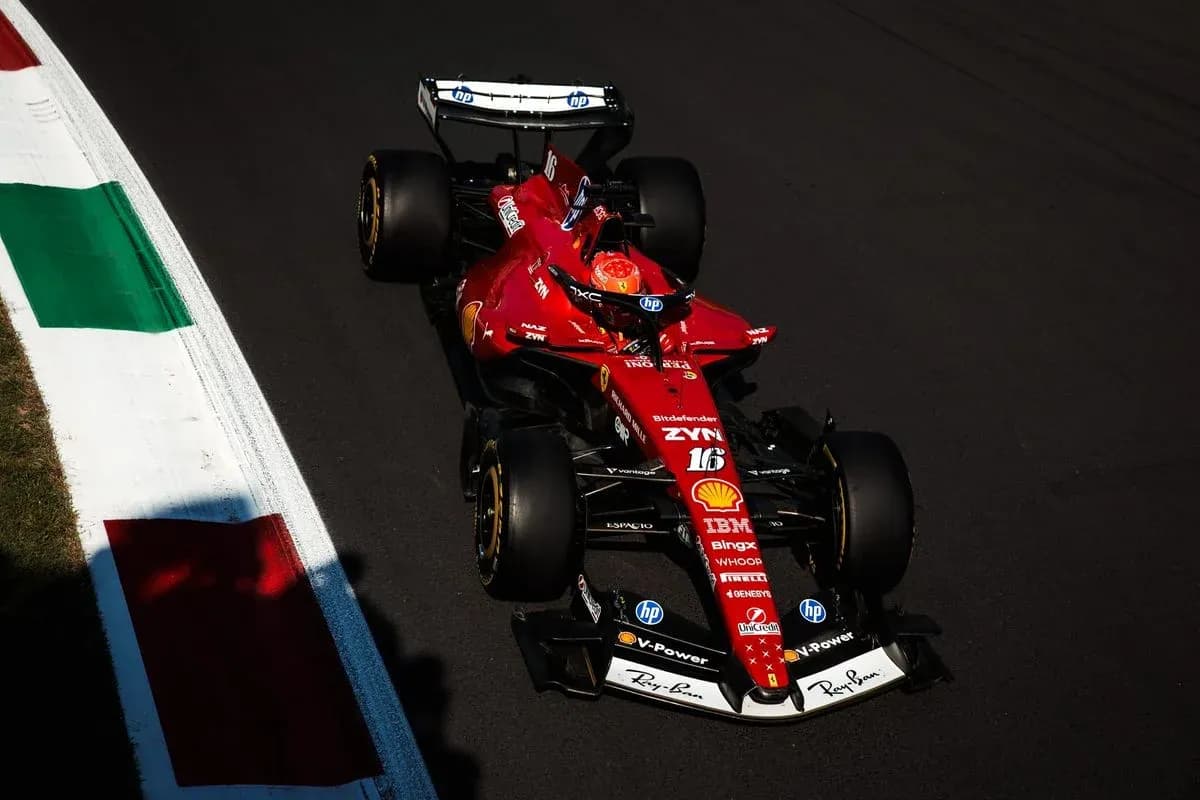
Ferrari's Progress in FP2: Leclerc's Performance and Engine Insights
Ferrari’s new power unit did not light up the timing screens, but for once Fred Vasseur allowed himself something close to satisfaction.
Charles Leclerc ended FP2 just 0.120s shy of George Russell’s Mercedes, second on the timesheets and looking sharp over a race stint. This was no revolution, no sudden red resurgence, but it was tangible progress from the second engine upgrade brought in under the FIA’s ADUO rules, following the first step back in Austria.
Vasseur, true to type, kept the hype on a tight leash.
“You have to keep in mind the performance in the straight line is the drag, the weight of the car, it's everything, it's not just the engine,” he said. “We did a step for sure, and we didn't bring ADUO 2 for nothing, but I think we still have a decent gap.”
The numbers backed him up. Ferrari’s deficit on the straights, which Lewis Hamilton has called “considerable” versus Mercedes, remained obvious. Overlay Leclerc’s best FP2 lap with Russell’s and a clear picture emerges: the Mercedes pulls away on the straights, the Ferrari claws it back under braking and through the turns.
Across the first two-thirds of the lap, Leclerc bleeds roughly six tenths. Only on the final straight does he recover a chunk of that time, helped by Russell suffering more clipping on the run to Parabolica. On this energy-hungry layout, every team is still chasing the sweet spot between harvesting and deployment. Nobody has nailed it yet.
Hamilton’s day told a slightly different story. Set-up changes in FP2 left him wrestling a car he called “really hard to pull the lap out of” and “not an easy one to drive”, but he sounded convinced there was more to come from both the balance and the energy usage.
“That's what we need to look into, if it's that [or] if it's the deployment,” he said when asked whether trimming downforce and drag might unlock time. “But the engine is an improvement, which I'm really grateful for the guys back at the factory for working on. But our deployment schedule is different to the others, our competitors. It seems like they maybe have less drag for the straights, so that's something we need to definitely look at.”
Hamilton did praise the unit as “really nice to drive in the low speed”. Yet it was Leclerc who carried Ferrari’s banner all day, not just on a single lap but over the long runs.
His race simulation stacked up well. On average, Leclerc lapped just three hundredths slower than Kimi Antonelli, though that headline comes with a major asterisk: the Ferrari ran on softs, the Mercedes on hards. Even with that tyre offset, the data points to Ferrari as the most likely challenger over a stint, with most in the paddock still expecting Mercedes to hold the upper hand once overnight tweaks land.
Red Bull, for now, sit in the shadows of that fight.
Max Verstappen spent FP2 chasing a car that simply would not behave, having already lost FP1 to Ayumu Iwasa’s outing. That lack of seat time hurt.
“Clearly we have a balance issue on the car,” admitted technical director Pierre Wache. “A little bit like Zandvoort, to be honest, and we try to understand what the issue is, try to fix it in a different way by setup and car components.
“It's the main thing we are working on. What doesn't help is when Max didn’t drive during FP1 and he jumped in the car there, we have less time to react and now we have to react for FP3.”
While Verstappen searched for answers, Liam Lawson quietly put together one of the standout long runs of the day. Despite a messy build-up – splitting his pre-weekend work between Red Bull and Racing Bulls while Isack Hadjar’s fitness remained uncertain – Lawson delivered a hard-tyre stint that matched Antonelli’s numbers. On paper, that flatters Red Bull slightly; both Leclerc and Antonelli hit traffic during their runs. Still, it was a reminder that the world champions cannot be written off even on a scrappy Friday.
McLaren, by contrast, found themselves nowhere near their recent high.
Lando Norris, winner of the last two grands prix, ended up 0.443s down on the long-run averages on hards and 0.384s off on outright pace. He summed it up bluntly: this was “much trickier than the last few Fridays”.
“It's a bit everywhere, honestly,” Norris said of where the time was going. “There's not one corner we're quicker than anyone else ahead of us.
“We're losing a bit in the straights compared to Mercedes, which we kind of expect, but also the high speed is where we lose most of our laptime, which is normally where we're quick. So we have to try and figure out a few things, but we're just off the pace everywhere at the minute.”
McLaren, usually so confident in high-speed corners, suddenly looked ordinary there. That will sting.
Behind the front-runners, the midfield produced its usual intrigue.
Arvid Lindblad topped that pack on a strong day for Racing Bulls, with Haas rookie Ollie Bearman just 0.021s adrift. Over the long runs, Haas slipped behind Racing Bulls and Alpine – Franco Colapinto loved his car in FP1 but later described it as “disconnected” in FP2 – yet the overall picture at Haas was still more positive than in recent weeks.
Both VF-26s carried a major aerodynamic upgrade. Only Bearman, though, had the latest Ferrari engine, with the team receiving just one unit this weekend. Team principal Ayao Komatsu confirmed “it's delivering in terms of characteristics”, a small but important step for a squad that has failed to score in the last six races. The concern remains the “inconsistency issues” that have dogged both cars, with Esteban Ocon again encountering problems.
Audi took a different path. No new aero parts on Friday, but the team played its joker to alter the homologated gear ratios and final drive. The reward was modest. Audi lagged the leading midfield runners more than expected, and though an upturn is anticipated on Saturday, it ended the day only just ahead of Carlos Sainz’s Williams on single-lap pace and marginally behind on long-run form. Sainz ran softs in what was essentially an experimental Friday, as Williams made full use of its track time before a major upgrade arrives in Azerbaijan later this month.
Right at the back, a familiar storyline resurfaced.
Aston Martin struggled as predicted, even with the upgraded Honda engine that arrived at Zandvoort. The team did at least find some driveability gains. Lance Stroll called it “a little bit better”, but that faint praise came with a reality check from Valtteri Bottas, who felt Cadillac “have the upper hand on the straights”. If he is right, the kind of miracle drive that dragged Fernando Alonso into the points at Zandvoort looks a long shot here.
So Ferrari leave Friday with a power unit that finally nudges them closer, a car that still gives away too much on the straights, and a driver in Leclerc who looks ready to punish any slip from Mercedes. The question now is simple: was this the limit of their new engine’s promise, or just the first hint of what it can really unlock over the rest of the season?