Hadjar Returns to Red Bull: The Pressure of Performance
Red Bull’s driver carousel pauses in Baku. The senior team finally gets its first-choice pairing back, Isack Hadjar alongside Max Verstappen, after an injury layoff that stretched across three grands prix and reshaped perceptions of everyone in the Red Bull orbit.
In the space of three races, Liam Lawson reminded people he belongs in Formula 1, Yuki Tsunoda underlined what he already was, Arvid Lindblad quietly tilted the balance of power at Racing Bulls, and Verstappen made it clear the bar at the front has moved again.
Now Hadjar has to catch that wave – fast.
Hadjar steps back into a faster Red Bull
Hadjar returns to his seat with one luxury and one burden.
The luxury: he comes back knowing Lawson did a solid, professional job, but nothing that screams “you’ve just lost your drive”. With no prior mileage in this year’s Red Bull and being bounced between teams again, Lawson still scored points and kept the team’s tally alive. That was more than respectable.
The burden: the car is now operating at a higher level than when Hadjar last drove it, and Verstappen has already shown what its new ceiling looks like.
Before the summer break, Hadjar’s rookie campaign had been quietly impressive. Across the first 11 races he averaged 6.5 points per event to Verstappen’s 9.9. Put simply, if Verstappen was typically finishing fifth, Hadjar tended to be one or two places behind. That’s the profile of a very capable number two in a tight midfield.
But Red Bull’s reference point has shifted.
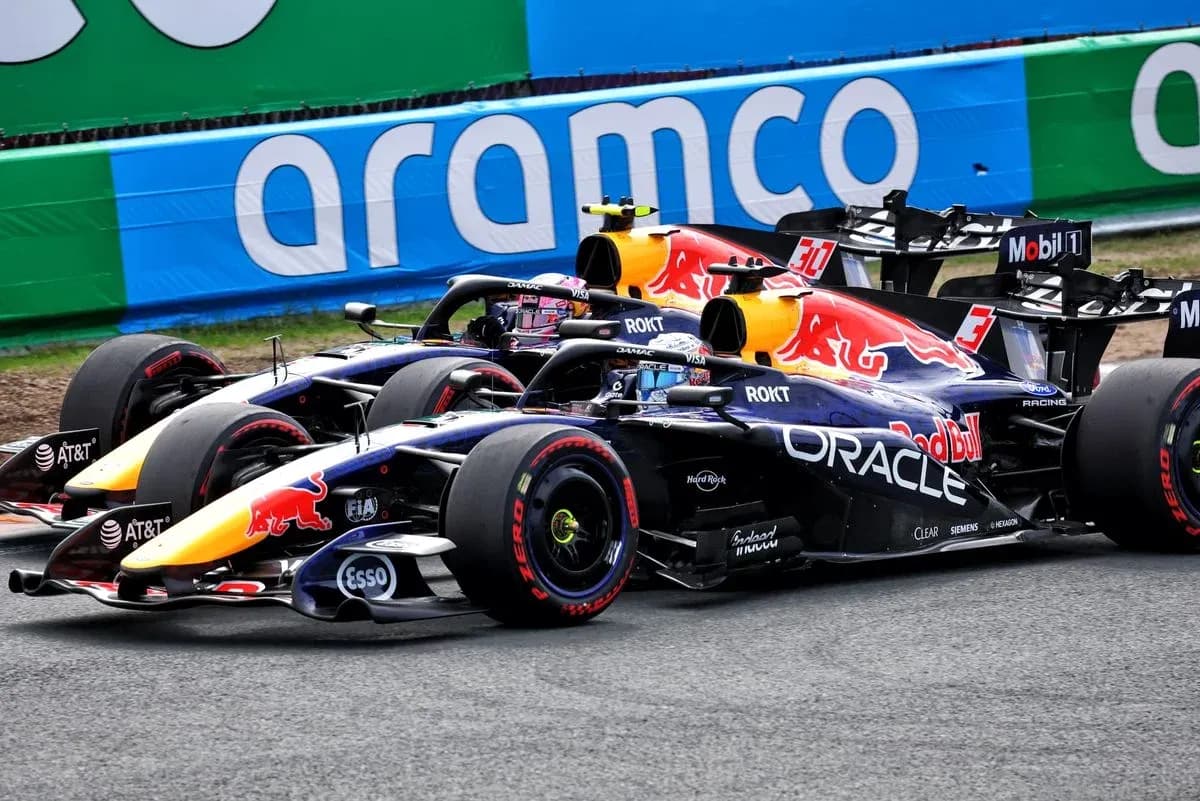
In the three races Hadjar missed, Verstappen’s average exploded to 12 points per race, even with a crash at Zandvoort in the middle of it. Podiums at Monza and the Madring showed a car – and a driver – pushing back towards the sharp end. Lawson, dropped into the deep end, could only manage 4.7 points per race in that spell.
So Hadjar doesn’t just have to get back to where he was. He has to be better. This is a triple-header, physically brutal and mentally draining, a direct examination of his rehabilitation, his race sharpness, and his ability to instantly operate at Verstappen’s tempo in a car that has moved on without him.
If he doesn’t, Red Bull will have backed the wrong horse for the final phase of the season. And that’s exactly the kind of misstep this organisation has built its reputation on avoiding.
Lawson shows he really can carry a team
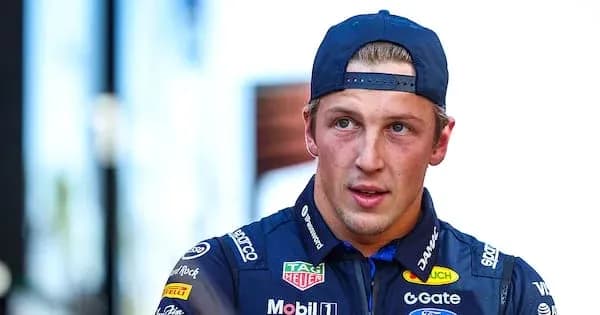
Lawson’s stock inside Red Bull was already strong before the break. A consistent first half of the season with Racing Bulls had made him the leading points scorer outside the top four teams. He’d become the benchmark midfielder.
There was noise around Nikola Tsolov and his standout Formula 2 form, but those closest to Lawson spoke of a different driver this year. A step change in approach over the winter. More authority in debriefs. A willingness to grind through regulations he didn’t like – he’s no fan of the 2026 rule set – to squeeze more from the car.
His engineering group in particular loved how he’d unearthed clever energy-management tricks that nudged Racing Bulls forward. The mood was clear: keep Lawson with Arvid Lindblad, don’t mess with a line-up that works.
Then Red Bull called.
The second chance in the senior team, longer than his first and under more pressure, gave Lawson the opportunity to erase the memory of his fraught 2025 stint. He settled into a tricky car quickly and did exactly what the team needed: twice in the points, never lost, never overwhelmed.
Monza was the toughest weekend, but it was always likely to be. An engine penalty dumped him at the back and turned Sunday into damage limitation. Even so, he stayed within the frame of respectability.
Did he do enough to rip up Red Bull’s plans and convince them he should be Verstappen’s long-term team-mate? No. Verstappen’s peaks in this car demand something extraordinary, and Lawson’s run, while good, wasn’t that.
But for Racing Bulls? For a team intent on leading the midfield? He showed he is precisely the kind of driver you want: fast, disciplined, adaptable, and increasingly influential behind the scenes. That’s how you build a project – and how you stay in Formula 1.
Tsunoda reminds everyone what he is
Yuki Tsunoda’s three-race cameo was short, sharp, and very on-brand.
Drop him into the 2026 Racing Bulls at Zandvoort, and he’s immediately there. He qualified just a tenth slower than Lindblad despite jumping into unfamiliar machinery. No drama, just pace.
At Monza, he stumbled in Q1, then made up for it in the race. A scruffy grid slot, some questionable positioning that Audi is still trying to weaponise in an effort to strip him of the point he scored, but when the chequered flag fell he’d delivered. One point on the board. Job done.
Madrid was the one that got away. Damage ruined his race and any chance of repeating the feat, but the broader picture was already clear. Tsunoda remains what his four full seasons at Red Bull’s second team suggested: a reliable points scorer when the car is good enough.
He’s quick to adapt. He’ll get you on the board. He won’t, on this evidence, suddenly force a political crisis higher up the food chain with eye-popping drives that scream “this guy cannot be left on the sidelines”.
His own verdict summed it up: “I gave it my all and there’s nothing to regret.”
If this really is the end of a 114-race F1 career, it’s a far more dignified closing chapter than being pummelled alongside Verstappen, lap after lap, in equal machinery. He walks away, if he walks away, as a dependable operator who did not let the level drop when the phone rang.
Lindblad quietly grabs the wheel at Racing Bulls
Arvid Lindblad entered the year as the only rookie on the grid. He’s now something more than that.
The Lawson–Lindblad partnership has underpinned Racing Bulls’ season. Their combined consistency is a major reason the team still leads Alpine in the constructors’ standings. That’s not a coincidence; it’s the product of two drivers hitting a similar level most weekends.
This three-race stretch, though, asked a different question of Lindblad. With Tsunoda parachuted in and adapting quickly, Racing Bulls needed its regular driver to lead. To be the reference, not just the rookie with promise.
He delivered.
At Monza, his pace allowed him to beat an Alpine he had no real business beating on paper, even if Franco Colapinto’s self-induced chaos helped. At the Madring, his weekend was imperfect, but he still brought home two points – the kind of quiet, unspectacular return that wins midfield battles over a season.
Zandvoort could have been better on paper, but the story is in the detail. A harsh in-race penalty dumped him out of contention, yet his presence in the pack disrupted Pierre Gasly’s race and limited Alpine’s haul. That, in turn, gave Tsunoda the best possible shot at scoring.
Seven consecutive Q3 appearances now sit on his CV. Racing Bulls still has daylight over Alpine in the standings. And all of this from a driver who is only 19.
People at Red Bull notice those things. They notice when a rookie stops looking like a rookie and starts quietly steering a team’s campaign. The question now is simple: has the balance of power at Racing Bulls shifted permanently in Lindblad’s favour?
Verstappen wants a wingman – Hadjar must be it
Max Verstappen has always cared deeply about who sits on the other side of the garage. Not for the sake of camaraderie, but for what it means for his own chances.
When Red Bull fights at the front against Mercedes, Ferrari and McLaren, it cannot afford to be a one-car operation. Those rivals can usually count on both drivers. Verstappen needs the same.
Lawson, for all the caveats, never finished within a minute of the race winner during his Red Bull outings. Circumstances explain some of that, but the effect is the same: Verstappen was often fighting alone, even if he was the one who exited spectacularly at Zandvoort.
A fully fit, fully sharp Hadjar changes that equation.
If he comes back at his best, he becomes a genuine factor in race outcomes at the front. He can take points off rivals, open up strategic options, and help drag Red Bull away from the uncomfortable reality of sitting fourth in the constructors’ championship.
There’s another layer, too. Hadjar has missed three races and spent two months on the sidelines. If he returns instantly at a high level, it hands Verstappen fresh ammunition in his long-running argument that the 2026 cars don’t punish drivers enough physically. Turn up cold, score big, and the narrative writes itself.
What happens next is on Hadjar. The car is better. Verstappen has raised the bar. Lawson, Tsunoda and Lindblad have all strengthened their cases.
Now the driver who started this season as Red Bull’s big new bet has to prove he can rise with the tide – not get swept away by it.