Max Verstappen and the Legacy of Robert Kubica
Max Verstappen doesn’t hand out compliments lightly. So when the triple world champion pauses in the middle of a title defence to talk about Robert Kubica, people in the paddock listen.
The Dutchman’s admiration is rooted in something every driver fears: the career-ending crash that doesn’t quite end the career.
Kubica’s life changed in 2011 in a rally accident that left him with severe arm injuries and, in reality, tore up the script that had him marked down as a future Formula 1 race winner, perhaps more. Fourteen years later, he is back on the top step of one of motorsport’s greatest podiums, having conquered the 2025 Le Mans 24 Hours in the #83 AF Corse Ferrari Hypercar alongside Yifei Ye and Phil Hanson.
“It’s special,” Verstappen said. “Robert was a fantastic driver, and of course he still is. He had an enormous amount of talent. If you ask anyone here in the paddock, or people who used to race against him, I think everyone will say he was destined to achieve much more in Formula 1. Unfortunately, then that accident happened.”
The respect runs deep. Drivers remember. They remember the raw speed at BMW Sauber, the audacious wins that never quite came, and the sense that F1 lost something the day Kubica’s rally car hit that barrier. His Le Mans victory, long after many had quietly filed his name under “what might have been”, has clearly struck a chord with the man currently defining this era of Grand Prix racing.
Norris wrestling with a different McLaren
While Verstappen reflects on a career rebuilt, Lando Norris is busy adapting to a car that feels like it’s been rebuilt from the ground up.
The McLaren driver has been blunt: this year’s machine is nothing like the one he fought with last season.
“I certainly think this year’s car is different to last year by quite a long way, and again, you have to adapt to that,” he said. The Englishman has spent the opening phase of the campaign recalibrating his instincts, trying to work out where the car wants to be driven rather than where he feels it should be.
He still believes the McLaren DNA is unique. Odd, even.
“Everyone who’s driven a McLaren has said how odd and unique a McLaren is to drive,” Norris explained. Several drivers who have sampled other machinery have echoed that sentiment, and Norris is living it again in 2025. “You have to drive it in a very different way, and there’s a lot of things I’ve had to adapt to at the beginning of the year to understand this year’s car.”
Is it a McLaren quirk or just the nature of this generation of cars? Norris isn’t sure. What he is sure about is that the learning curve has been steep.
McLaren are not waiting for the driver to simply catch up. Baku will bring what the team describe as their most significant upgrade of the season: a new floor, revised aero surfaces and, making a return, the rotating “Macarena” H-wing.
The car has struggled in fast corners, bleeding lap time where rivals look planted. The new floor is designed to claw that back, with the H-wing reintroduced in a new specification after being removed in Madrid when it didn’t suit the required downforce level. It is a bold tweak on a bold concept, and on the streets of Baku, with its long straights and fiddly middle sector, McLaren will find out quickly whether the gamble pays off.
Red Bull play the long game with Hadjar
At Red Bull, the focus is on a different kind of adaptation: healing.
Isack Hadjar is back. The Frenchman, who impressed in his rookie season and has already stood on the podium alongside Verstappen, returns to his seat for the Azerbaijan Grand Prix after recovering from a wrist injury.
Red Bull boss Laurent Mekies has been adamant for weeks that they would not rush him. The lesson is fresh in F1’s collective memory. Lance Stroll famously dragged his broken wrist to sixth place just two weeks after his 2023 pre-season crash, but paid for it with chronic pain, a second corrective surgery and a missed race later in the year.
That caution framed Red Bull’s handling of Hadjar. His career is on an upward trajectory; there was no appetite to jeopardise that for the sake of a single race weekend.
The team’s statement was clear and measured: “Oracle Red Bull Racing is delighted to welcome Isack back this weekend. Having made a successful recovery from his wrist injury, Isack will return to action at the Baku City Circuit on Thursday.”
The message also carried a nod of appreciation to the man who has been holding the fort.
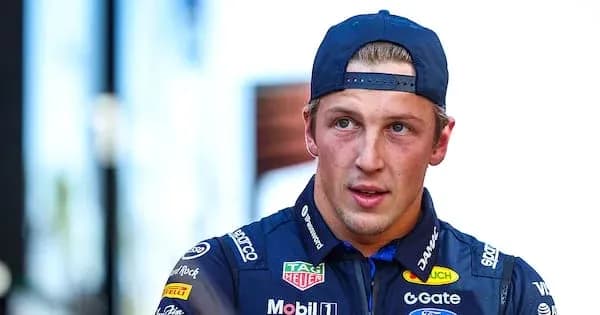
“The team would like to sincerely thank Liam for his professionalism, dedication and hard work over the past three races. Stepping in under challenging circumstances, he delivered some impressive performances and made a valuable contribution to the Team. We wish him all the very best as he returns to Visa Cash App Racing Bulls.”
Hadjar now returns with medical clearance to withstand the brutal loads that go through a driver’s wrist at 200mph, especially on a street circuit lined with concrete and compromise. Red Bull have taken the short-term hit in the belief that both driver and team will be stronger for it in the long run.
Lawson caught in the crossfire
Not everyone has been so generous in their assessment of Liam Lawson.
Nico Rosberg, never shy with an opinion since swapping the cockpit for the TV gantry, has questioned whether any of Red Bull’s current or recent options are truly worthy of being Verstappen’s long-term team-mate. Speaking to Sky F1, the 2016 world champion framed the challenge in stark terms.
“They do need to decide at some point,” he said. “The thing for Red Bull, though, is they’re looking for the next Max Verstappen and the next Sebastian Vettel. Everything else is just not good enough. At the moment, I’m not sure that Liam Lawson would be considered at that level with what he’s been producing so far. With [Arvid] Lindblad and also [Isack] Hadjar, it’s still possible in the discussions for them.”
Those comments cut across Lawson’s recent body of work. The Kiwi stepped into Hadjar’s car in difficult circumstances, taking sixth in Spain and 14th at Monza. The results do not tell the full story, and Mekies was quick to push back on the criticism.
“I think he’s done a very good job,” the Red Bull team principal said. “I think we all know how difficult it is to jump to a different team, to a different car, and I think that he has done that to the best of what could have been our expectations.
“He has taken some very important points today with the P6. He did the same in Zandvoort and in Monza he would have done something similar without the contact with Nico [Hulkenberg] and the front wing damage.
“So, I think he did a very good job, again very different pictures compared to the first two races of 2025 when he was in the team so we are thankful and happy with that.”
Red Bull’s search for the “next Max” remains the defining subplot of the driver market. Lawson, Hadjar and Lindblad are all in the frame, all under the microscope, and all being judged against a standard that only a handful of drivers in history have ever met.
FIA tears up the stopwatch
While teams juggle drivers, upgrades and expectations, the rule-makers are quietly redrawing the shape of a Grand Prix.
The FIA has confirmed a series of significant changes for next season after the latest F1 Commission meeting, tweaks that will alter how races feel and unfold.
The long-standing rule that a race must be completed within a maximum two-hour window, inside a three-hour total period, will be scrapped. That gives race control more room to breathe when interruptions, red flags or heavy rain disrupt the running, and should reduce the rush to squeeze a full-distance race into a rigid time box.
There is a twist, though. The standard race distance will be cut from 305km to 290km, with the Monaco Grand Prix remaining at its traditional 260km. On paper, that means slightly shorter races, but more flexibility in how they are managed.
The change links directly to the previously agreed power unit structure for next year. The 2026 regulations came under heavy fire from teams and drivers, who feared cars would be forced to lift and coast excessively to manage energy. The revised distance and rules are designed to let drivers attack more, more often, with the FIA believing it will allow full-throttle running over a greater portion of each lap.
Gearbox homologation will also be removed, a notable shift in philosophy. The Sporting Advisory Committee has framed it as a move to “preserve supplier development freedom”, opening the door for manufacturers to keep refining their gearboxes rather than being locked into a frozen design.
From Kubica’s long road back to glory, to Norris wrestling with a wayward McLaren, to Hadjar’s carefully managed return and Lawson’s trial by opinion, the sport is in a restless, transitional mood. The cars are changing. The rules are changing. The pecking order is shifting.
The only question now is who adapts fastest.