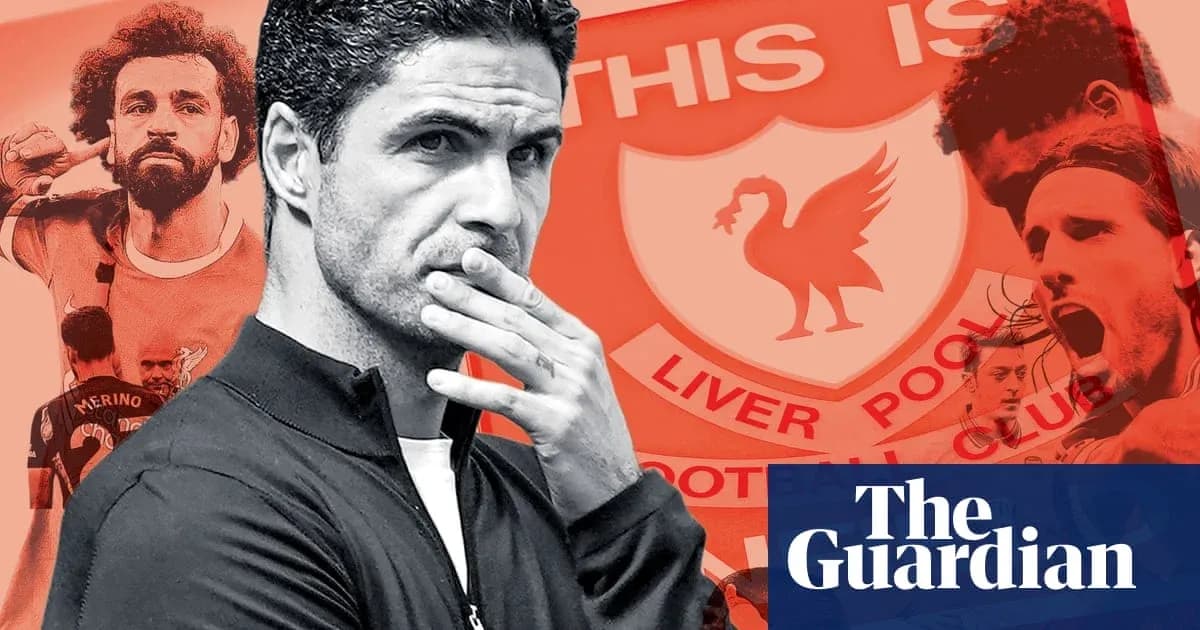
Mikel Arteta's Anfield Challenge: Overcoming History and Doubts
Mikel Arteta has a word for what Anfield can do to a footballer: bajar.
He borrowed it from cycling. You’re climbing, flying, feeling untouchable – and then, in a single kilometre, your legs go. “Boom.” Everything turns. In Amazon’s All or Nothing, he admitted that only once in his career did a game simply rush past him, red shirts everywhere, no response in his body. It was at Anfield.
On Sunday he goes back again, carrying all of that history with him, and faces a childhood friend in the opposite dugout. Andoni Iraola will be on the Liverpool touchline, still bedding in his ideas, still shaping a side that has started to find a rhythm. Arteta arrives five days after being knocked out of the Carabao Cup by Fleetwood, a club 84 places below Arsenal in the pyramid. The word bajar hangs in the air again, but for very different reasons.
A ground that never forgets
Arteta’s relationship with Anfield is complicated. He finally won there as a player in September 2012 with Arsenal, ending a wretched personal run that included five failed Merseyside derbies in Everton blue. Yet even that victory sent him to hospital, concussed after a collision with Jordan Henderson in what he has since called “the biggest fear of my life”.
He returned six months later in the same colours and won again, Lukas Podolski and Santi Cazorla scoring in a 2-0 triumph. That was the last time Arsenal took three league points away from Anfield. Thirteen Premier League visits have come and gone since without a win, a run that matches the club’s worst at Liverpool. The only success in that time came in the League Cup in 2020, on penalties, in Arteta’s second visit as manager.
No wonder he has tried everything. In November 2021, he pumped “You’ll Never Walk Alone” through the training ground speakers to simulate the Anfield noise. Liverpool responded with a 4-0 reminder that the real thing is different. Last season’s defeat, sealed by Dominik Szoboszlai’s late free-kick after three successive draws in this fixture, brought a different kind of criticism. Arteta was accused of caution without conviction, of failing to release the handbrake, having started Mikel Merino as a No 10. Gary Neville went so far as to say Arsenal lacked “the mentality to go and win big matches at big away grounds”.
That accusation bites because it is not confined to Anfield. Arsenal have not beaten Manchester City in the league at the Etihad since 2015, in Arsène Wenger’s final great away performance in that stadium. For all the progress under Arteta, that charge of coming up short at the most hostile venues still lingers.
Fleetwood, frailties and a bruised squad
The Fleetwood defeat did not help. Arsenal left a stadium that holds fewer than 6,000 people having been taken to penalties and then dumped out of a competition that had already stretched them in recent seasons, with a semi-final and a final appearance in the last two years. They flew back to London with the shootout still fresh in the mind, a grim echo of May’s Champions League final loss to Paris Saint-Germain.
Arteta’s team selection on the Lancashire coast told its own story. Kai Havertz and Viktor Gyökeres started together up front, a surprise pairing that looked like an attempt to shield Martin Ødegaard and spread the attacking burden. Neither forward convinced. Both looked short of rhythm and confidence at exactly the wrong time.
The injury list adds to the unease. Bukayo Saka is out with a thigh problem. Noni Madueke’s ankle is a concern. The failed appeal over Max Dowman’s red card has removed the teenager from contention for three matches. Options are thinning just as the fixtures harden.
So the temptation is obvious. Strip the plan back. Do what this Arsenal side do best.
Echoes of 1989
Arteta’s best route to victory at Anfield may not be through front-foot bravado, but through the controlled, meticulous football that underpinned last season’s title win. There is a template in the club’s own history, and it leads straight back to this ground.
Thirty-seven years ago, George Graham took Arsenal to Anfield needing a 2-0 win to snatch the title from Liverpool on the final night of the 1988‑89 season. The narrative then, as now, said they would have to storm the place, attack from the first whistle, take risks. Graham refused.
“I told my players to keep things tight in the first half – it was imperative we did not concede,” he recalled on the 20th anniversary of that night. The newspapers wanted chaos. He wanted control. “If Liverpool had scored an early goal it would have been over. But they did very little attacking and played into our hands.”
They know how that story ends: Michael Thomas surging through in stoppage time, the finish, the title, the end of an 18-year wait. It was the ultimate reward for discipline.
That night had a deeper layer. Before kick-off, Arsenal’s players ran to all four corners of Anfield, handing flowers to Liverpool supporters in a gesture of solidarity after the Hillsborough disaster the previous month. The idea came from Ken Friar, the long-serving Arsenal director who died this month, and it remains one of the most poignant acts of respect between two great clubs.
Arteta and Graham: kindred minds
Graham and Arteta were both 44 when they lifted their first league titles with Arsenal. Both played in midfield, both carried an obsession with shape and defensive detail into the dugout. “1-0 to the Arsenal” became Graham’s calling card, particularly in the later years of his reign, and Arteta has quietly revived that habit. Since he took over in December 2019, Arsenal have won 1-0 in the Premier League 32 times – more often than any side except Everton.
The current team gave a small reminder of that last weekend. A routine 2-0 win over Everton brought their first set-piece goal of the season, a curious delay for a side usually so well-drilled on dead balls. It may prove timely. Liverpool under Iraola have shown vulnerability from set plays, and Anfield can be turned by a corner or a free-kick as quickly as by a sweeping move from open play.
Arteta knows the value of that platform. “Collectively, we acknowledge the importance of defending,” he said last year when the comparisons with Graham began to surface. “We know that if we excel in that part of the game, the chances and the probabilities to win more matches is going to be very, very high.” It is not romance. It is arithmetic.
The next Anfield chapter
So he arrives at Anfield again, carrying scars as a player, doubts as a manager and the fresh sting of Fleetwood. The easy narrative says the stadium will swallow Arsenal once more, that the red shirts will start to fly and the word bajar will creep back into his mind.
Yet the other story is right there in the club’s past: a manager of similar age, with similar instincts, walking into the same arena, ignoring the noise and trusting his structure.
Arteta does not need a replica of 1989. He just needs his own version of it – his own tight first half, his own moment when Liverpool “do very little attacking and play into our hands”, his own cold, controlled performance that answers Neville’s accusation in the most unforgiving of away grounds.
On Sunday, we find out whether this Arsenal are ready to stop surviving Anfield and start imposing themselves on it.