Formula 1 Returns to Madrid: A New Era Begins
Madrid has never lacked for spectacle.
Fifteen European Cups, 36 La Liga titles, and a rolling cast of Galacticos have seen to that. On most weekends, the Bernabeu is the city’s beating heart, a towering steel amphitheatre where Jude Bellingham, Kylian Mbappé and their predecessors have turned drama into routine.
Now Formula 1 wants a slice of that stage.
For the first time since 1981, a grand prix returns to Madrid. Not to the old Jarama circuit, and not to some picturesque ribbon of tarmac winding past palaces and plazas, but to a purpose-built street track on the edge of the city, in the shadow of the airport and the Ifema expo halls.
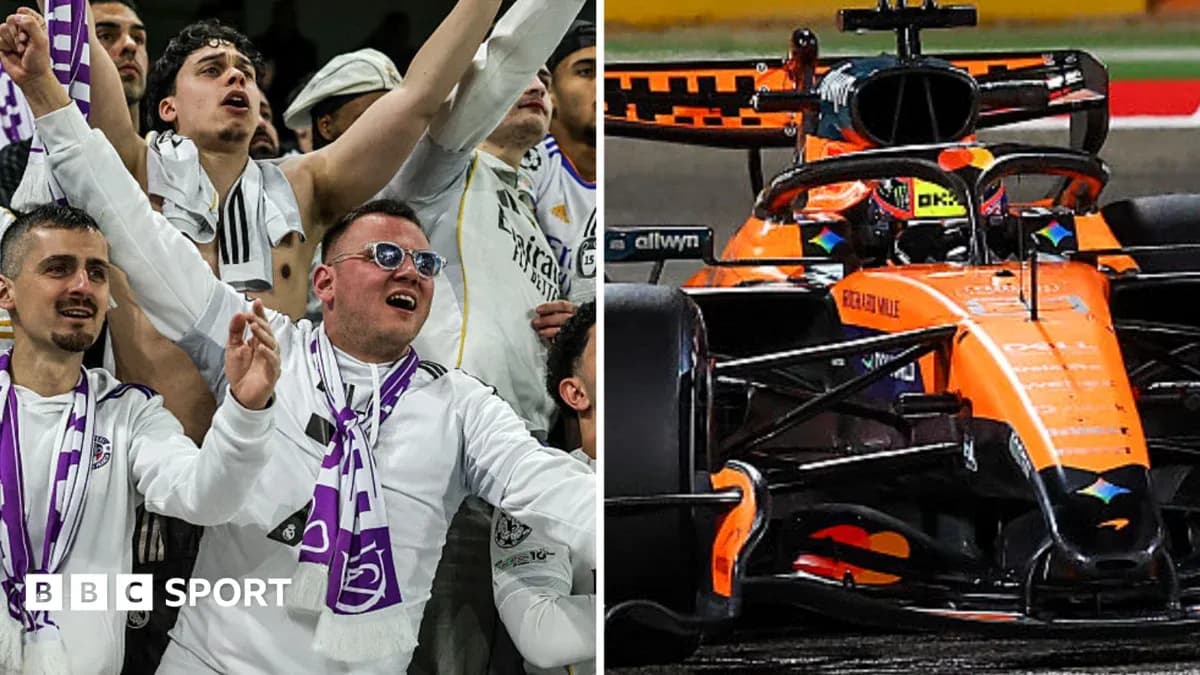
On paper, it is a bold move. In reality, it is a direct challenge: can F1 command attention in a city already intoxicated by football?
A city that already has everything
Real Madrid are widely regarded as the greatest club side the sport has produced. Their museum is a gallery of trophies; their history, a catalogue of superstars. Zinedine Zidane, Ronaldo, the original Galacticos, gave way to a new generation led now by Bellingham and Mbappé.
At the end of August, 75,000 Madridistas roared Mbappé’s deft volley into the Malaga net to make it 3-0 inside half an hour. The Bernabeu shook. Atletico Madrid, snarling away across the city, are never far behind in La Liga’s title race. The capital is spoiled, gorging on high-stakes football every few days.
So what, exactly, is missing?
That’s the question Formula 1 is trying to answer. Just a few kilometres from the Bernabeu and the more modest but atmospheric home of Real Madrid’s women’s team, a new soundtrack is about to cut across the city: the scream of hybrid engines and the clatter of wheel-to-wheel combat.
On the streets, the reaction is not hostility. It’s curiosity.
“Yes, [the F1 race] is good for Madrid,” says one fan. “There is pride in our sport, Madrid is an open city with open people and open minds. The race can [take] Madrid's [identity] outside of football… But I'm more than excited… I'm curious – I want to see how it goes.”
Another supporter has long wanted F1 to come closer to home. “We’ve always been dreaming of having something [from F1] closer to home. Having it back is great. I’ve been to Barcelona and the Belgian GP and I think let’s see how it goes. Organising tends to be messy in the first year – I don’t want to be the guinea pig.
“Let’s hope it brings the city more into the spotlight. Madrid has a lot to learn from F1 about how to run a global spectacle; F1 could probably learn the true Spanish way. Barcelona is more international, the drivers and fans coming to Madrid will get more of a taste of Spain.”
The message is clear: the appetite is there, but so is the scrutiny. In a city that prides itself on doing big nights better than anyone, F1 cannot afford to feel small.
From fantasy to 10-year reality
Walk through central Madrid and the city’s confidence is everywhere. The Prado houses masterpieces. Crossing signals chirp like birds. Mexican conifers sway above the traffic, framed by grand Palaciosian facades. It is a city that knows how to look good.
But that elegance doesn’t automatically translate into a good race track. Narrow streets, flat grids and tight corners might charm tourists, not 200mph cars. So the organisers went elsewhere.
They chose Ifema, an expo complex on the city’s edge, often dismissed as functional and unloved. For Luis Garcia Abad, boss of Madring and former manager to Spain’s only world champion, Fernando Alonso, the project began as little more than a daydream.
“It started as a joke, it was a fantasy,” he says. “An F1 grand prix is like a unicorn – you are trying always to see the unicorn but at the end you realise [sometimes] it's impossible.
“The queue of cities trying to organise an F1 GP is huge. They have to choose right – we signed a contract for 10 years.
“Maybe seven or eight years ago we talked about this race. At some point Ifema called me and said ‘what are you thinking [about its viability]?’ After one morning [here] I said: ‘It’s possible.’”
Possible, but not easy. Madrid is compact by capital-city standards, and its public transport is efficient. That gave the organisers a weapon: they could strip away car parks and push fans onto trains and metros, cutting down on private traffic. The VIPs, of course, will glide in and out of their own secluded spaces, far from the platforms of Avenida de America.
The rest of the crowd will pour in on foot and by rail. What they find when they arrive is the real gamble.
Monumental: Madrid’s statement corner
Abad talks about “a real experience, not just to be in Madrid but for F1. Every part of the track has its own personality. Monumental… Turn 12, is huge, amazing.
“We really wanted to have an iconic part of the circuit – more than 30,000 people around one corner.”
Monumental is the corner everyone in the paddock is whispering about. A 26-degree banked curve, longer than the famous turn at Zandvoort, it slices through what will feel like a self-contained town on race day. It is theatre built in asphalt and steel.
Above it, a VIP area sits like a citadel. Organisers joke it could easily house the King of Spain and his family. In the searing 44C heat that hit during construction, just walking up the structure felt like a test; sitting on it, impossible.
“Luis wanted to think of something recognisable in our circuit. Something iconic,” says Carlos Jimenez, operations director for Ifema.
Monumental is the headline act, but it is not the only technical headache the build team faced. Jimenez insists the venue has sustainability at its core: renewable energy powers the race, and existing buildings are woven into the layout. Even so, the numbers are eye-catching. Around 65m euros have gone into additional construction around the site; the track itself has swallowed 85m euros.
“There were a lot of challenges,” Jimenez says. “We started building it in the wettest winter in 20 years in Spain. The rain was torrential. We suffered a lot, and had to stabilise parts of clay which behaves badly with wet conditions. It was very challenging. There are three layers of asphalt here. We learnt from one layer to the next.
“In 2022 it seemed like a little bit of a crazy idea. But Madrid has momentum right now; it's a vibrant city, very well known for football.
“Like a ski resort must have entertainment for apres-ski, a circuit must have good after-race entertainment. Madrid will become in top position – the offer of this city is incredible in terms of gastronomy, a spectacular climate, which is very mild in September. And the party in Madrid is unbeatable.”
That’s the sales pitch: a race that doesn’t end at the chequered flag, but spills into the night, into the tapas bars and terraces that already keep the city awake until dawn.
A street circuit with teeth
Make no mistake, Madring is a street circuit. Part public road, part purpose-built ribbon, it pins the cars between walls that loom over you even when you’re just walking the track. Stand on the racing line and you feel the squeeze. On first glance, overtaking looks like a dare, not a routine move.
“From a driver's point of view it's quite a harsh circuit,” Abad says, sounding almost gleeful. “Twenty-two corners, up and down, banking corners – the circuit is adapted to the new [F1] regulations.
“I spoke with Charles Leclerc and he said it was an amazing track, and in the race I believe you will have the opportunity to overtake, but not by free. We’re talking about gladiators – the best drivers in the world.”
Plenty of those future gladiators have already sampled the place in anger. Formula 3 ran a test here, and the first impressions were striking.
“It’s going to be really edgy,” says Madrid’s own F3 driver Bruno del Pino. “You are always on the limit, the corners are quick and the walls are close. It’s like [Saudi GP circuit] Jeddah but with more difficulty.
“With Monumental, you see so much of an angle it never ends. The first time around, you see it going straight up and you feel like you'll fly straight out [of the track].
“It is flat for us because of the downforce so it’s not really a corner, but the previous combination of Turns 10 and 11 are high speed and close to the wall – quite a few drivers will kiss the wall.”
Britain’s F3 driver Freddie Slater is even more effusive. “A lap of Madrid is so exhilarating, and the adrenaline is pumping – it's an incredible track to drive. It's one of the best tracks on calendar, if not the best.
“It's got character, it's got bumps, uphill and downhill – it's a bit more old-school.”
This is what F1 has been hunting in its new wave of city races: circuits that look spectacular on television but still bite when drivers push too hard. Madring promises both.
Does F1 need Madrid, or Madrid need F1?
Strip away the marketing and the money, and one question lingers over the whole project: who stands to gain more?
Abad has a clear answer.
“Not just Madrid needing F1, maybe even F1 needing Madrid,” he says. “We’re investing money to create an experience inside of a city.
“The future of the [F1] championship is something in this direction – we need to take care of customers and spectators. They are our future.”
In other words, F1 is not just selling speed. It is selling a weekend, a mood, a sense that being in Madrid for a grand prix is as essential as being there for a Champions League semi-final.
The city already knows how to host epic nights. Now the grid will find out whether, amid the roar of the engines and the shadow of the Bernabeu, Madrid can turn a one-off race into a defining stop on the calendar – and whether the sport can match a football culture that rarely settles for second best.