The Madring: F1’s New Bold Circuit in Madrid
Formula 1 rolls into unfamiliar territory this weekend. The Madring, wrapped around the IFEMA Exhibition Centre on the edge of Madrid’s main airport, is the championship’s first brand-new circuit since Las Vegas in 2023 – and it looks nothing like a stopgap street track.
Half the lap may be drawn through public roads, but the other half feels purpose-built. The layout dives and climbs, funnels and opens, with an 8% uphill gradient between Turn 7 and Turn 8 that hits harder in person than any render ever suggested. Drivers have another day before they unleash an F1 car around it, yet the place is already telling its story: this could be a beautiful headache.
La Monumental: the new colosseum
All eyes go to one corner. La Monumental.
The banked, 550-metre-long left-hander has dominated every conversation since the first drawings leaked out. Drivers, engineers and Pirelli have all circled it as one of the most technically demanding challenges on the calendar, the kind of corner that can define a lap and, on the wrong day, ruin a weekend.
Under construction it looked ambitious. Finished, it looks outrageous.
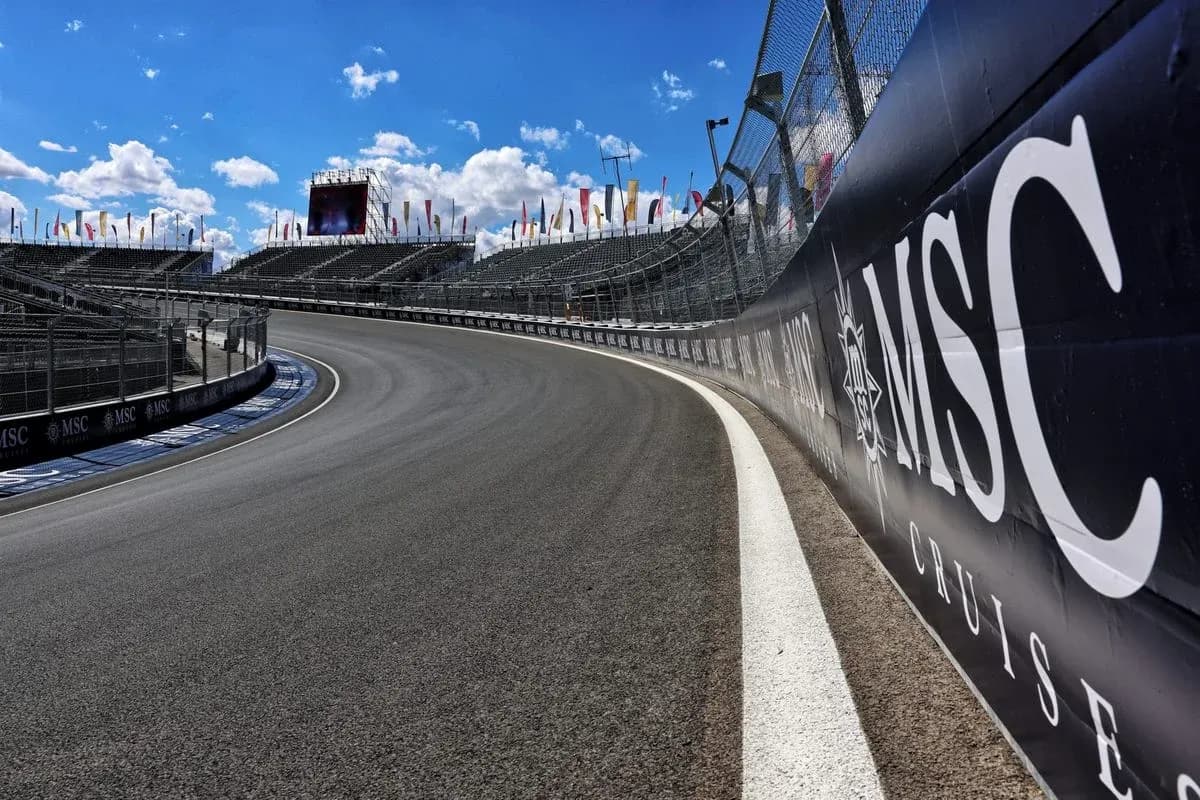
Grandstands tower over the banking, stacked steeply enough to give the place a genuine amphitheatre feel. A vast hospitality complex fills the inside of the turn, enclosing the track and trapping the noise in a way that recalls the claustrophobic intensity of Interlagos’ start-finish straight.
The question now is not whether it’s spectacular. It is. The real intrigue is whether multiple racing lines will emerge across the banking. If they do, La Monumental stops being just a showpiece and becomes a weapon for overtaking.
A chicane with teeth
La Monumental might sell the posters, but Turn 5 is already under suspicion as the corner that bites.
Madring is littered with places that can catch a driver out. The heavy-braking right-hander at Turn 17, approached through a fast left kink, will keep rear tyres and brake temperatures on a knife-edge. Yet the evidence from F3 testing – and the black scars still streaked across the asphalt – points to the Turn 5/6 chicane as the true trouble spot.
It sits at the end of one of the quickest sections of the lap, a long, sweeping blast from Turn 3 that loads the car up and tempts drivers to stay flat for a fraction too long. Then the road snaps tight. The chicane kerbs demand respect, but it’s the barrier angle on exit that really sharpens the risk.
The wall juts in to create a pinch point. Get greedy on the throttle, get nudged wide in combat, or simply misjudge the change of direction, and that exit barrier is waiting. It’s the kind of corner that punishes inches, not metres.
Silky surface, razor edges
For a street circuit, Madring breaks the stereotype. No bone-rattling bumps, no patched-up patches from a rushed resurfacing.
A walk around the track reveals a smooth, uniform asphalt that should let teams run their cars low without fearing surprise undulations. Ride heights won’t need to be a compromise between performance and survival in the way they often are on older city layouts.
The edges, though, are unforgiving in their own way. In many places, the walls draw a clean, hard line between track and error. Where there is runoff, painted kerbs mark the outer limit, and the FIA has added its now-familiar ribbed paint strips – as seen in Jeddah, Miami and Austin – to guide drivers and make track limits a little less subjective.
The surface invites speed. The boundaries will define who dares to use it.
A paddock on a different scale
Away from the racing line, Madring has already disoriented the paddock.
The garages sit inside the IFEMA exhibition complex, and the result is a paddock layout unlike anything else on the calendar. Instead of a single, continuous row of team bays, there’s a 150-metre void in the middle between Williams and Racing Bulls, filled by the media and TV pen.
Behind the garages, the picture becomes even stranger. The transporters and engineering offices are scattered around the exhibition halls, with hospitality pushed off to its own enclave. Some teams have landed the relative luxury of air-conditioned indoor spaces. Others, including McLaren and Mercedes, operate outside in the heat, exposed to the elements in a way their rivals are not.
The gaps between neighbours are comical. Williams and Racing Bulls are normally separated by a few paces in a traditional paddock. Here, walking between them takes more than two minutes. It’s still F1, but on a stretched, distorted canvas.
Pitlane marathon, awkward exit
The peculiar garage layout has another consequence: a mammoth pitlane.
Measured between the two speed-limiter lines, the Madring pitlane runs to 562 metres. That alone makes every stop a strategic commitment. Then comes the exit.
Rather than rejoining at Turn 1, the pitlane feeds the cars back in at Turn 3. Drivers will accelerate hard along a narrow corridor, heading straight towards a right-hand concrete barrier before blending into the racing line. It’s tight, it’s long, and it will demand precision on cold tyres.
Pirelli expects a time loss of around 25 seconds for a full pit visit. The rejoin at Turn 3 helps keep that number from ballooning even further, but it still turns each stop into a high-stakes decision. Strategy calls will carry real weight here; a misjudged stop won’t just cost track position, it could trap a driver in traffic with no quick way back.
A circuit with a point to prove
Madring is not just another dot on the calendar. It’s a statement: a hybrid street track with permanent-circuit ambition, a smooth surface wrapped in concrete walls, a showpiece banking wrapped around a chicane that could define qualifying and the race.
By the time the lights go out, we’ll know whether La Monumental offers the multiple lines everyone hopes for, whether Turn 5 becomes the weekend’s flashpoint, and whether teams can tame that long pitlane without strangling their strategy.
For now, the new Madrid arena sits waiting – smooth, steep, and ready to expose whoever misreads it.