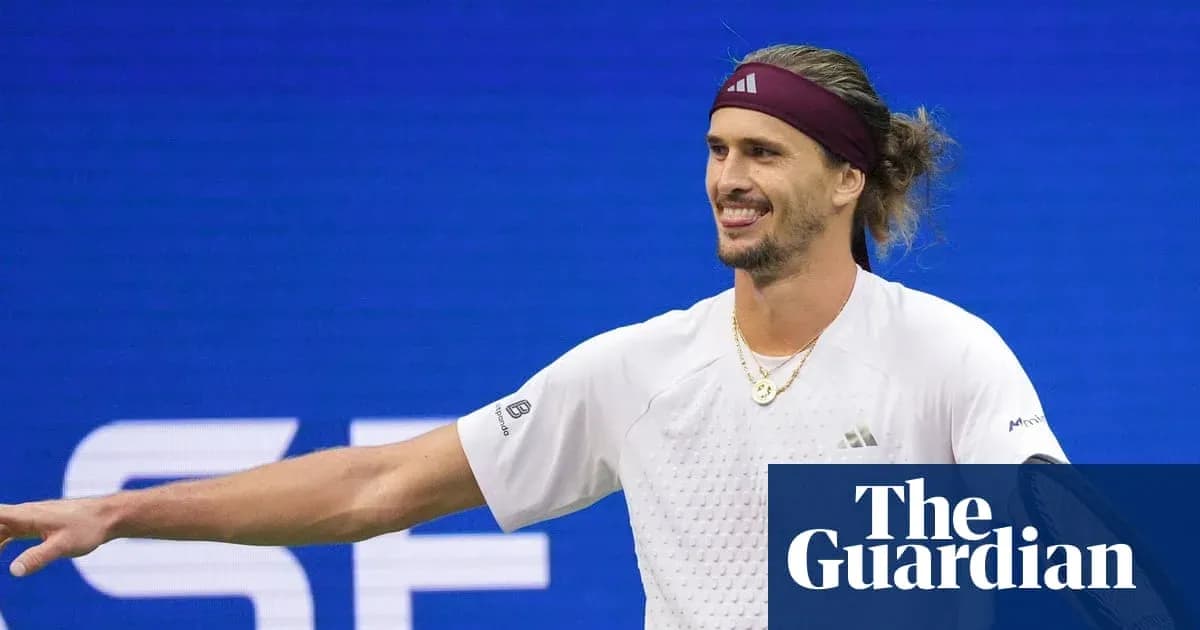
Alexander Zverev Advances to US Open Final with Precision
For 107 largely routine minutes on Arthur Ashe Stadium, a men’s semi-final drifted along without much drama. Then Karen Khachanov finally lit a fuse.
Already a set and a break down, with his long-running rivalry with Alexander Zverev veering towards a one-sided beating, the Russian clawed his way into a second-set tie-break and, at last, dragged some tension into the evening. Serving at 5-6, he ripped a fearless forehand winner to erase Zverev’s first set point. At 6-7, he went even bolder, threading a screaming backhand pass and unleashing a roar that echoed around the half-interested stands.
For a different version of Alexander Zverev, that might have been the moment the doubts flooded in. Not this one.
The Olympic champion has spent this season stacking big wins and hardening his nerve. He steadied himself, shut down Khachanov’s surge and handled that breaker with a cold precision that has become his trademark. Then he did it again in the third. In straight sets – 6-3, 7-6 (7), 7-6 (6) – Zverev moved to within one match of a second grand slam title in his last three majors.
This is now a run with weight behind it. The German has reached three consecutive grand slam finals for the first time in his career: the breakthrough triumph at Roland Garros, the first Wimbledon final of his life, and now another shot at the US Open, the site of one of his most painful defeats.
Four years ago, in a silent, Covid-era Arthur Ashe, Zverev led Dominic Thiem by two sets and served for the title, only to watch it all crumble in a five-set collapse. That night left a scar and a question mark. On Sunday, he walks back into the same arena for his sixth major final with a very different story behind him.
Khachanov, ranked No 50, never came in as a marquee name, but he arrived with a résumé that deserved more respect than the odds suggested. A former world No 8, a Paris Masters champion in 2018, an Olympic silver medallist behind Zverev in Tokyo, and historically a tougher matchup for the German than most: Zverev led their head-to-head 6-3 coming in, but Khachanov had beaten him as recently as last year in Canada.
The gap on paper did not feel like a guarantee. The gap on court did.
Zverev’s serve set the tone and never really dipped. He hit his spots, took control of rallies early and refused to give Khachanov the cheap looks he needed to build momentum. From the baseline, the German’s weight of shot and discipline squeezed the court, forcing the Russian to play closer and closer to the lines.
Khachanov’s forehand could not live with that pressure. The shot that once helped him bully top players instead bled errors, especially when the scoreboard tightened. Late in both the second and third sets, with the chance to tilt the match, that wing repeatedly broke down. Zverev did not have to be spectacular; he just had to be relentless.
This US Open has unfolded with a familiar subplot around him. At Roland Garros, once Jannik Sinner fell early, Carlos Alcaraz pulled out injured and Novak Djokovic’s body betrayed him, the draw seemed to clear for Zverev. The question was whether anyone left could stop his march to the title. In Paris, nobody did.
In New York, the pattern has felt similar. The top half of the draw opened up, and Zverev walked through it with the calm of a man who has learned how to handle expectation. His highest-ranked opponents on the way to the final have been No 22 Luciano Darderi and No 28 Alejandro Tabilo. If he lifts the trophy on Sunday, he will have claimed his first two majors without facing a single top-eight player.
That statistic will fuel arguments. It will not change the fact that a player can only beat whoever stands across the net. After being pushed to five sets in his first two rounds, Zverev has not dropped a set since. He has tightened his game, shortened his matches and conserved energy for the one that really matters.
He will step into that final with a lopsided record in his pocket. Against Ben Shelton and Frances Tiafoe, the two Americans battling for the right to face him, Zverev owns a combined 15-1 head-to-head. The lone defeat came against Tiafoe nine years ago, in a very different phase of both careers.
If the numbers hint at a looming coronation, the atmosphere on Friday told a different story. For a men’s grand slam semi-final featuring the world No 2 and a former semi-finalist, the buzz was strikingly flat. At a tournament where ticket resale prices have been a running controversy, with seats for marquee sessions hitting eye-watering figures, this match cut the other way. On StubHub, you could get in for $21. Hardly the stuff of New York frenzy.
Those who stayed away missed a masterclass more than a classic. Zverev did not need drama to underline his authority. He simply tightened the screws, point by point, until Khachanov’s resistance snapped in two tie-breaks that always felt like they belonged to him.
Now comes the test that really matters: not the quality of his path, not the price of the tickets, but whether the player who once let this title slip from his grasp can walk back into Arthur Ashe and leave with it in his hands.