Alexander Zverev Reaches US Open Final Determined to Win
Alexander Zverev is heading back to the US Open final, and this time he looks like a man determined to finish the job.
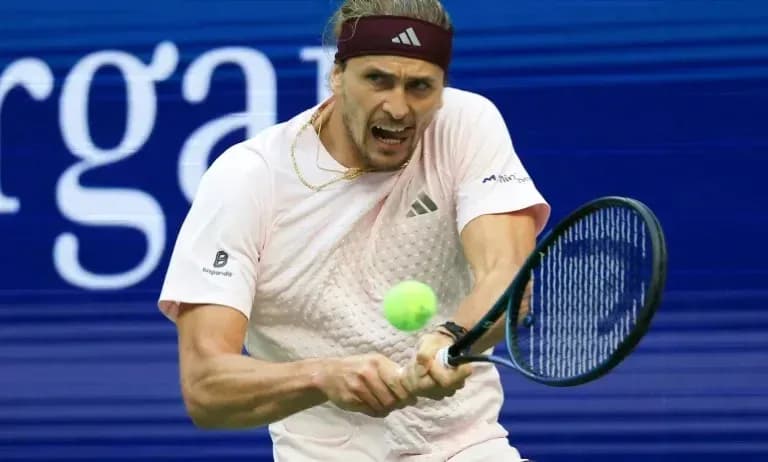
The top seed brushed aside Karen Khachanov in straight sets on Friday, 6-3, 7-6 (9/7), 7-6 (8/6), to reach his third consecutive Grand Slam final and move one win away from a second major title in a season that is rapidly turning into the best of his career.
Zverev finds his hard-court edge
Four years ago, Zverev walked off this court shattered after letting a two-sets-to-love lead slip against Dominic Thiem in the 2020 final. The scars from that night have lingered over every New York campaign since.
This run feels different.
He arrived in New York looking oddly vulnerable, dragged into back-to-back five-set marathons in the opening rounds and spending nine hours and 26 minutes on court just to stay alive. Those early struggles have hardened him. Since then, his tennis has sharpened, his serve has tightened, and his authority has grown with every match.
Against Khachanov, the scoreline said straight sets. The reality was far more brutal.
“It was a straight-set win, but anything but straightforward,” Zverev admitted. “He played incredibly well, fought incredibly well.”
Zverev needed two hours and 57 minutes to subdue the world No. 50, who was trying to become the lowest-ranked Grand Slam finalist since Marcos Baghdatis, then No. 54, at the 2006 Australian Open. The German’s 15 aces and steel in both tiebreaks ultimately made the difference, but Khachanov forced him to earn every inch.
Khachanov pushes back
The first set belonged to Zverev. He imposed his serve early, found rhythm on the backhand, and never allowed Khachanov a foothold. The Russian couldn’t generate a single break point and slipped behind 6-3 without much ceremony.
The match changed in the second.
Zverev grabbed an early break and looked ready to run away with it, only for Khachanov to finally loosen the shoulders. He flashed a passing shot by Zverev to open the fourth game, grinned at last, and then raised his arm to the crowd when a forehand winner handed him his first break chance of the match. Zverev double-faulted, and suddenly the contest had a pulse.
From there, they traded blows, both men holding firm until the tiebreaker. That’s where the tension spiked.
Khachanov saved two set points with a booming forehand and a laser backhand down the line that brought a roar from the crowd. Zverev, though, refused to blink. He steadied, tightened his patterns, and closed out the breaker 9-7, edging two pivotal points that swung the night.
The third set crackled with nervous energy. No breaks. No real daylight for either man. Just heavy serves, short rallies, and the sense that one loose swing might flip the match.
Khachanov struck first in the tiebreak, surging to a 6-4 lead and two set points. The door opened. He couldn’t walk through it. Two forehand errors dragged him back to 6-6, and Zverev pounced. An ace — his 15th — took him to match point, and one last Khachanov forehand flew long.
“Second and third set I think it’s more than obvious that they could have gone both ways,” Zverev said. “I just played a few points better here and there, and I’m happy with the win.”
The margins were thin. The outcome was not.
American dream vs German resolve
Waiting for Zverev on Sunday will be the survivor of an all-American semi-final between Ben Shelton and Frances Tiafoe, a showdown dripping with narrative and history.
Shelton arrives on a surge of adrenaline after toppling defending champion and seven-time Grand Slam winner Carlos Alcaraz in a five-set epic that ended at 3:34 am — the latest finish in US Open history. It was the biggest win of his young career and thrust him to the brink of a first major final.
Tiafoe stands in the same place, chasing his own debut in a Slam title match and the chance to become the man who finally ends a drought that has hung over US men’s tennis for more than two decades. No American man has lifted a Grand Slam trophy since Andy Roddick won this tournament in 2003.
Shelton holds the edge in their head-to-head, but their history in New York is finely balanced. They’ve split two previous US Open meetings: Shelton won their 2023 quarter-final, Tiafoe hit back in the third round a year later. The stakes have never been higher between them.
Zverev knows exactly what he’s walking into: a partisan crowd, a nation desperate for a homegrown champion, and an opponent riding a wave of emotion.
He didn’t shy away from that narrative.
He predicted an “absolutely epic” battle between Shelton and Tiafoe — and then made his own intentions crystal clear.
“Hopefully I can not make the American dream come true on Sunday,” he said, half-smiling, fully serious.
A night with weight beyond tennis
All of this unfolded on a day when the tennis shared the stage with memory.
The tournament marked the 25th anniversary of the September 11 attacks, which brought down the twin towers of the World Trade Center just a few miles from Flushing Meadows. National anthem ceremonies in both the day and night sessions carried a somber tone, a reminder that sport in this city never exists in a vacuum.
The crowd rose, observed, remembered. Then they turned back to the court, where the next generation of champions tried to write something new.
Women’s final set for a clash of power
On Saturday, the women take center stage. Elena Rybakina, representing Kazakhstan, will try to stop Aryna Sabalenka from completing a hat-trick of US Open titles.
Rybakina arrives with fresh authority, having ended Sabalenka’s near two-year reign at No. 1 by reaching the semi-finals. Sabalenka, now chasing a third straight crown in New York, brings the weight of a champion who knows exactly how to close a fortnight here.
Two power players, one throne.
On Sunday, Zverev will walk out with his own mission: to turn a season of near-perfection at the majors — French Open champion, Wimbledon runner-up — into something even bigger, and to silence a stadium desperate to celebrate an American man as Grand Slam champion for the first time in 23 years.
He has been here before. The question now is whether this time, in this city, he can finally rewrite his ending.