2026 FIBA Women's Basketball World Cup: Team USA Prepares for Challenge
The lights go on in Berlin on Friday, and so does the pressure.
In less than 24 hours, the 2026 FIBA Women's Basketball World Cup tips off, and Team USA opens its bid for a fifth straight world title against China (8:15 a.m. ET, TruTV/TNT/HBO Max). The Americans arrive as favorites, as they almost always do, but this time the path looks rougher, the margins thinner, the questions louder.
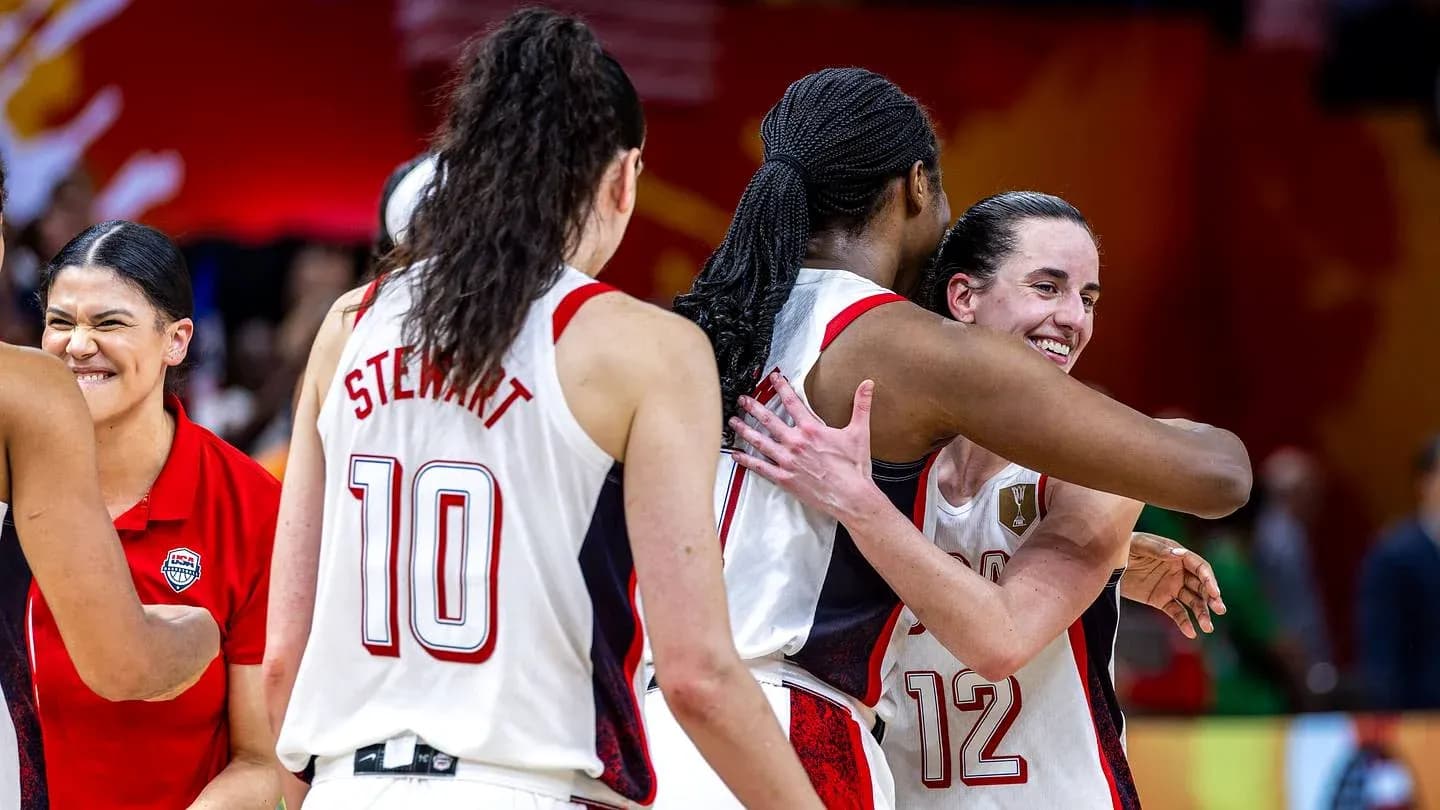
Caitlin Clark, playing in her first senior World Cup, understands the stage.
“Even getting to play here in the World Cup, that's special within itself, too,” she told FIBA. “Sometimes this is an even harder competition than the Olympics… These competitions are only getting harder to win.”
She’s right. The gap is closing. And the U.S. is walking into Berlin without two of its biggest stars.
Life without A’ja Wilson and Kelsey Plum
No A’ja Wilson. No Kelsey Plum. That’s a chunk of scoring, experience and swagger ripped out of Kara Lawson’s rotation before a ball is even tipped.
Wilson, the fulcrum of so many recent USA runs, is out injured. Plum, a relentless scorer and emotional spark, is sidelined as well. Lawson’s first major act at her debut World Cup is not a grand tactical flourish, but a puzzle: how to keep everyone in their natural spots, maintain balance, and still lean on the team’s overwhelming depth.
The solution likely starts with experience at the point and versatility everywhere else.
Chelsea Gray to steady the ship
Chelsea Gray, Las Vegas Aces (PG)
Lawson is expected to hand the keys to Chelsea Gray, the veteran guard whose basketball IQ has long been a cheat code in big moments. Surrounded by a young guard group that has never played a senior World Cup or Olympics, Gray’s presence alone calms the floor.
What remains unknown is volume. How many minutes can she shoulder? How much will Lawson ask of her as the primary organizer?
In March’s FIBA Qualifying Tournament, Gray played limited minutes as the staff evaluated options. Her numbers — 5.6 points and 4.8 assists per game — barely scratch the surface of what she can do when fully empowered. In Berlin, the leash figures to be longer, even if Clark is waiting eagerly behind her.
Jackie Young, the two-way hinge
Jackie Young, Las Vegas Aces (SG)
Jackie Young has never played in a World Cup, but she looks like the obvious choice at shooting guard. She brings something this roster badly needs without Plum: a true two-way wing who can score at all three levels, facilitate, and defend the opponent’s best perimeter threat.
With the 2024 U.S. Olympic team in Paris, Young averaged 9.5 points, 2.3 rebounds, 2.3 assists and tied for the team lead in steals at 1.5 per game. Those numbers hint at her value, but the real story is her versatility. Lawson can slide her across multiple backcourt roles, and the defense rarely suffers.
In a tournament where every possession in the knockout rounds feels like a referendum on focus, Young’s reliability matters.
Napheesa Collier shifts to the wing
Napheesa Collier, Minnesota Lynx (SF)
The frontcourt is where Lawson’s creativity shows most clearly.
Napheesa Collier, a natural power forward, is expected to slide to small forward. It’s a subtle shift on paper. On the floor, it changes everything. Collier’s length, rebounding instincts and scoring touch now live on the wing, giving the U.S. a bigger, more physical look than many opponents can handle.
She’s new to the World Cup stage with the senior team, but not to winning with USA across her chest. Collier owns gold from the 2020 Tokyo Olympics and the 2024 Paris Games, where she averaged 6.7 points, 6.5 rebounds and 1.3 assists. Those are the numbers of a player who does the unglamorous work, then quietly tips a game in her team’s favor.
If she handles the defensive assignments at the three, the U.S. can switch almost everything and smother teams from the perimeter inward.
Breanna Stewart, the anchor with three golds
Breanna Stewart, New York Liberty (PF)
Every World Cup team needs a constant. For the United States, it’s Breanna Stewart.
Lawson will likely start her at power forward, with the option to slide her to center when the game tightens and the possessions shrink. No one on this roster knows this tournament better: Stewart owns three World Cup gold medals and has been the backbone of USA’s frontcourt dominance for a decade.
In 2022, she averaged 12.8 points, 6.6 rebounds, 3.0 assists, 1.3 steals and 1.4 blocks and earned a spot on the All-Star Five. That’s not just production. That’s control — of tempo, of space, of the scoreboard.
With Wilson absent, Stewart becomes the primary paint producer, rim protector and defensive anchor. If she dictates the interior on both ends, the U.S. can still look like the juggernaut everyone expects.
Aliyah Boston steps into the void
Aliyah Boston, Indiana Fever (C)
The biggest change is at center.
Without Wilson, Aliyah Boston is poised to start in the middle. It’s a promotion and a responsibility. Boston’s job is simple to describe and brutal to execute: win her one-on-one matchups, own the glass, and use her agility to punish slower bigs in the paint.
She wasn’t part of the 2026 World Cup Qualifying roster, having withdrawn before that competition, but she did feature in the 2024 Olympic Qualifying team. There, she averaged 5.0 points, 5.5 rebounds, 1.0 steal and 1.0 block in nearly 23 minutes a night.
Those numbers hint at a player ready to scale up. In Berlin, she won’t be a complementary piece. She’ll be the starting five on a team that expects to play for gold.
Firepower off the bench: Clark and Bueckers
The starting five may set the tone, but the bench could decide the tournament.
Caitlin Clark, Indiana Fever (relief of Chelsea Gray)
Clark will almost certainly see heavy minutes behind Gray at point guard. Her skill set is obvious: elite court vision, deep shooting range, and the ability to bend a defense with a single pass or pull-up three.
In March, she dominated the FIBA World Cup qualifying tournament and walked away as MVP, averaging 11.6 points and 6.4 assists. Those numbers came with the ball in her hands, the game on her terms.
In Berlin, Lawson can toggle between Gray’s measured orchestration and Clark’s attacking flair. It’s a luxury most national teams can’t dream of.
Paige Bueckers, Dallas Wings (relief of Jackie Young)
Next to Clark, Paige Bueckers should spell Young on the wing. Her two-way profile mirrors some of what Young brings — scoring, playmaking, defensive grit — and that continuity matters.
When Young sits, the U.S. doesn’t have to reinvent its identity. Bueckers can slot in, keep the ball moving, and chase opposing guards off the three-point line. On a roster where roles need to be clear, hers fits neatly.
Wings and bigs: Copper, Iriafen and Reese
Kahleah Copper, Phoenix Mercury (relief of Napheesa Collier)
Behind Collier, Kahleah Copper offers a different flavor. She’s a straight-line driver, a relentless attacker who can change the rhythm of a game in a single shift. As a one-two punch at the three, Collier and Copper give Lawson the choice between size and physicality or pace and aggression.
Kiki Iriafen, Washington Mystics (relief of Breanna Stewart)
Angel Reese, Atlanta Dream (relief of Aliyah Boston)
Kiki Iriafen and Angel Reese round out a frontcourt rotation that should see plenty of minutes, even if the exact patterns remain unclear.
Iriafen can spell Stewart, keeping the energy high and the interior defense sharp. Reese, listed as Boston’s backup, has already spent time at center this WNBA season as the Dream navigated injuries. That experience matters. She can slide to the five when Lawson wants more mobility or a different rebounding look.
How those minutes are divided is the great unknown. What’s clear is that both will play, both will be asked to impact games, and both give Lawson the flexibility to go big, go fast, or go bruising depending on the opponent.
The United States arrives in Berlin without two of its biggest names, but not without answers. The projected starting five offers experience, length and defensive bite. The bench brings youth, star power and a different kind of chaos.
The gold standard hasn’t changed. The question is whether this new mix can uphold it in a world that’s catching up.