Alex de Minaur's Season Hits Low Point as Sweeny Upsets in New York
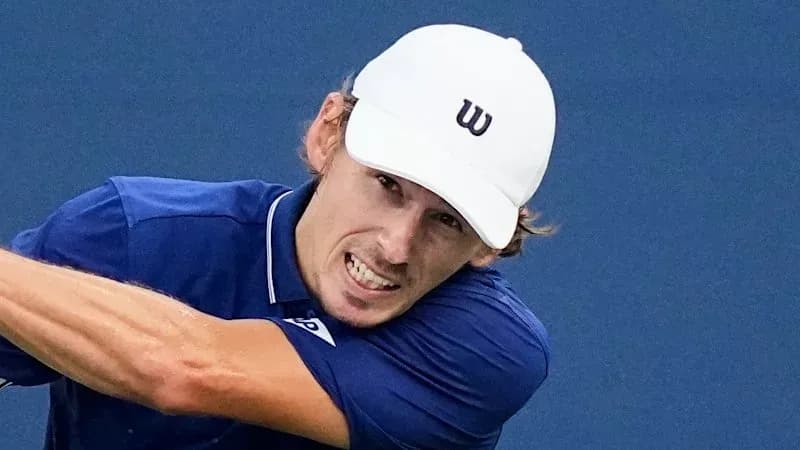
Alex de Minaur walked off Louis Armstrong Stadium with his head down and his season suddenly laid bare. A year that began with a surge into the world’s top 10 has stalled badly, and in New York on Friday it hit its lowest point.
The world No.7 crashed out of the US Open in the second round, beaten 6-4, 7-5, 6-2 by Botic van de Zandschulp, a dangerous floater who has rediscovered his own edge. For de Minaur, it capped his least successful grand slam year in three seasons and left his top-10 ranking on borrowed time.
“My level today wasn’t good enough. It’s pretty straightforward,” he said, not hiding from the reality.
He tried to compete, to scrap, to do all the things that usually make him such a stubborn opponent. The legs were there, the attitude was there. The feel wasn’t.
“I was making a lot of errors, which is not really my normal game style,” he said. “The more I tried, the more intensity, the more fired up I was getting, I just kept on making unforced errors … [it was] a tough day at the office.”
On a day when Australian tennis twisted in every direction at Flushing Meadows, de Minaur’s exit came as wildcard Dane Sweeny produced the win of his life, and as Nick Kyrgios accepted a one-month suspension for out-of-competition cocaine use.
The contrast could not have been sharper.
De Minaur’s slide bites hard
This is not the Alex de Minaur who ripped through the first months of 2026. He reached a second Australian Open quarter-final in January and looked ready to plant himself in the game’s top tier. Since then, the climb has stalled.
He went out in the third round at Roland-Garros, the fourth round at Wimbledon, and now the second round in New York – his earliest US Open exit in five years. Across his past 13 majors, he has fallen this early only twice.
The numbers against van de Zandschulp told the story. Seven double faults, just four aces. Eleven break points faced, five service games lost. A serve that has long been dissected and doubted abandoned him again.
He double-faulted to fall a set and 4-3 behind. A lucky net cord in the next game, when a scrambling backhand dribbled over for a winner, gave him a sniff. He clawed back from 15-40, then surged to 5-4. The door was ajar.
The pressure finally told – on him, not on his opponent.
Serving at 5-5, de Minaur fought through a marathon game, saving four break points before finally yielding on the fifth. Van de Zandschulp apologised after a mishit ball dropped short and dragged the Australian forward, opening up the passing lane. De Minaur still had a play on the point. He didn’t take it.
Two sets down, history glared at him. In 27 previous attempts, he had never overturned a two-set deficit. That record did not budge.
He left the court between sets, tried to reset, tried to swing the momentum with more aggression. Instead, he overcooked a forehand in the third game to surrender serve again. Two break-back chances disappeared in the next game. Van de Zandschulp broke once more and that was that.
For the Dutchman, it was another big New York scalp, two years after he dumped Carlos Alcaraz in this same round. For the Australian, it was a continuation of a worrying trend: since February, he has gone beyond the quarter-finals at any event only once.
The pain has been visible. After his Wimbledon loss to Flavio Cobolli, he admitted that failing to rise on that stage “breaks me inside”. He tried to downplay his emotions after another rough defeat in Washington, but his tennis has not bounced back.
Now his ranking, and the aura that came with his top-10 breakthrough, are under threat.
Sweeny storms into the spotlight
While de Minaur packed his bags, Dane Sweeny finally stepped into the light.
The 170-centimetre battler, ranked 123 in the world, produced a stunning four-set upset of Lorenzo Musetti, winning 3-6, 6-1, 6-2, 6-2 to reach the third round of a grand slam for the first time. It was his maiden victory over a top-20 opponent and it arrived in the most unlikely fashion.
Musetti, a dual grand slam semi-finalist, faded badly after the opening set. He hunched over between points, looked unwell, and took an off-court medical timeout when he fell 3-0 behind in the third. He flickered occasionally, but Sweeny never let him breathe.
Sweeny’s relentless hitting and tireless movement kept Musetti under constant pressure. Each time the Italian snatched back a break, he surrendered it straight away. The fourth set followed the same script: an early Musetti lapse, an immediate Sweeny break, and no way back.
For Sweeny, this is not some overnight miracle. His only previous taste of this level came in January, when Ben Shelton dismissed him in straight sets in the second round of the Australian Open. He has spent years grinding away off Broadway, often far from the main-draw glamour.
He even stepped away from the sport for several months during a form slump two years ago, just as he felt close to cracking the elite. That decision now looks like the turning point.
“That’s the beautiful thing about pursuing something so hard like tennis,” he said. “Tennis can change on the flip of a coin. You’ve just got to keep persevering, and that’s what I did. I wasn’t getting results for a long while, but there’s a law of probability. I knew it was somehow going to swing in my favour if I just kept going, and I did.
“Now I’m here, and it’s the best decision I ever made to come back after that two months.”
He is guaranteed more than $400,000 in prize money and sits at a provisional career-high live ranking of No.109. Next comes another seeded Italian, Luciano Darderi, and another chance to push through a door he has spent years banging on.
“I’m so grateful to be able to even compete in grand slams,” Sweeny said. “The tennis journey is such a rollercoaster … To win, and to get a couple of wins, is awesome.”
He almost didn’t get this chance at all. Sweeny was meant to slog through US Open qualifying, but a string of withdrawals allowed Alexei Popyrin to squeeze directly into the main draw. That move shifted Tennis Australia’s reciprocal wildcard to Sweeny.
He has made every bit of it count. He claimed his first grand slam win outside Melbourne Park when Corentin Moutet retired with an arm injury while trailing 7-6 (7-4), 6-4, 3-0. Then he took down Musetti, twice recovering breaks and immediately breaking back, his intensity never dipping.
For once, the breaks are falling his way. He is not wasting them.
Kyrgios banned, Aussies fall on a chaotic day
While Sweeny celebrated and de Minaur searched for answers, the International Tennis Integrity Agency dropped its own bombshell.
Nick Kyrgios accepted a one-month suspension for out-of-competition cocaine use, reduced from three months after he agreed to enter a treatment program. The ban, which stemmed from a night out before he competed in Mallorca, cost him his prize money and ranking points from that event.
Kyrgios had already apologised publicly, calling it a “huge mistake” and admitting to the ITIA that he used cocaine socially. His suspension officially ended on Thursday, subject to him completing the program.
Former doubles partner and long-time rival Stefanos Tsitsipas, speaking after his first-round win in New York, said the news did not surprise him and that he had been aware of the situation.
On court, the Australian contingent thinned quickly.
Qualifier Tristan Schoolkate briefly threatened to follow Sweeny’s path, snatching the first set from Roland-Garros finalist Cobolli before losing 3-6, 6-3, 6-4, 7-5 to the No.5 seed. Popyrin, who had benefited from those late withdrawals to avoid qualifying, started brightly but faded in a 2-6, 7-6 (7-4), 7-6 (7-3), 6-2 loss to 25th seed Alejandro Tabilo.
Elsewhere, the chaos spread beyond the Australian camp. Third seed Felix Auger-Aliassime departed in four sets to Karen Khachanov on a day that chewed up big names. Coco Gauff, Iga Swiatek, Taylor Fritz and Naomi Osaka all held firm and moved through.
By the end of it, only one Australian remained standing in singles.
Not de Minaur, the top-10 star who began the year as the nation’s standard-bearer. Not Kyrgios, sidelined and in treatment. Not Popyrin, not Schoolkate.
Dane Sweeny, the wildcard who once stepped away from the sport, now carries the flag alone into the second week hunt at Flushing Meadows.
For Australian tennis, the question is no longer who leads today. It’s who will still be standing when this turbulent season finally settles.