Ben Shelton Shocks Carlos Alcaraz in Historic U.S. Open Upset
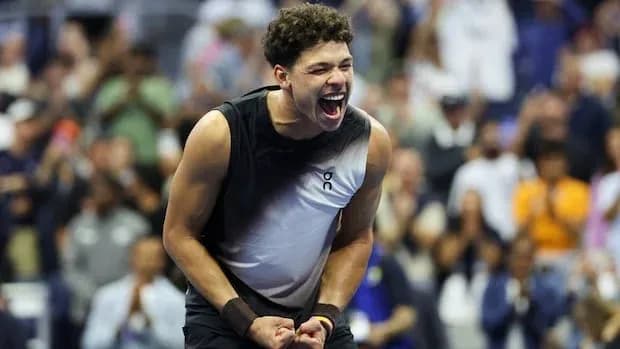
Ben Shelton stood on the baseline at 3:33 a.m., lungs burning, legs heavy, history staring back at him from across the net.
Carlos Alcaraz, the defending U.S. Open champion, bounced on his toes as if the night weren’t already four and a half hours old. One more point. One more swing. One more chance to keep a Grand Slam reign alive.
Shelton ended it with a blur.
A 146 m.p.h. ace tore down the T, a serve so clean that even an Alcaraz with fresh legs and a healthy stomach wouldn’t have touched it. The ball thudded into the back wall, and with it went Alcaraz’s 18-match winning streak at majors and his grip on the trophy in New York.
Final score: 6-7 (5), 6-1, 6-3, 1-6, 7-6 (10-7). Duration: 4 hours, 28 minutes. Time stamp: the latest finish in U.S. Open history.
“It was a war,” Shelton said, drained but almost giddy. “Carlos is one of the greatest champions of our sport. It was the most enjoyable match I've had in my career, for sure.”
A champion pushed to the edge
Alcaraz did not give up his crown quietly.
He arrived in New York with questions hanging over him. He had not played since April because of a right wrist injury. He had started the season by winning the Australian Open, looked ready to dominate again, then disappeared into rehab and recovery.
This was his first tournament back. This was supposed to be a test run.
Instead, it turned into a street fight.
Alcaraz clawed out the opening-set tiebreak, absorbed a nine-game surge from Shelton that ripped the match away in the middle, then forced a deciding set by tearing through the fourth, 6-1. At some point in the chaos, his body rebelled. He vomited before the start of the fifth, then walked back onto Arthur Ashe Stadium and kept swinging.
“I’m leaving happy and my head held high,” he said. “The truth is, I wanted to win … but also our goal was to leave the tournament having played matches and staying healthy.”
He achieved that second part. The first was ripped away by a 21-year-old American who refused to blink.
A New York night that wouldn’t end
The U.S. Open sells itself on its nights. The noise, the celebrity, the late finishes that turn into urban legend. This one went beyond even that.
Thousands refused to leave. At 3 a.m., Arthur Ashe Stadium was still roughly one-third full, a stubborn, hoarse core that had invested too much to walk out. They rode every swing, every challenge, every double fault. They gave Shelton a home-court advantage even against one of the sport’s most beloved stars.
“USA! USA!” rolled around the upper deck. “Ben Shelton!” followed, a chant that grew sharper with every booming serve past 140 m.p.h.
Shelton soaked it up.
“It's incredible,” he said. “I always say that this is the greatest sports city in the world; I say that this is the greatest stadium in the world. I'm just hoping that my best friend and my sister over there don't have to be at work at 6 a.m. in three hours.”
They might have. No one seemed to care. Not in that moment.
This was the same arena where Alcaraz had once written his own late-night epic, beating Jannik Sinner in a 2022 quarterfinal that ended at 2:50 a.m. on his way to his first major title at 19. That match no longer holds the record. Shelton and Alcaraz pushed it 43 minutes further into tomorrow.
The tiebreak that flipped everything
Shelton had seized control earlier in the night by winning nine straight games, turning a set-and-a-break deficit into a stranglehold: from early in the second set to 3-0 in the third. Alcaraz looked rattled. Shelton looked untouchable.
But the Spaniard is built to suffer. He reset, surged again, and dragged the match into a deciding-set tiebreak.
There, the script seemed ready to repeat. Alcaraz ran off four straight points and surged ahead 5-3, the kind of moment when champions usually slam the door.
Shelton refused to let him.
He leaned on the shot that has already become his calling card: that monstrous lefty serve. He hammered his way back into the breaker, backed by the crowd and helped by a handful of uncharacteristic errors from Alcaraz. One forehand flew. A backhand clipped the tape. The tension shifted.
Shelton pounced. At 9-7, with two match points in hand, he uncorked that final 146 m.p.h. ace, a finishing touch that felt less like a kid’s breakthrough and more like a statement.
The defending champion was out. The American summer had a new leading man.
Tiafoe’s great escape
Shelton’s reward is a semifinal that will feel more like an in-house shootout than a Grand Slam pressure cooker.
Next up: No. 11 seed Frances Tiafoe, who staged his own five-set rescue mission earlier in the day, beating Alex Michelsen 5-7, 3-6, 7-5, 6-3, 7-6 (10-6) to reach his third U.S. Open semifinal.
Tiafoe admitted he started flat. The scoreboard backed him up. Michelsen, ranked No. 46 and riding a breakout tournament, took the first two sets and served for the match at 5-4 in the third. He had not dropped a set all event. He looked ready to blow the draw wide open.
Then the match turned.
Tiafoe dug in, stole the third set, took the fourth, and dragged the 19-year-old into a fifth-set tiebreak. The more experienced man owned the big points. Michelsen, for all his shot-making, slipped to 0-6 in five-set matches. Tiafoe walked away with the kind of victory that can rewire a tournament.
“It wasn't good, let's put it that way. It wasn't good,” he said of his early form. “Three out of five is a blessing, because you have time to get it together. I definitely waited for the last minute.”
He picked the right one.
An American finalist, a new champion guaranteed
The Shelton–Tiafoe semifinal guarantees one thing that has felt almost unthinkable for two decades: an American man will play in a Grand Slam final.
The last time an American man actually won one was 2003, when Andy Roddick lifted the trophy in this same stadium. Since then, U.S. tennis has churned out hopefuls, contenders, nearly-men. The drought has stretched across generations.
Now, one of two electric, crowd-pleasing shot-makers will have a swing at ending it.
The rest of the men’s draw promises change as well. On the opposite half, none of Wednesday’s quarterfinalists — led by world No. 1 Alexander Zverev — has ever won the U.S. Open. The tournament will crown a new champion, whoever survives the wreckage of this marathon week.
Three of the four singles quarterfinals went to match tiebreaks on this long, punishing day in New York. Aryna Sabalenka started it by edging Wimbledon champion Linda Noskova to keep her own bid for a third straight U.S. Open title alive. Shelton and Tiafoe closed it by dragging American men’s tennis into a moment it has been chasing for years.
One epic comeback. One historic upset. One all-American semifinal.
The question now isn’t whether the drought can end.
It’s which of these two will dare to finish the job.