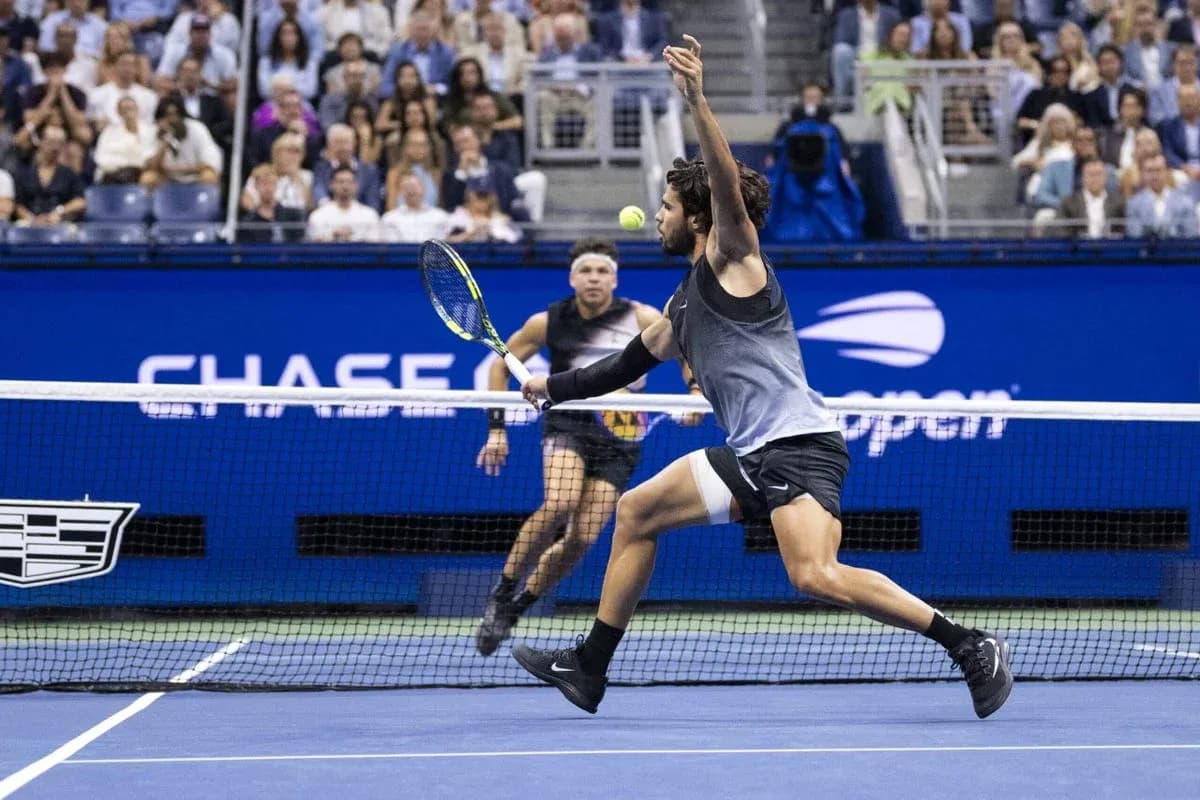
Ben Shelton Triumphs in Epic U.S. Open Match Against Carlos Alcaraz
NEW YORK — By the time Ben Shelton uncorked a 146 mph ace to end it, Arthur Ashe Stadium felt less like a tennis court and more like the last, wild corner of New York still awake.
The clock on the scoreboard read 3:33 a.m. The stands, once crammed with nearly 24,000 fans, had thinned but not lost their edge. Those who stayed got something beyond a tennis match. They got a five-set street fight between an American showman and a Spanish prodigy, a duel that pushed the U.S. Open into its latest finish ever.
Shelton beat Carlos Alcaraz 6-7(5), 6-1, 6-3, 1-6, 7-6(10-7), a scoreline that only hints at the chaos, the momentum swings, the sheer stubbornness that kept both men upright when logic said their legs should have given out hours earlier.
“This was a war. Epic match. So physical,” Shelton said afterward, still buzzing. He called it “the most enjoyable match” of his career. You believed him. You could see it in the way he roared to the rafters, in the way he refused to let Alcaraz — a seven-time Grand Slam champion at just 23 — run away with a night that seemed made for him.
A main event at midnight
They didn’t even start until 11:05 p.m. local time, a pay-per-view main event masquerading as a fourth-round match. All day, Ashe had hosted drama. This was the encore, two of the sport’s biggest personalities stepping into the ring long after most of New York had gone to bed.
For a while, it followed the familiar script.
Shelton came out swinging, his serve thundering, his athleticism bending rallies into shapes few players can handle. Alcaraz, still feeling his way back after nearly five months out with a wrist injury, looked a touch loose but dangerous, his all-court artistry always lurking.
At 5-5 in the first set, the pattern that has broken so many of Alcaraz’s opponents appeared again. A couple of sloppy points from Shelton, a missed first serve or two, and suddenly the Spaniard had the break. That’s usually the beginning of the end.
Not this time. Shelton broke right back, helped by two wild forehand shanks from Alcaraz that flew well off the court. Odd errors from a player who had cruised through his first four matches. A crack in the armor, maybe. Or just a warning that this night would not behave.
The tiebreak turned into a highlight reel. They traded mistakes, then produced a point that will live in late-night lore: lunges, scrambles, improvisation, and finally Shelton floating a perfect lob over a retreating Alcaraz, who slid with his back to the net as the ball dropped in.
Shelton led 5-3. The crowd sensed a breakthrough.
Alcaraz slammed that door shut.
He forced a routine backhand error, then ripped a backhand to the sideline and followed it with a forehand into the open court. A bullet forehand down the line. Then one of his signature all-court sprints, capped by a slick lob and a desperate, outrageous tweener save from Shelton that only delayed the inevitable. First set, Alcaraz.
Shelton had thrown everything at him for over an hour and walked away with nothing. It felt like so many of his recent nights against Alcaraz and Jannik Sinner: brave, brilliant, and ultimately punished.
Shelton turns the tide
The match should have tilted from there. Instead, it cracked.
The next 80 minutes belonged almost entirely to Shelton. Alcaraz’s level dipped hard — 17 unforced errors in the second set alone, just 8 winners. Shelton broke once, then twice, then a third time, pounding serves into the body, driving groundstrokes into the corners, dictating with swagger.
Yes, he really did drill Alcaraz 6-1. Yes, he really did level the match.
The third set felt like an extension of that surge. Shelton on the front foot, Alcaraz chasing shadows, the American landing body blows with his serve and stepping in on anything short. Midway through, Alcaraz finally started pumping his fist, trying to jolt himself awake, trying to remind the stadium and himself who he is.
Shelton wobbled as he tried to serve out the set. At 30-30, they produced yet another absurd rally — both men sprinting to catch angled drop shots, stretching the geometry of the court. Alcaraz ended it with a twisting forehand winner while running toward the back wall, the kind of point that usually fuels one of his patented surges.
Shelton knew the danger. On his way to the towel, his father and coach, Bryan, leaned over the video board and stuck out a hand. A simple message: Keep going. Keep running.
Shelton slapped it. Then he stepped back to the line and fired three huge serves, drew three errors, and banked the set. He was one away.
On the other side of the net, Alcaraz sat with his head between his knees, looking spent. When he rose for the fourth set, he staggered through the first few games like a man on fumes. A forehand miss handed Shelton a chance to break. The knockout punch was there.
Shelton missed. Backhand long.
Another mishit from Alcaraz into the net gave him a second opening. Shelton fluffed that too, this time with a forehand error.
He didn’t panic. Alcaraz was giving him looks. More chances would come.
They didn’t. Not in that set.
Alcaraz, disoriented for much of the night, suddenly sharpened. He serve-and-drop-volleyed off a rocket return, drew one more error, roared, and found oxygen. Tennis turns in a heartbeat. Minutes earlier, Shelton had seemed on cruise control. Now he couldn’t find the court.
Sensing the shift, Alcaraz dragged him east and west along the baseline, grinding him down, breaking him for the first time since late in the opening set with another of those corner-to-corner rallies that he usually owns. The fourth set raced away 6-1. The clock crept toward 2 a.m. The crowd, still roughly 10,000 strong, braced for a final act.
Into the deep end of the night
Fifth set. 2-2. Alcaraz lashed a forehand to earn break point. You could feel the narrative forming: the champion, cornered but not finished, about to close the door.
Shelton refused.
He retreated two steps, timed an overhead perfectly, and crushed it so hard Alcaraz tumbled to the court. Then came the serve. Always the serve. He held, turned to the crowd, and shook his racket in the air. Noise poured down from the stands. “U.S.A” rolled around Ashe.
At 2:45 a.m., Bryan Shelton was on his feet again, watching his son navigate the most surreal of shifts. By 2:51, they had passed the previous record for the latest finish in U.S. Open history, set in 2022 when Alcaraz and Sinner played a quarterfinal that felt like an expedition into tennis’s future.
This time, the future stood on the other side of the net from Alcaraz.
The Spaniard still had one more escape in him. Shelton earned three chances to move within a game of serving for the match. On one, he floated a chip approach from the middle of the court instead of ripping it. The ball barely bounced before the lights on the net posts flashed red. Out.
On the next, Alcaraz ripped a running crosscourt passing shot. On the third, Shelton slapped a backhand into the net. By 3 a.m., both men were still standing, still swinging, still refusing to blink.
At 3:20 a.m., nearly 14 hours after the first ball had been struck on Ashe the previous afternoon, they arrived at the only fitting conclusion: a 10-point match tiebreak for everything.
Garbage trucks beeped in the distance as workers prepared the Billie Jean King National Tennis Center for sunrise and another day of tennis. Inside Ashe, chants of “Let’s go Ben” echoed between the upper decks. Every missed first serve drew a groan. Every clean strike lit the place up again.
Shelton jumped to a 3-1 lead in the breaker, then wobbled. Three errors in four points, plus a heavy Alcaraz forehand, flipped the scoreboard and quieted the building. For a moment, it felt like the script was tightening around the American again.
Then it was Alcaraz’s turn to leak.
“Let’s go Ben” rose once more. Shelton found his range on the serve, pounded one in. Alcaraz sent a forehand long. Shelton moved to within two points of the finish line, then one.
At 8-7, serving, the match sat squarely on his racket.
He went body first. Unreturnable. 9-7.
One more.
Shelton tossed the ball, swung, and sent a 146 mph ace screaming past Alcaraz. No rally. No doubt. Just a clean, brutal full stop to a night that refused to end.
An American man hasn’t won a Grand Slam title in 23 years. On Sunday, one will be in the U.S. Open final after Shelton faces Frances Tiafoe.
If this is how Shelton handles the graveyard shift, you have to wonder: what happens when the lights are on at prime time?