Cameron Brink Speaks Out Against Transgender Debate in WNBA
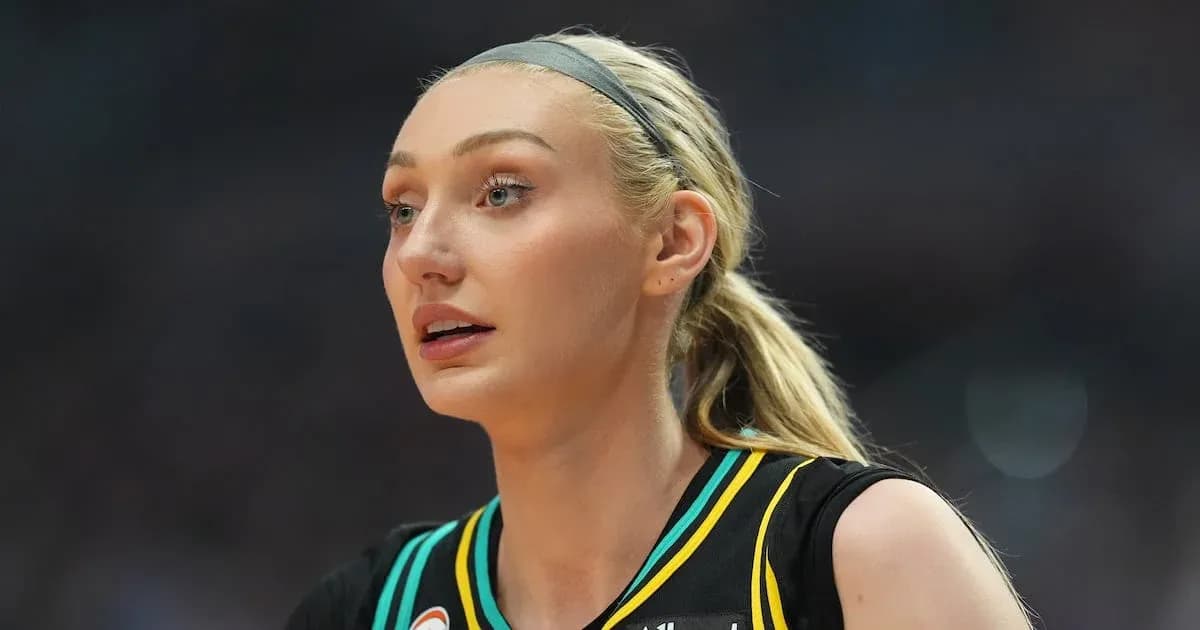
Cameron Brink has no interest in being quiet, and even less interest in helping anyone chase clicks.
The Los Angeles Sparks forward has stepped directly into one of the loudest debates around the WNBA and swatted it away with the same conviction she shows at the rim.
To her, the uproar over transgender players in the league isn’t a crisis. It isn’t even a conversation worth having.
“It’s a non-issue,” Brink told The Mirror’s Jarrod Castillo, cutting through the noise. “I think it’s just people trying to come for the trans community and I just don’t stand for that.”
At 24, in only her third WNBA season, Brink is already playing heavy minutes in a league that has never been more scrutinized. The spotlight is harsher, the discourse louder, and the bad-faith actors more eager than ever to hijack attention. She’s watched that play out in real time.
The latest flashpoint came on Sunday in Chicago, where former NBA center Enes Kanter Freedom was escorted out of a Chicago Sky game after a confrontation with Natasha Cloud. Freedom, along with former NBA player and 2024 GOP Senate candidate in Minnesota Royce White, has spent recent weeks publicly “declaring” himself transgender and vowing to enter the WNBA Draft — a stunt designed to mock, not participate.
Brink didn’t bother with diplomacy.
“I think what – I don’t even know what the f--k his name is – Enes Kanter, he’s a stupid piece of s--t,” she said. “And I think a lot of people think that and I think he’s just trying to stay relevant.”
No soft landing. No both-sides framing. Brink sees a calculated attempt to turn a marginalized group into content.
“Taking something that’s a non-issue right now and just trying to use it for clickbait, for views, for likes and then targeting a vulnerable community is just really low,” she said. “I think people are tuned in for the right reasons and it’s great that we can all talk about things that are important and hard and you can have your opinions on that…”
The key phrase there is “right reasons.” The WNBA, now in its 30th season, has never had an openly trans woman on a roster. There are currently no trans players in the league. The only openly trans and non-binary player in WNBA history, Layshia Clarendon, retired in 2024 after 11 seasons.
Yet the league has been pulled into the center of the wider cultural fight.
The recent wave of outrage followed an ESPN feature last month on Indiana Fever guard Sophie Cunningham, who voiced opposition to transgender girls and women competing in girls’ and women’s sports. That interview poured fuel on an already simmering debate, and the usual political opportunists and online provocateurs rushed in.
Brink’s response lands differently because of who she is and where she is in her career. A native of Princeton, N.J., and a standout at Stanford, she entered the WNBA with expectations strapped to her shoulders. The Sparks took her with the No. 2 overall pick in the 2024 WNBA Draft, asking her to help anchor a franchise in transition.
She has delivered steady production: 9.4 points per game on 50 percent shooting, 5.0 rebounds and 1.7 assists in just 18.5 minutes a night across 28 games this season. Efficient, reliable, and increasingly vocal.
That last part matters. Young stars are not just asked to score and defend anymore; they’re expected to stand for something. Brink has chosen her ground.
She’s not pretending the conversation around gender and sport is simple. She is, however, refusing to let people like Freedom and White turn it into a circus at the expense of a community she believes is already under siege.
“I think people are tuned in for the right reasons,” she said, drawing a line between genuine concern and performance outrage.
Right now, the WNBA is surging — in attendance, in TV numbers, in cultural relevance. With that rise comes a familiar pattern: people on the outside trying to weaponize the league’s platform for their own agendas.
Brink has made it clear she’s not playing along.
The Sparks forward is still carving out her place in the hierarchy of the league. On the floor, she’s a growing problem for opponents. Off it, she’s already decided which fights are real and which ones are manufactured — and she’s calling out the latter with the kind of blunt force that tends to echo far beyond a single news cycle.