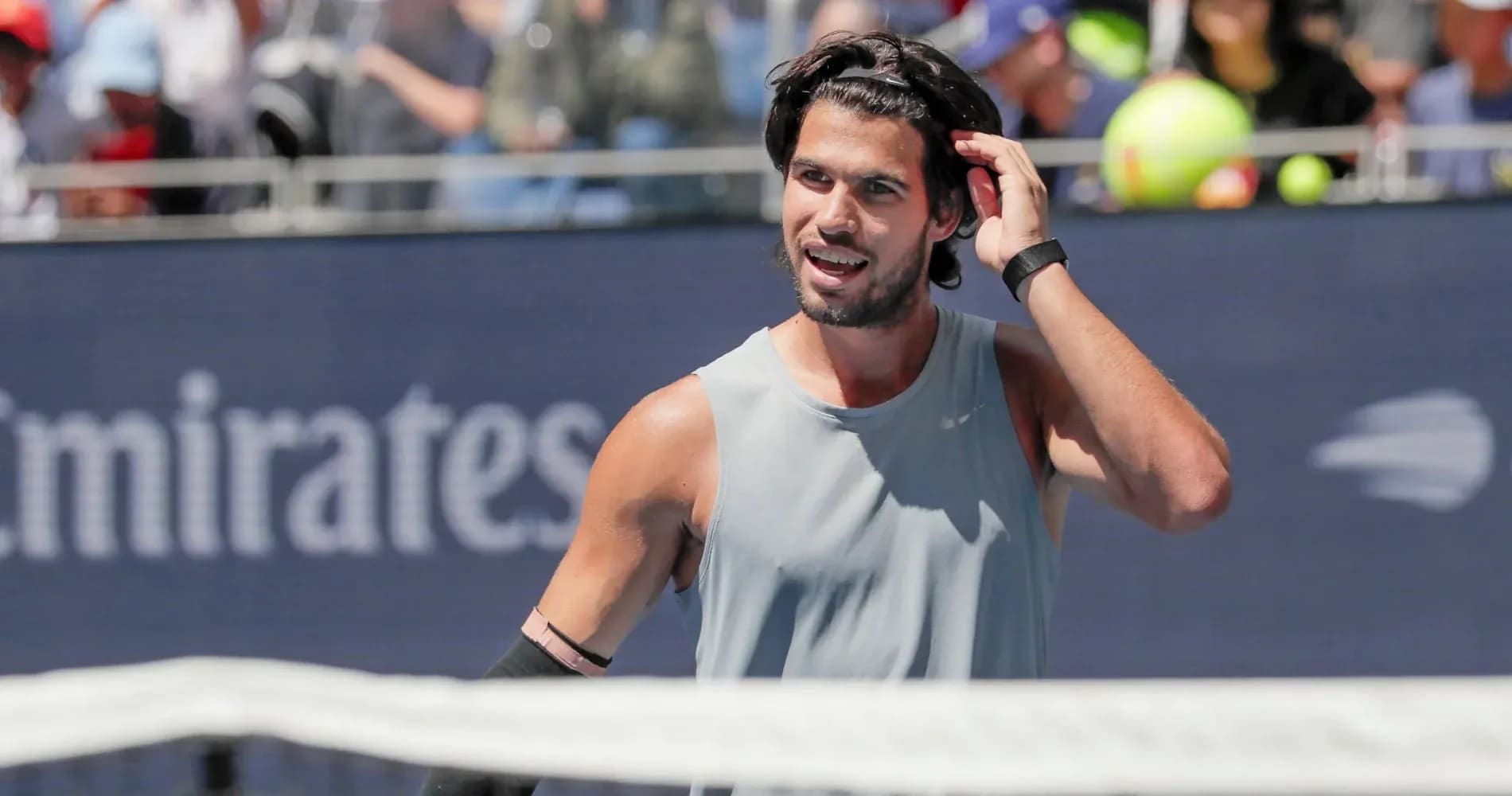
Carlos Alcaraz Dominates Tommy Paul at US Open
Carlos Alcaraz does not so much defend a title in New York as impose one.
On a humid night at Flushing Meadows, Tommy Paul threw everything he had at him – the angles, the changes of pace, the court craft that has carried the American deep at every other major. It still wasn’t close enough. The scoreline suggested three tight sets. The numbers told a different story.
Alcaraz finished with 33 winners to Paul’s 18, both men stuck on 32 unforced errors. That’s where the similarity ended. The Spaniard came forward 29 times and won 23 of those points, picked his moments, and picked Paul apart. He landed 67% of his first serves, was broken just once in 15 service games, and converted four of the 14 break points he carved out.
Paul saved 10 of those 14, which kept the match alive but never truly in the balance. Across three sets, Alcaraz won 99 of 173 points. For Paul, it was a night spent hanging on; for Alcaraz, it was control disguised as a contest.
One brief scare, then the door slammed shut
The only real flicker of danger came when Alcaraz stepped up to serve for the match at 5-4 in the third. For the first time, the stadium leaned in. He slipped to 15-40, facing two of the four break points he would see all evening. A crack in the armour? Not for long.
He wiped both chances away, then took the next two points as if rewinding the script. A crosscourt forehand winner brought up match point, a service winner sealed it at the first attempt. The moment that could have opened the door for Paul instead underlined the gap between them.
A streak stretching across continents
Alcaraz has not lost at Flushing Meadows since 2024. The win marked his 11th straight victory at the US Open and his 18th in a row at hard-court majors, a run that stretches back through last year’s title in New York and this season’s Australian Open.
This one carried him into a 15th Grand Slam quarterfinal and left him three matches from history: no man has defended the US Open title since Roger Federer’s five in a row from 2004 to 2008. Alcaraz is now close enough to that statistic for it to feel less like a comparison and more like a target.
It also nudged a career number into rare air. His win rate in hard-court majors now sits at 86.79%, third in the Open era. Only Novak Djokovic and Federer are ahead of him, and Federer’s 86.82% is barely a step away. Alcaraz has already moved past Pete Sampras on that list. The company he keeps is getting more exclusive by the month.
On court, he explained the plan in simple terms: suffocate Paul’s rhythm, deny him comfort, make every ball a question. He spoke of staying ready to run, of staying aggressive, of refusing to let Paul “stay on the court” in any meaningful way. The calm, he said, came from the pressure he applied in return games; break the opponent’s serve often enough, and your own feels like a refuge.
Asked whether, after four and a half months away, the two-time champion was back to full power, he pointed to his New York record. Since 2021, with one exception, he has reached at least the quarterfinals here. For him, that is the clearest evidence of how special this place is – and how reliably he plays his best tennis on this stage.
Paul’s New York gap remains
For Paul, the story remains stubbornly incomplete. His résumé now includes quarterfinals at the Australian Open, Roland-Garros and Wimbledon. The US Open, the home major, still will not yield.
He arrived this year openly targeting a first quarterfinal in New York. He leaves again in the fourth round, just as he did 12 months ago. Against Alcaraz, he has now lost seven of nine meetings. The patterns are becoming familiar: flashes of brilliance, clever patterns of play, but not enough sustained pressure to topple a player operating at this level.
The defeat does not erase his progress across the Slams, yet it sharpens the question. To crack the last eight here, he will almost certainly have to go through players of Alcaraz’s calibre again. On this evidence, the gap is not about talent but about the ability to bend a match to his will when the other man refuses to blink.
A loaded path ahead
Alcaraz now waits for the winner of the fourth-round clash between No. 8 seed Ben Shelton and Stefanos Tsitsipas. Either opponent brings intrigue: the explosive American with the crowd at his back, or the Greek shotmaker searching for a statement on hard courts.
Lurking beyond that in the same half are No. 7 seed Daniil Medvedev, a former champion in New York, and American No. 11 seed Frances Tiafoe, whose night-session energy can tilt an arena. Across the draw stands top seed Alexander Zverev, the Roland-Garros champion, anchoring the opposite half.
Three more nights like this, and the questions about Alcaraz’s wrist – and about any rust from his layoff – will fade into background noise. The conversation will shift to something far more familiar in this city: whether New York is watching the start of another era of dominance on its hard courts.