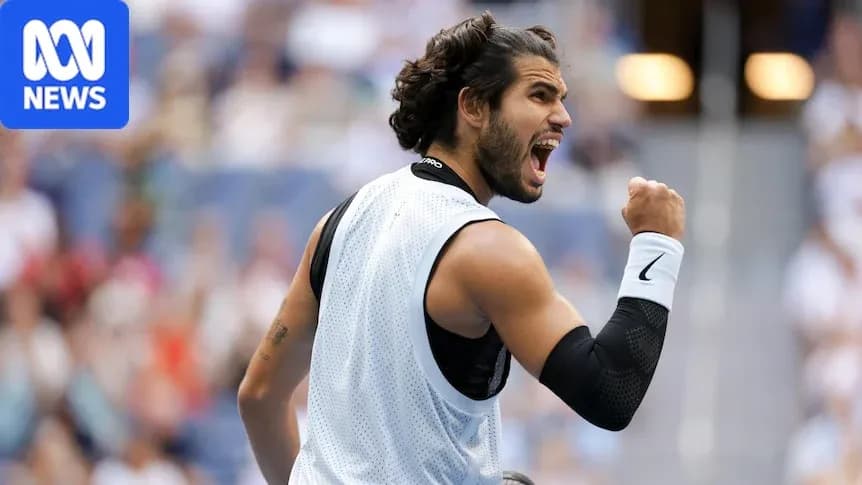
Carlos Alcaraz Dominates Tommy Paul to Reach US Open Quarterfinals
Carlos Alcaraz roared into the US Open quarterfinals with a straight-sets dismantling of Tommy Paul, a 6-4, 6-3, 6-4 victory that looked less like a comeback story and more like a warning shot to the rest of the field.
On a humid night in Arthur Ashe Stadium, the defending champion played as if the last five months had been a brief intermission, not a major interruption. The right wrist that kept him out since April, that forced him to miss the past two slams and has derailed plenty of careers before his, looked not just healthy but vicious.
The numbers backed it up. Eighteen straight wins at the majors. Thirty-three winners. One forehand that screamed down the line at 164km/h, a blur of yellow that left Paul frozen and the crowd gasping. That missile came early in the second set, a statement shot that underlined what everyone in the stadium could see: Alcaraz is back at full power.
He has always loved this place. Flushing Meadows is where he claimed his maiden major four years ago, and where he has now reached the quarterfinals in five of his six appearances. The relationship between player and court feels almost symbiotic; the bigger the stage on Ashe, the bolder his tennis becomes.
The atmosphere, though, was complicated. Much of the crowd leaned toward Paul, the American 20th seed who spent the night sprinting, sliding, and improvising, desperate to disrupt the Spaniard’s rhythm. He produced another around-the-post winner — his second of the tournament — a party trick that briefly turned the stadium into his own.
Alcaraz didn’t blink.
He stuck to his identity, dictating with heavy, aggressive baseline play, stepping in on returns, and rushing Paul’s timing. He spoke of trying to “play my game” and it showed: constant pressure, relentless court positioning, and the kind of daring shot selection that can make opponents feel as if they’re playing uphill on every point.
Paul’s speed dragged rallies into the corners and asked questions of Alcaraz’s movement and patience. The world No. 2 answered with clarity. He targeted Paul’s return, squeezed errors out of him, and used his own variety to keep the American off balance. When the rallies stretched, Alcaraz had the heavier blow. When they shortened, he had the sharper knife.
The scoreline might suggest a routine night. It wasn’t. The exchanges were quick, sharp, and at times brutal, with Paul constantly probing and Alcaraz constantly responding. The Spaniard’s ability to stay calm under that pressure — to keep taking the ball early, to keep swinging big on important points — told its own story about his confidence and his wrist.
At times, Alcaraz shifted down a gear, cruising through service games, absorbing the noise and the occasional surge from Paul. Then, just as the American looked ready to claw back some ground, the defending champion would tighten the screws, finding a first serve, a backhand up the line, or one of those forehands that rip through the air like a crack of thunder.
He did wobble near the finish line, a brief flinch that gave Paul a sliver of hope. It didn’t last. Alcaraz regrouped quickly, reset his feet, and landed the knockout blows with the same audacity that had carried him through the night. One last rocket of a forehand brought up match point, a fitting end for a performance built around controlled aggression.
The win pushed him to the brink of a remarkable mark: a 13-0 record against American players at the grand slams, a streak that underlines how comfortable he is walking into partisan arenas and silencing home hopes.
Next comes either Ben Shelton or Stefanos Tsitsipas, a quarterfinal that promises a very different kind of test but the same unforgiving spotlight of Ashe. On the opposite side of the draw, Frances Tiafoe was battling Daniil Medvedev for the right to chase an all-American quarterfinal against Alex Michelsen, who earlier had taken out 27th seed Tomas Martin Etcheverry 7-6(8/6), 6-4, 6-4.
For now, though, the story belongs to the man who was supposed to be vulnerable, rusty, unsure. Instead, Carlos Alcaraz walked off Arthur Ashe looking like what he has so often been in New York: the man to beat.