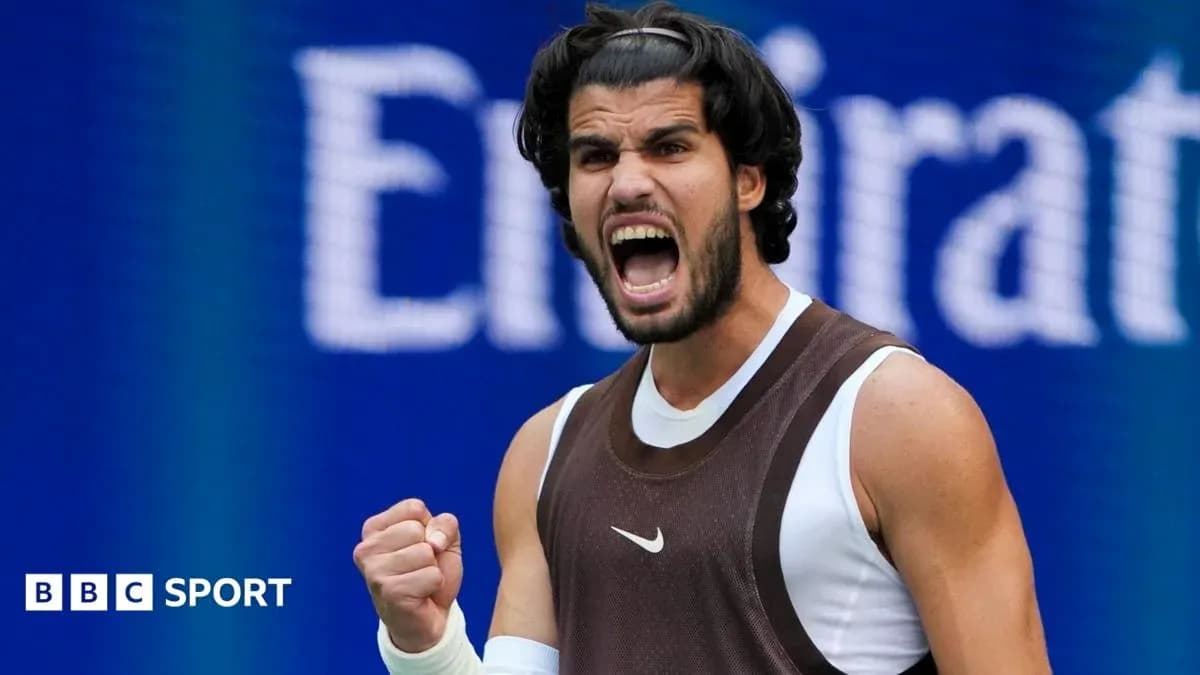
Carlos Alcaraz Dominates Wu Yibing at US Open
Carlos Alcaraz brushed aside Wu Yibing to reach the US Open fourth round, then delivered the kind of message the rest of the draw did not want to hear: he feels sharper with every swing of the racket.
On a warm New York afternoon, the defending champion needed just two hours and 20 minutes to post a 6-3 6-4 6-1 win over the Chinese player, a performance that looked far more like a statement than a tune-up. The scoreline told one story. The way he moved told another.
This is a man coming off a 139-day absence from singles competition after a wrist injury in April. His first-round match at Flushing Meadows marked his return to a one-on-one battle, and even then he eased through in straight sets. The only wobble came in round two, when Portugal’s Jaime Faria snatched the opening set before Alcaraz tightened his grip and turned the match around.
Against Wu, there was no such generosity. The Spaniard broke early, imposed his weight of shot and never really let the match breathe. Once he had the first set in his pocket, he accelerated. By the third, Wu was hanging on. Alcaraz was hunting.
“To be honest, I'm better than I thought,” he admitted afterwards. He had expected the body to creak, the lay-off to bite. It hasn’t. “Physically I thought I was going to be bad after the first match, but I am recovering really well. I am doing great things off the court to be in a good state.
“Right now, I think my level is really good. I think I have caught the rhythm of the competition. Every time that I step on the court I give it all. I'm just trying to improve, be better every match and I think I'm getting there.”
The rhythm was obvious. The forehand, once again, dictated. The backhand held firm. The movement – that elastic, predatory coverage of the baseline – looked closer to peak Alcaraz than a player easing his way back from a long-term problem.
A Draw Quietly Clearing
While Alcaraz has been playing himself into form, the men’s draw around him has started to crumble.
World number one Jannik Sinner is not in New York because of injury, leaving French Open champion and Wimbledon runner-up Alexander Zverev as the top seed. Novak Djokovic, the great constant of this era, fell at the very first hurdle to Argentine Mariano Navone. Canadian third seed Felix Auger-Aliassime followed in round two, beaten by Karen Khachanov.
The effect is striking. As second seed, Alcaraz cannot see Zverev before the final, and the German has already been dragged into back-to-back five-set marathons, both stretching past 2am. The physical toll is mounting early in his fortnight. Alcaraz, by contrast, has spent three matches building pace, not burning fuel.
As it stands, only one other top-10 player can block his path before the semi-finals: American eighth seed Ben Shelton. The Spaniard has beaten Shelton three times out of three, including at the US Open last year. If seedings hold, Daniil Medvedev would be waiting in the last four. Alcaraz leads that rivalry 6-3, though the Russian did sting him at Indian Wells in March, a reminder that Medvedev’s flat, skidding game can still rattle him on hard courts.
On the other side, Zverev’s potential route looks far more cluttered. Home favourite Taylor Fritz and Italy’s French Open runner-up Flavio Cobolli are among those who could stand in his way before the title match. None of them will fear the German’s workload so far.
Tommy Paul Next – And a Familiar Script
Before any of that, Alcaraz must deal with Tommy Paul in the fourth round. The American is seeded 20th, an intelligent, resourceful baseliner who can change pace and angle and thrives in front of a home crowd.
History, though, leans heavily one way. Alcaraz has beaten Paul six times in a row. He knows the patterns, knows where the pressure points lie, and knows he can outlast him in the biggest moments.
The Spaniard’s target in New York is an eighth major title, an extraordinary number for a 23-year-old still feeling his way back from injury. The route has opened slightly. The body is responding. The game is rising.
If this is him still “getting there,” the rest of the field has a serious problem when he finally arrives.