Coco Gauff Survives Match Points to Defeat Mirra Andreeva
Coco Gauff was on the brink. Twice.
Two match points down to Mirra Andreeva, her game in pieces, the Arthur Ashe crowd restless and stunned, the defending US Open champion looked headed for the exit. Twenty-six brutal minutes had seen her lose the opening set 6-2, her serve misfiring, her forehand leaking errors, her confidence nowhere to be seen.
She hit just three winners in that first set and sprayed 14 unforced errors. Andreeva, the teenage French Open champion and fifth seed, needed no invitation. She took the ball early, took time away, took control.
Gauff looked lost.
A Reset, a Tie-Break, and a Turning Point
The American walked off court after that opener needing something—anything—to change. When she came back, the body language had shifted. The level? Not immediately. But the fight was there.
The second set turned into a scrap. Gauff steadied her serve, found a few more first balls, and at least stopped handing Andreeva free points. The Russian, who had been so loose and fearless, began to feel the weight of the moment as the set tightened.
It all funneled into a tie-break that felt like the match itself compressed into a few furious minutes. Andreeva earned two match points. Two clear looks at the biggest win of her young career. She couldn’t take either.
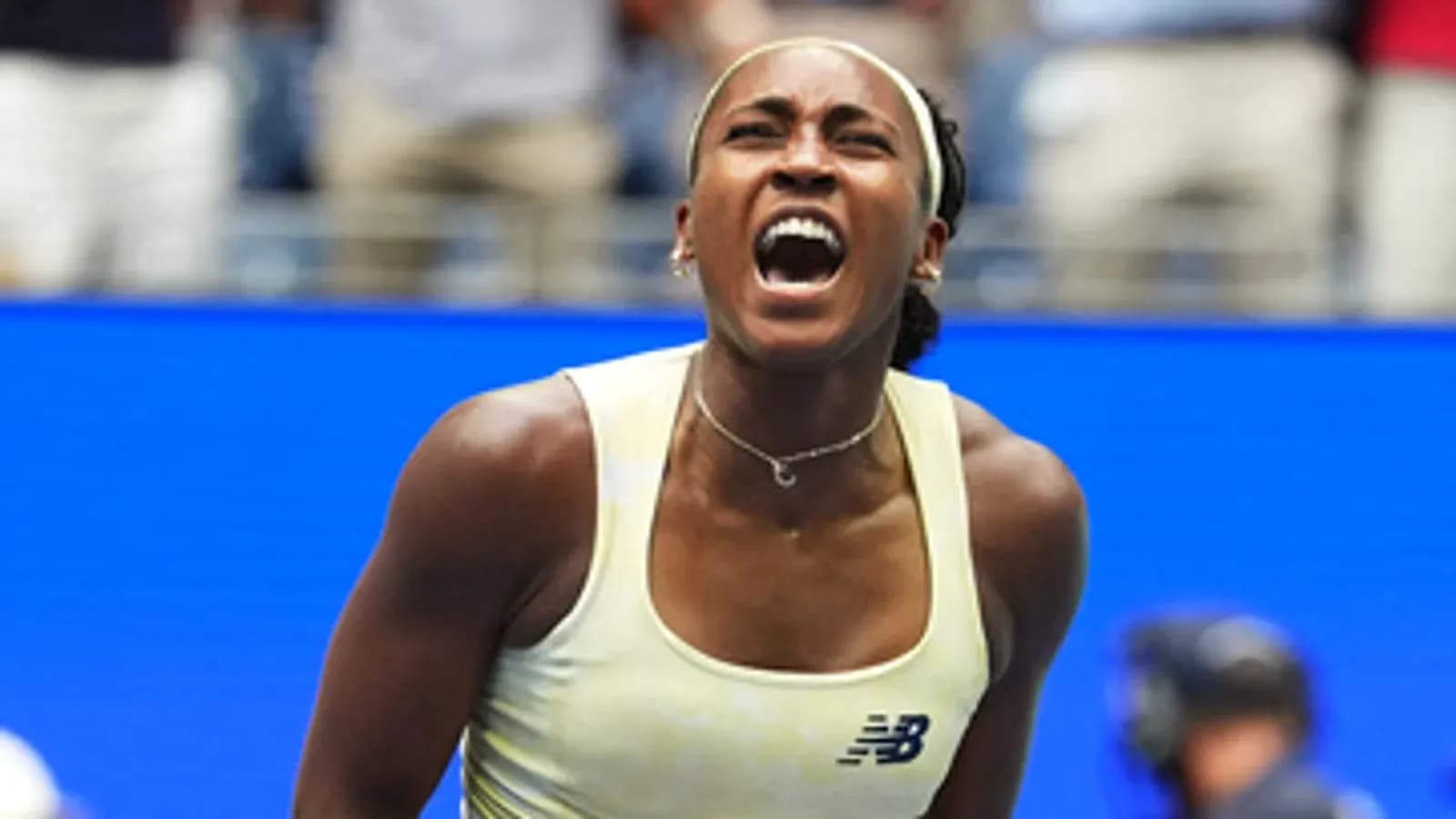
Gauff survived them, dragged the breaker to 8-6, and with it dragged herself back into the tournament: 7-6 (7) and one set all.
That was the crack in Andreeva’s composure. The pressure finally told.
As they walked to their chairs, the Russian hurled her racket toward her seat in frustration. It skidded and spun toward a nearby camera operator, who had to move quickly out of the way. She risked a default in a flash of anger that underlined how much the moment had slipped away.
From there, the match belonged to Gauff.
Heart Over Technique
The third set was not about perfection. It was about survival and then assertion.
Gauff, now playing with a freedom that had been missing for an hour, surged through the decider 6-2. The serve that had abandoned her early began to land. The forehand, still not flawless, at least held up under pressure. She dictated more rallies, moved Andreeva around, and fed off a crowd that had been desperate to get involved.
She closed it out 2-6 7-6 (7) 6-2, a scoreline that only tells half the story of how close she came to going home.
Afterwards, she admitted she needed a mental reset and drew on a familiar source of inspiration: another American comeback under the Ashe lights. She spoke about thinking of Frances Tiafoe’s fightback the previous night, about wanting to leave the court with no regrets, about the crowd dragging her through the darkest moments.
Marion Bartoli, watching on for Sky Sports, cut straight to the essence. For her, this was less about Gauff’s level and more about her will. It was, she said, “pure heart to find a way, somehow.” The kind of match, Bartoli argued, that only a handful of players in the world can win from that position. Gauff is one of them.
Tim Henman saw something else layered in: two brilliant shot-makers suddenly gripped by nerves. The serves disintegrated, the ball speeds dipped, the tension rose. The match turned into a mental examination as much as a technical one. Keep the ball in the court. Cut out the errors. Handle the fear.
Gauff did. Andreeva, this time, did not.
A Brutal Lesson for Andreeva
For Andreeva, this will sting. Two match points in a US Open quarter-final against the defending champion is the kind of opportunity that can define a season. Losing from there, Henman suggested, will be a “very difficult defeat” to absorb.
But it will also teach. The Russian has already shown she belongs at this level; the way she handled Gauff for a set and a half was proof enough. What she lacked on this night was the final step—closing.
She will leave New York with regret, but also with a clear blueprint of what it takes to finish the job on the biggest court in tennis.
Rybakina Rises to No 1
Waiting for Gauff in the semi-final is the new world No 1.
Earlier in the day, Elena Rybakina fought through her own three-set test against Qinwen Zheng to secure both a last-four place and the top ranking. The 27-year-old from Kazakhstan will end Aryna Sabalenka’s 99-week stay at No 1 when the new list is published on Monday.
She gets there the hard way. Zheng, who had already logged nearly 12 hours on court across qualifying and the main draw, came out swinging and took the first set 6-3. Rybakina, the Australian Open champion, looked flat, negative, and error-prone. Her forehand misfired, her rhythm deserted her, and Zheng punished every short ball.
Then Rybakina reset.
She stormed through the second set 6-1, tightening her game and stepping inside the baseline. The rallies changed shape. Zheng’s legs, after so many matches, began to feel the toll. In the decider, Rybakina kept pressing, broke at key moments, and closed it out 6-4 to win 3-6 6-1 6-4.
It was the first set she had dropped all fortnight, but the response underlined why she is now officially the best-ranked player in the world. When the match grew tight in the third, she didn’t retreat. She hit through the court, took control of the baseline, and imposed her weight of shot.
Henman called it a “really good performance” in the end, noting how she raised her aggression and showed her class when the match balanced on a knife edge.
Zheng’s run, meanwhile, had echoes of Emma Raducanu’s breakout in New York—a qualifier cutting through the draw with fearless hitting. It ended here, but not without reward. After elbow surgery had dropped her to 121 in the rankings, she now stands back on the verge of the top 50, her trajectory restored.
A Semi-Final With Edge
So the stage is set: Coco Gauff, the defending champion who just refused to lose, against Elena Rybakina, the new world No 1 and first-time US Open semi-finalist.
One survived match points. The other survived a slow start and the weight of a ranking chase. Both come in battle-tested, both with something significant already banked from this fortnight.
For Gauff, this was a reminder of her greatest weapon: not the serve, not the speed, but the stubborn refusal to accept defeat. For Rybakina, it was confirmation that her calm, heavy-hitting game travels to every surface, every stage.
Now they meet with a place in the final—and perhaps the shape of the women’s game over the next few years—hanging in the balance.