The Decline of Five-Day Test Cricket
Test cricket used to be a five-day conversation. Increasingly, it is a two- or three-day argument.
As rain held up the start of Day 3 of England’s second Test against Pakistan, Michael Atherton filled the delay on Sky Sports with a stark diagnosis of where the longest format now stands. His verdict was clear: the modern game is chewing through Test matches at a speed that would have been unthinkable in his playing days.
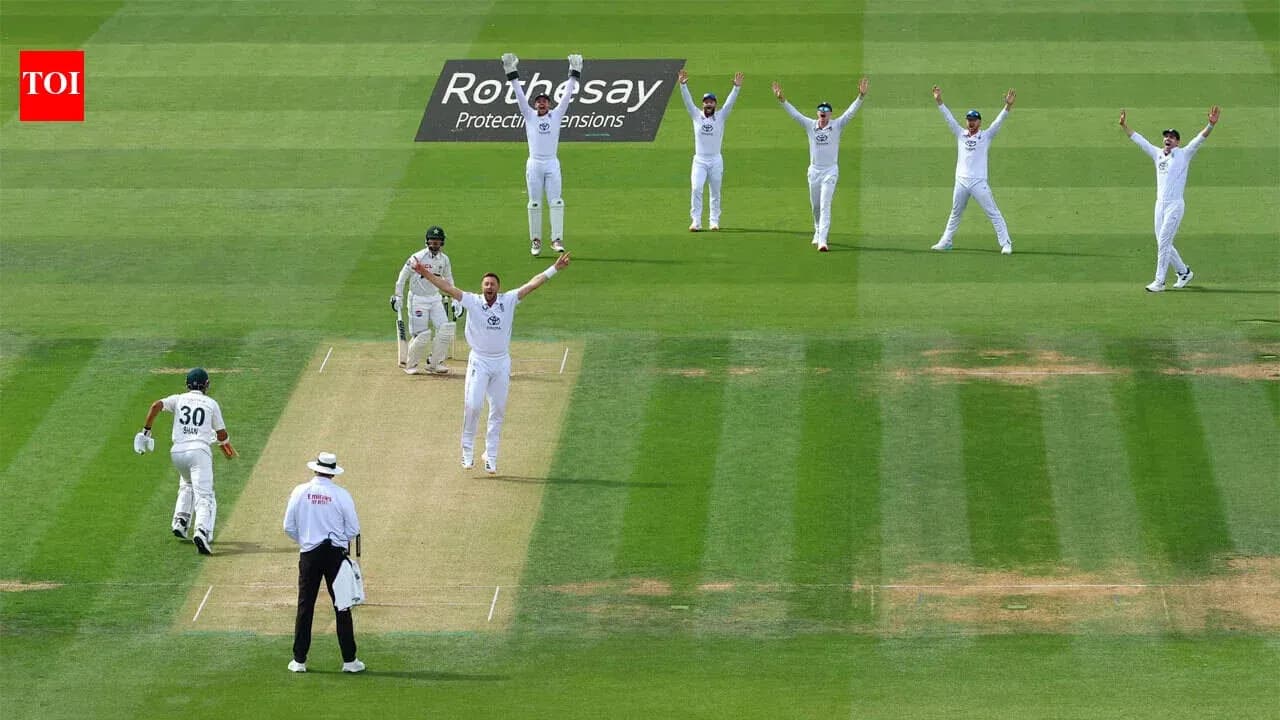
The backdrop was fitting. England appealing in vain for the wicket of Pakistan’s Azan Awais, a damp outfield, a slow morning. Yet beyond the drizzle, the numbers tell a story of acceleration.
The five-day game that rarely reaches Day 5
Sky Sports’ data laid it out in unforgiving detail. In the 1970s, 77.65% of Tests went the distance and lasted all five days. By the 2010s, that figure had dropped to 54.76%.
In the 2020s, it has fallen off a cliff. Only 41.43% of Tests now make it to the final day.
At the other end of the scale, the short Tests are no longer curiosities. They are creeping towards normal. Just 2.79% of Tests in the 1970s ended inside two or three days. In this decade, that share has exploded to 23%.
The recent Australia–Bangladesh Test in Mackay, wrapped up inside two days, was not an outlier. It was another entry on an increasingly crowded list.
“The Test matches are going quicker,” Atherton said, and the numbers leave little room for argument.
T20 instincts, higher risk, quicker endings
Atherton traced the roots of the shift back to the white-ball revolution. Batting, he argued, has fundamentally changed.
“Batting is higher risk now because of T20 cricket. If you take more risk, you have more chance of getting out,” he said.
This is the heart of it. Generations raised on T20 and aggressive one-day cricket bring those instincts with them into Tests. Strokeplay is bolder, tempo is higher, and the willingness to absorb pressure for hours on end is rarer. The run rate climbs. So does the wicket column.
The spectacle can be thrilling. It also shortens games.
Fast bowlers, DRS and the rise of the bowler
The batters’ new mindset is only part of the equation. Atherton pointed to a second, equally important factor: a strong, global crop of fast bowlers.
“There’s a good crop of fast bowlers around right now,” he noted, and it is hard to argue when you look across the major Test nations. With pace and skill operating in most conditions, mistakes get punished quickly.
Then there is the Decision Review System.
“DRS has had an impact; umpires are more likely to give LBWs,” Atherton said.
The days of the benefit of the doubt automatically going to the batter are fading. With ball-tracking backing them up, umpires are more confident raising the finger. Marginal calls that once survived now fall. Innings that might have dragged on for another hour end abruptly.
Home advantage and the World Test Championship
The World Test Championship has added another layer. With points and league tables at stake, home advantage has become a weapon to be maximised, not just a quirk of the schedule.
“Pitches have become more advantageous since the advent of the World Test Championship; teams are generally looking to get home advantage more,” Atherton said. “So, whether it is turning pitches in India, or seam-friendly pitches in England, pitches have become more bowling-friendly since the advent of WTC.”
The pattern is familiar. India lean into spin and turn. England trust seam and swing. Other nations follow suit with their own strengths. The result is often gripping cricket – but not necessarily long cricket.
When surfaces offer pronounced assistance, batters walk a thinner line. Sessions become decisive. A bad hour can destroy a match.
A different world from Atherton’s era
For Atherton, who battled through the 1990s as an opening batter, the contrast is stark.
“When Nas (Nasser Hussain) and I were playing in the 1990s, the number of games finished in three days or less was around about 7 per cent (6.98 per cent). And that is now 20 per cent, so that is a big difference,” he said.
The long, attritional draws that defined much of his career have almost vanished. Instead, the sport has drifted to the other extreme: decisive, often brutal conclusions.
One statistic he highlighted was especially jarring. “In the last decade (from 2017–current), there have been nine occasions where Test matches have finished in two days, and there wasn’t a single two-day Test between 1946 and 2000,” Atherton said.
More two-day Tests in less than a decade than in more than half a century. That is not a subtle shift. It is a rupture.
What kind of Test cricket does the game want?
For administrators, broadcasters and players, the question now is not whether Test cricket is changing. It clearly is. The question is what version of the format the sport wants to preserve.
A faster, more volatile product, shaped by T20 aggression, sharp DRS calls and home-tailored pitches? Or a return, somehow, to the slower-burn contests where Day 5 was a stage, not an afterthought?
Right now, as Atherton’s numbers show, the clock on the traditional five-day Test is ticking a lot faster than it used to.