Dwyane Wade's Transformative Journey: Changing the Locker Room Culture
Dwyane Wade spent a career mastering hostile environments. Road arenas. NBA Finals. Last-shot situations with a franchise’s hopes hanging off his shooting hand.
The toughest room he ever had to navigate turned out to be his own locker room.
The Miami Heat legend, now firmly on the path to the Hall of Fame, recently opened up about the tension he felt once his daughter Zaya came out as a trans woman and he began to truly hear the language that had long echoed off those walls.
For years, the jokes were background noise. Part of the “masculine, toxic environment,” as Wade put it, that he and so many others grew up in. Then Zaya’s journey became public, and everything shifted.
He didn’t change teams. He changed perspective.
“I started to like become a little different because I started listening a little bit differently,” Wade said. The same locker-room banter that once blended into the soundtrack of an NBA season suddenly cut through him. Casual shots at the LGBTQ community, throwaway lines meant to get a laugh, now collided with the reality of his daughter’s life.
He stopped laughing. He started leaving.
Teammates would crack jokes; Wade would quietly walk out. The franchise icon, the face of “Heat culture,” no longer felt aligned with the culture in that room. The more he grew as a father, the more out of place he felt as a bystander.
No active NBA player has ever come out while still in uniform. Jason Collins waited until after his career to publicly share his story, wary of the noise and controversy that would follow. Wade was living a different version of that tension — not as a player hiding his identity, but as a superstar father suddenly awake to what that environment meant for people like his daughter.
The pressure finally told, and Wade turned to the one person in that space who understood him best.
A Brother Steps Up
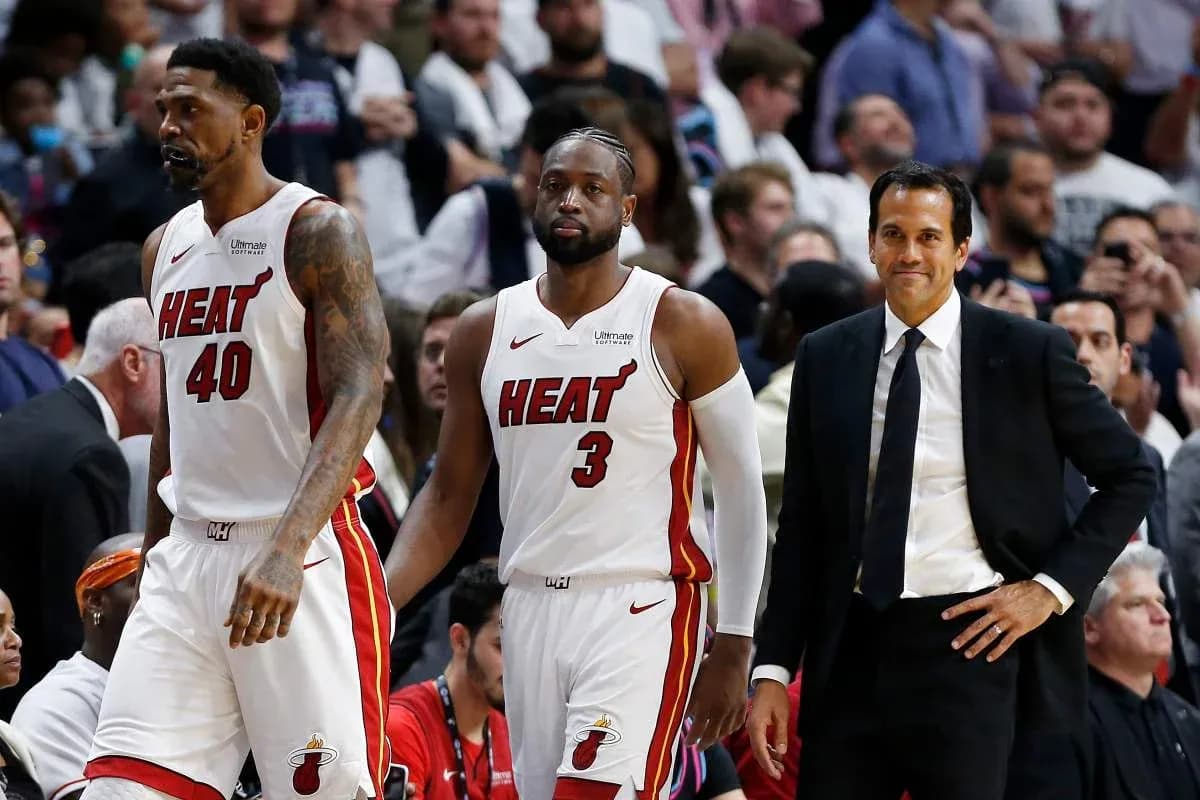
Udonis Haslem has been many things for Miami: enforcer, captain, culture carrier, the steady voice in a franchise that prides itself on edge and accountability. To Wade, he was more than that. He was family.
Haslem was also, as Wade admitted, “in on the jokes.”
“I remember having a conversation with UD because he seen that I was like I wasn’t in on the jokes no more,” Wade recalled. “I wasn’t laughing. I was leaving out of the locker room when I would hear certain things or whatever.”
The silence between them grew heavy. Wade didn’t want to resent his brother. He didn’t want to sit in the corner of a room he helped build and feel like a stranger. So he did what leaders are supposed to do: he confronted it.
“I had to sit and talk to him about it,” Wade said. He laid out how the language landed now, how the jokes hit when you’re thinking about your own child, about “different communities” that no longer felt abstract.
Haslem listened.
“And from that conversation that him and I had, like he didn’t know, right? He didn’t know,” Wade explained. Once he did, he changed. Not just his wording, but his tone, his thinking, his actions.
One conversation. One trusted voice. One safe space inside a room that so often rewards bravado over vulnerability.
That’s how culture actually shifts.
Haslem’s response mattered not just because of his bond with Wade, but because of who he is inside that organization. When a player as deeply embedded in “Heat culture” as Haslem adjusts, others notice. When Wade, the greatest player in franchise history, refuses to co-sign the old norms, the standard moves.
Miami’s reputation as an elite franchise often centers on Pat Riley’s ruthlessness and Erik Spoelstra’s tactical brilliance. But the unseen work — two veterans talking in a quiet corner, one father explaining why a punchline isn’t funny anymore — is just as much a part of what that culture has become.
Wade has since emerged as a prominent ally to the LGBTQ community, praised for the way he has supported Zaya publicly and privately. His advocacy didn’t start with a speech or a campaign. It started in the most traditional, old-school setting the sport has: an NBA locker room, where a legend decided that the jokes he grew up with no longer had a place in the world he wanted for his daughter.
He spent a career changing games. This time, he chose to change the room.