Elena Rybakina One Win Away from No.1 Ranking at US Open
Elena Rybakina is one win away from the summit, and she isn’t pretending otherwise.
The world No.2 dismantled Naomi Osaka 6-1, 6-4 in just 66 minutes at the US Open, a statement victory that leaves her a single step from overtaking Aryna Sabalenka and claiming the No.1 ranking. Asked directly about the prospect of becoming the sport’s leading player, Rybakina didn’t hide behind clichés.
“Of course I want it,” she said. “I don’t know anyone that wouldn’t wish this. That is definitely one of my goals. If I start well as I did today, I think I have all the chances to (become world No.1). I’ll try my best and hopefully, it will go my way.”
On this evidence, it might.
Her serve, heavy and relentless, crushed Osaka’s resistance early. The first set was a rout. Osaka, a four-time major champion and former world No.1, never settled, never found the depth or aggression to trouble a locked-in Rybakina. The Japanese star’s 2026 US Open campaign ends with a straight-sets defeat that never truly felt in doubt.
The second set offered a flicker. Osaka dug in, tried to extend rallies, tried to drag the match into a physical battle. For a moment, the contest tightened. Rybakina trailed 2-1 and had to serve to stay in touch, but every time Osaka hinted at a surge, the Kazakh’s delivery slammed the door. The serve was the separator, the weapon nobody inside the stadium could ignore.
That level has impressed those watching closely. Australian great Jelena Dokic believes Rybakina now stands as the clear favourite to lift the trophy in New York, her power game and composure under pressure marking her out in a women’s draw that has already lost its most decorated name.
Because on the other half of this story, the six-time grand slam champion is gone.
Iga Świątek, the sport’s dominant force in recent years, was stunned in straight sets by Qinwen Zheng. The scoreline – 7-5, 6-3 – only hints at the drama. Świątek raced to a 5-0 lead in the opening set, apparently cruising. Then the match turned on its head.
Zheng, who beat Świątek to win Olympic gold in 2024, mounted a staggering comeback. Point by point, she chipped away at the deficit, found her range, and dragged the crowd into her surge. From 0-5 down to 7-5 up, she reeled off seven straight games, leaving one of the game’s fiercest competitors staring at the scoreboard in disbelief.
“I guess to come back from 0-5 is not lucky, that’s all I can say,” the 23-year-old said. “I didn’t start the match so well, but little by little I found my rhythm on this centre court because it’s been a long, long time since I’ve played here. I haven’t beaten a top-10 player in a while. The more matches I play, the more rhythm I get. I just feel really pumped and ready for my next match.”
Świątek never fully recovered. Zheng carried the momentum into the second set, dictating with authority, and closed out the match 6-3 to reach the quarter-finals. The win wasn’t a one-off; it was a continuation of a rivalry that now includes an Olympic final and a grand slam upset, and it sets up a compelling quarter-final against Rybakina.
One player chasing No.1. Another fresh from toppling a six-time major winner and Olympic victim turned grand slam scalp. The stakes are obvious.
While the women’s draw crackles with storylines, the men’s side keeps ticking along in the background. Learner Tien and Karen Khachanov are locked into their own battle in the men’s singles, with Alexander Blockx waiting in the quarter-finals for whoever survives. It’s a quieter subplot on a day dominated by the women, but it feeds into a broader theme at this year’s US Open: the sense that new names, new rivalries, and new narratives are pushing hard against the old order.
Not every storyline is about the tennis itself.
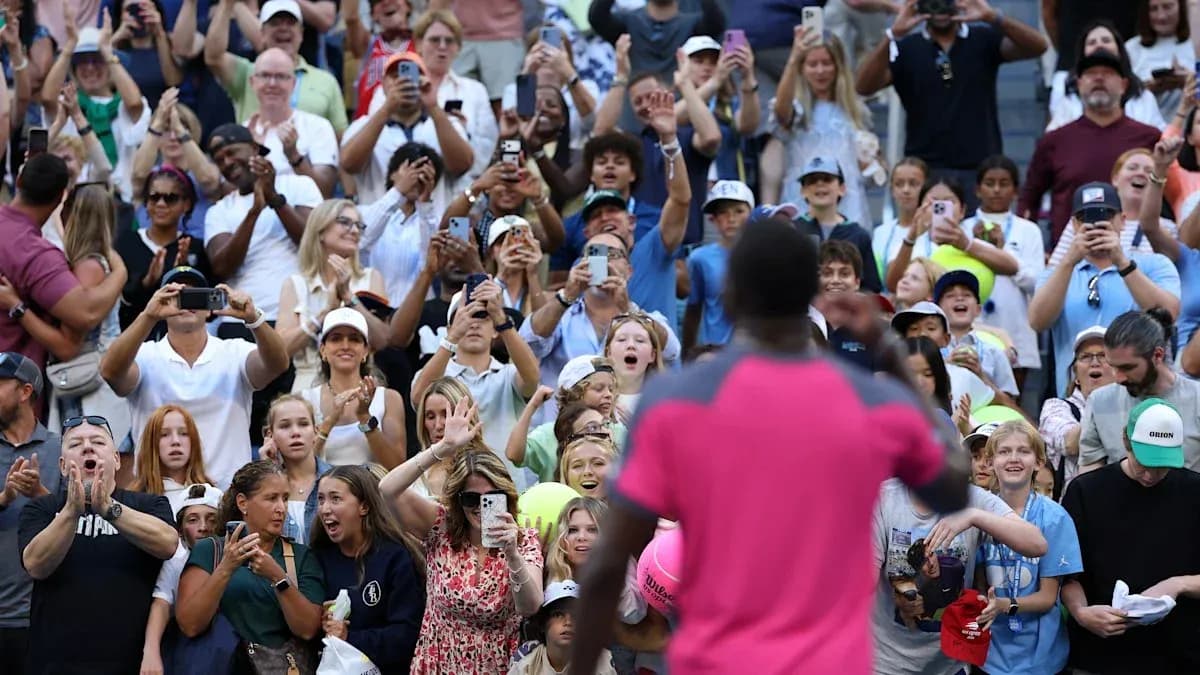
Flushing Meadows has been wrestling with a different kind of noise. Matches have been repeatedly disrupted by influencers and spectators using bright lights to film content during play, drawing frustration from players and umpires. Coco Gauff and Naomi Osaka are among those who have spoken out, making it clear they welcome new fans but expect them to respect the sport’s basic etiquette.
The tournament has responded with big-screen messages urging spectators to stop using distracting lighting and to respect the flow of matches. It’s damage control, a late attempt to restore order in a stadium some players feel has slipped too far.
French veteran Adrian Mannarino did not sugarcoat it. He described the atmosphere as turning “into a bit of a zoo,” pointing to both the movement of people during points and the smell of marijuana drifting through the stands.
“People are allowed to move around in the crowd during points,” he said after a doubles defeat. “The tournament puts up with it ... I don’t know if it’s the best thing for tennis in general.”
The contrast with Wimbledon could not be sharper.
The All England Club has already drawn its line in the grass. Organisers have confirmed they will not open the doors to an influx of influencers next year and will ban ring lights outright, determined to avoid the scenes that have unsettled players in New York. Content creators are not expected to receive accreditation, and the message is blunt: centre court is a stage for tennis, not a backdrop for social media.
Back in New York, though, the circus rolls on. The crowds are loud, the atmosphere volatile, the tennis often spectacular.
Rybakina stands one victory from the No.1 ranking and faces Zheng next, a player who has just torn down Świątek from a 5-0 deficit and carries the confidence of Olympic gold. One chasing history, the other riding a wave.
In a tournament that some players feel is veering towards chaos, the calmest answers might come from the ones holding the racquets.