Elena Rybakina Reaches First US Open Final After Overcoming Coco Gauff
Elena Rybakina walked into her first US Open semi-final a set down in every sense. On the scoreboard, on the court, and in the noise.
Coco Gauff flew out of the blocks under the lights of Arthur Ashe Stadium, a 22,000-strong crowd roaring her forward as she chased down everything in sight. Rybakina, usually so clinical, sprayed balls from the baseline, her vaunted serve strangely muted. Gauff took the first set 6-3 and looked every inch the home favourite ready to run away with it.
Then the match turned into a test of something deeper.
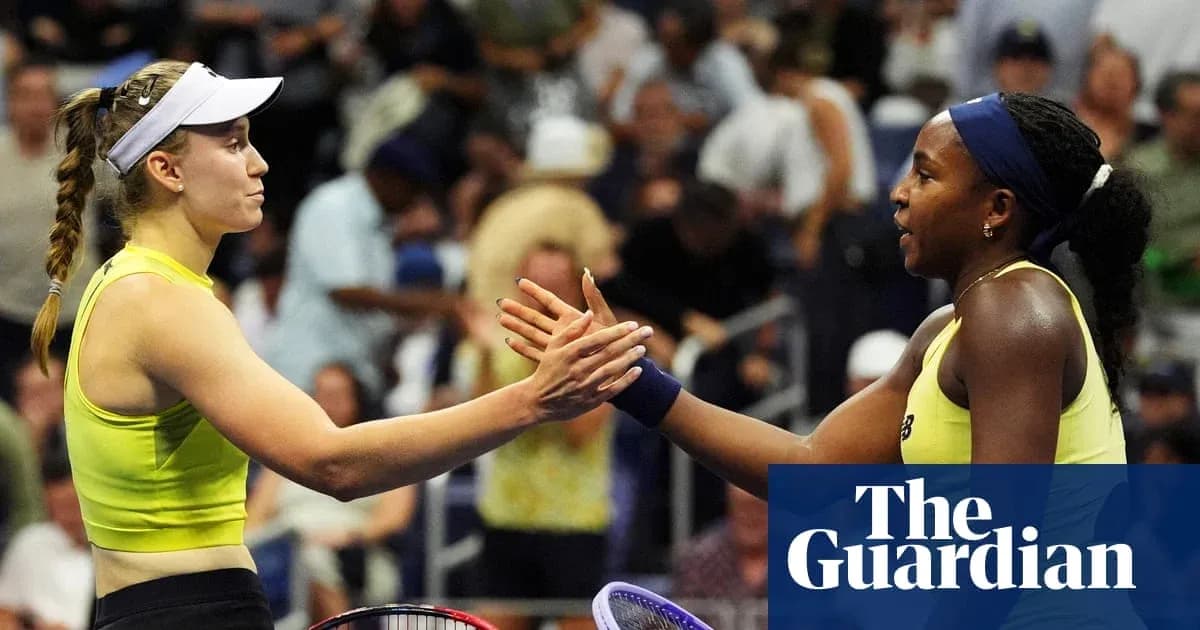
Rybakina, who has built a career on icy composure, went to work. The errors didn’t suddenly vanish, the timing didn’t instantly click, but she started solving the problem in front of her. Point by point, game by game, she dragged herself back, eventually overpowering Gauff 3-6, 6-4, 6-4 to reach her first US Open final.
She has not produced her peak tennis at any stage of this fortnight. That almost makes this run more telling. Six matches in, Rybakina has leaned on resilience and clarity under fire rather than perfection. This will be her fourth grand slam final, and since her breakthrough Wimbledon title in 2022, every subsequent major final has come on hard courts. After waiting four years to add a second grand slam this season, she now stands one match away from claiming two in the same year.
Her New York campaign already carried enormous weight before she walked on court against Gauff. Rybakina arrived with a shot at one of the sport’s defining benchmarks: world No 1. She achieved it here despite a worrying Achilles issue in the build-up and a poor history at the US Open. She kept advancing, even as her tennis flickered rather than blazed.
Securing the top ranking with a tense quarter-final win over Zheng Qinwen could easily have served as a natural emotional endpoint. It didn’t. Rybakina made clear that the ranking was only a step, not the destination. She came for the title. Now she will play for it in a final that reignites the rivalry of the season, facing outgoing No 1 Aryna Sabalenka in a rematch of the Australian Open final that Rybakina won.
On the other side of the net, this night felt like a harsh lesson for Gauff.
Her transformation over the past year has been built on a serve that once broke her down in tears on this very court. That shot, the source of so much angst 12 months ago, held up better than most of her game here. The real damage came from the forehand. Under the constant weight of Rybakina’s heavy, flat strikes, it cracked. Fifteen unforced errors spilled from that wing, many at crucial moments, as the fourth seed tried to fend off one of the game’s biggest hitters.
The occasion itself carried history. For the first time in 51 years, all four top seeds reached the women’s singles semi-finals at the US Open. No major had seen that in the women’s draw since Wimbledon 2009. It spoke to the strength and stability at the top of the game that the line-up felt more inevitable than shocking.
Familiarity usually breeds storylines at this stage, with elite players running into each other over and over. Not here. Rybakina, the second seed, and Gauff, the fourth, had largely circled each other from a distance. Their meeting at the Canadian Open last month, also won by Rybakina in three sets from a set down, was only their second career clash. This was chapter three, and it carried far higher stakes.
Gauff stepped into the semi-final with a few doubts to silence. Her serve had wobbled badly in the quarter-final against Mirra Andreeva, when she survived two match points and racked up 12 double faults. Any lingering nerves disappeared early on this night. In the opening set she served with authority in the tight moments, defended brilliantly, and coaxed a flurry of mistakes from Rybakina to grab control.
The response came fast.
To start the second set, Rybakina changed the geometry of the rallies. She stopped hitting so straight and began carving the ball wide, especially with a series of skidding, angled backhands that dragged Gauff off the court. As her groundstrokes started to land with more depth and precision, she surged to a 4-1 lead.
The set never settled into a clean rhythm. Both players sprayed errors, but Gauff’s forehand unravelled most dramatically. Serving at 4-5 to stay in the set, she delivered her worst game of the night: three forehand errors and a double fault handed Rybakina the set and a foothold in the match.
From there, the weapon that has defined Rybakina’s rise finally roared.
Her serve, one of the most destructive in the sport, truly ignited in the decider. At 1-1, she slammed down two booming aces to hold for 2-1, a statement game that reset the tone. With her delivery suddenly humming, she breezed through service games, and the burden shifted squarely onto Gauff.
By 2-3, Gauff was clinging on. Facing two break points, she dug deep, finding a couple of big first serves to claw her way to 3-3. The reprieve didn’t last. Serving at 3-4, she faltered again. Rybakina pounced, breaking for 5-3 and stepping up to the line to serve for the final.
Gauff, as she so often does, refused to go quietly. Down 3-5, 30-30 on Rybakina’s serve, she ripped a stunning backhand passing shot and then broke back for 4-5, igniting the crowd and injecting fresh tension into a match that seemed to be slipping away.
Rybakina didn’t flinch.
She shook off the missed chance immediately, moved back inside the baseline, and attacked the return game with renewed purpose. Gauff, now serving to stay alive for a second time, couldn’t withstand the barrage. Rybakina tore into her second serves, stepped in on anything short, and broke once more to close out the contest and book her place in a final between the two players who have held the No 1 ranking this season.
She came to New York chasing history. Now, with the top ranking secured and Sabalenka waiting, the question is no longer whether Rybakina belongs at the summit, but how long she intends to stay there.