Hoffenheim vs Dortmund: A Crucial Bundesliga Clash
Borussia Dortmund’s summer of spreadsheets and signatures is over. Now comes the part that actually matters.
Two wins from two have eased them into the new campaign – three points against Hamburg in the league, safe passage past HEBC in the cup – but those were gentle steps. Hoffenheim away is the first time this season the ground really starts to shake under Niko Kovac’s feet.
Hoffenheim’s revival meets its first stress test
Hoffenheim arrive as one of the Bundesliga’s quiet success stories of last year. They finished just a point shy of the Champions League spots, an outcome that felt a long way off when Christian Ilzer first walked through the door during the 24/25 season with the club staring at relegation. He kept them up, then doubled their points tally the following year. That is not survival. That is a reset.
This summer threatened to disrupt that momentum. Bazoumana Toure, the electric winger who stretched defences and games in equal measure, left the club. The planned move of Fisnik Asllani to RB Leipzig collapsed at the medical, and Asllani remains sidelined through injury. The rebuild had to be sharp and targeted.
Patrick Wimmer arrived from Wolfsburg to fill the Toure-shaped hole out wide, bringing direct running and end-product to Ilzer’s attack. Two highly regarded youngsters followed, and they have already become cult figures on name alone: Mats Rots and Nathan De Cat. De Cat, a dynamic two-way midfielder, is expected to slot into the centre of the pitch alongside Wouter Burger, forming a hard-running, technically sound core.
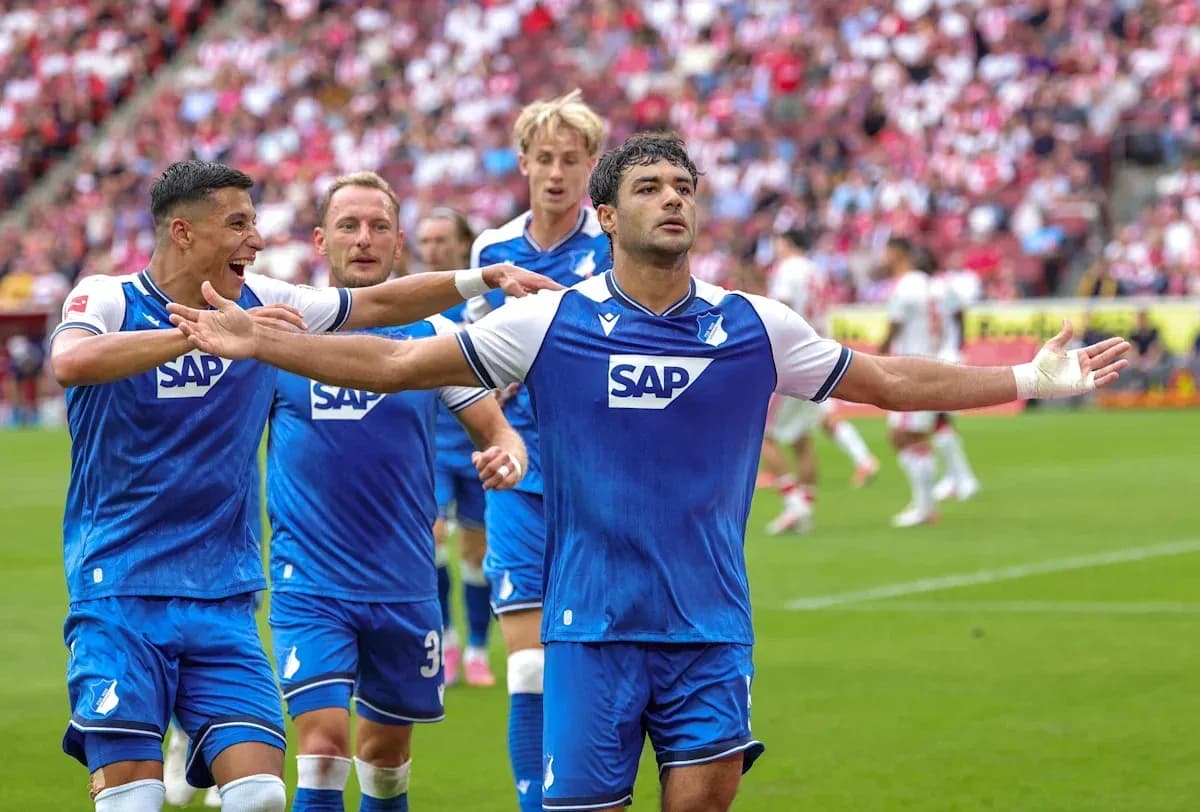
Only Wimmer started in Hoffenheim’s opening 2–3 defeat to Köln, a result that exposed some early-season rust but also underlined Ilzer’s intent. His team had 59% of the ball, picking up where they left off last year, when they finished fourth in the league for possession. The XI is likely to be reshaped for Dortmund’s visit, with Asllani still unavailable and the coach searching for the right balance between control and cutting edge.
Kovac’s first real dilemma
For Dortmund, the questions are sharper, more specific, and they start with personnel.
Konstantelias’s ACL injury and Samuele Inacio’s suspension have ripped out one of the key links in Kovac’s attacking structure. Someone has to step in alongside Karetsas, just behind Serhou Guirassy. Three names sit on the manager’s whiteboard: Marcel Sabitzer, Chukwuemeka, and new signing Ethan Nwaneri. Each offers something different, but Sabitzer’s experience and tactical discipline make him the obvious favourite to start.
The second question is more philosophical: how will Dortmund play when they don’t have everything their own way?
Against both Hamburg clubs, Dortmund dominated. They out-shot their opponents 35–9 across the two games, with an eye-catching 20 attempts in the Bundesliga opener alone. They had the ball, they dictated the tempo, they moved the opposition around and then went for the throat.
Hoffenheim will not be so accommodating. Ilzer’s side wants the ball, insists on it, and has the structure to keep it. Last season, only three teams saw more of it than Hoffenheim. Dortmund, for all their attacking verve, ranked sixth.
This is where the match tilts. Kovac’s side either finds a way to wrestle control of midfield from a possession-heavy opponent or learns to live with long stretches without the ball and turn those rare, clean breaks into goals. It is the kind of test that exposes whether a promising start is built on sand or stone.
The Kramaric problem
Then there is the familiar ghost lurking on the Hoffenheim bench.
At 35, Andrej Kramaric is no longer the first name on the teamsheet, but he remains one of the Bundesliga’s most ruthless specialists – particularly when Dortmund are in town. Across the club’s history, only five players have scored more goals against die Schwarzgelben. Four of them sit in the league’s all-time top ten scorers. The fifth is 15th.
Kramaric has 11 goals in 18 matches against Dortmund, including a brace in this very fixture last season. He reads their defensive line like a well-worn script, drifting into gaps that others don’t even see. Expect him to start on the bench, expect him to come on when legs are tiring, and expect him to treat every half-chance as if it were a penalty.
Dortmund know exactly what is coming. Stopping it is another matter.
Shape, structure, and a statement opportunity
Kovac experimented with a 4-3-3 in the cup win over HEBC, but this trip should drag him back towards his trusted 3-4-2-1. The logic is clear: more stability at the back, more protection in wide areas, and a defined platform for his front players.
Gregor Kobel is set to return in goal after Meyer’s midweek outing. In front of him, Gadou, Anton, and Ryerson are expected to form the back three, a blend of aggression and reliability. Out wide, Svensson and Beier should operate as wing-backs, responsible for both pinning Hoffenheim’s full-backs and tracking their wide threats.
In midfield, Nmecha and Bellingham remain the go-to pairing. They will be asked to do everything at once: screen transitions, break lines with the ball, and set the tempo when Dortmund finally get it. Ahead of them, Sabitzer and Karetsas are likely to work in the half-spaces, linking play and feeding Guirassy, who should resume his role up front after finding the net last week.
It is a system built to flex. It will need to.
Hoffenheim will try to turn this into a game of patterns and passing lanes. Dortmund will either match them stride for stride in the centre of the pitch or embrace a more ruthless, counter-punching version of themselves. Somewhere in that tension lies the real measure of Kovac’s Dortmund.
The transfer window is closed. The excuses are gone. Now we find out how good this team actually is.