Javagal Srinath's Ordinary Moment: The 'Mysore Express' in Bengaluru
On an ordinary day in Bengaluru, the 'Mysore Express' stood still.
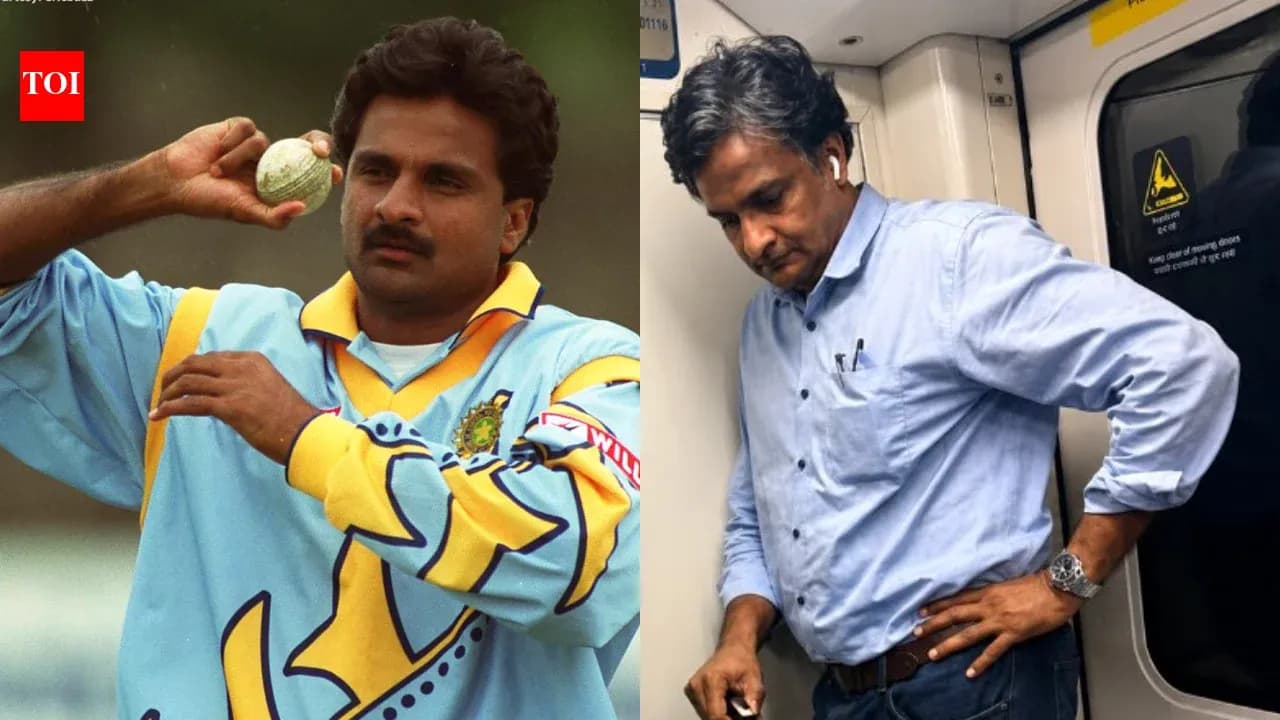
No new-ball in hand. No roaring crowd. Just Javagal Srinath, a trolley bag by his side, riding the Namma Metro like any other commuter. One photograph, taken quietly and shared online, has done what thousands of deliveries once did for him: put him back in the middle of a national conversation.
The image is almost disarming in its simplicity. Srinath in jeans and a light-blue shirt, standing inside a Metro coach, luggage parked beside him. No security cordon. No eager selfie hunters. No hint, at first glance, that this is the man who once led India’s pace attack through the 1990s, when genuine fast bowlers from the country were still a rarity.
That is precisely why the picture has cut through.
The 'Mysore Express' in slow motion
For a generation of Indian fans, Srinath is not just another former cricketer. He was the spearhead. The Karnataka quick who shouldered India’s pace burden across 67 Tests and 229 ODIs, often on unhelpful pitches, often with little support at the other end. His nickname, the 'Mysore Express', spoke to the speed and relentlessness with which he ran in for his country.
Yet years after retirement, it is not a yorker, a broken stump or a match-winning spell that has gone viral. It is a quiet, almost anonymous moment on public transport.
There is nothing in the frame to announce his past. No India blazer, no ICC accreditation card dangling from his neck. Just a middle-aged man on his way somewhere in his own city. That contrast — between the memory of the tearaway quick and the reality of the unassuming commuter — is what has struck fans.
The pressure of nostalgia finally told. Social media timelines filled up with the same sentiment: this is exactly who they believed Srinath to be.
Fans see what they always suspected
The reactions came quickly. Cricket followers praised what they called his simplicity, his refusal to lean into the trappings that so often follow international careers. Several users said this was not a one-off sighting; they had spotted him before in Bengaluru, moving alone, without the security or spectacle that usually surrounds former India stars.
The photograph also reopened an old conversation about Karnataka’s cricketing culture. Names like Rahul Dravid, Venkatesh Prasad and Anil Kumble surfaced alongside Srinath’s, as fans recalled an era in which some of India’s most influential cricketers carried themselves with a striking lack of fuss.
One widely shared comment captured the mood: that Kumble, Srinath, Dravid and Prasad represented a unique phase of Karnataka cricket, proving that immense success could sit comfortably alongside humility and grace. The Metro image became a visual shorthand for that idea.
For many, it was a reminder that sporting fame does not have to harden into celebrity.
A familiar figure at unfamiliar places
This is not the first time Srinath’s everyday life has turned into a talking point. A previous photograph, shared by a fan, showed him waiting at Mysuru railway station, a bag slung over his back, blending into the crowd. That image too had drawn admiration for how casually he appeared to be going about his business.
The Bengaluru Metro picture has triggered the same response. It surfaced online, began circulating widely, and again people paused to take in the ordinariness of it. The exact date of the photograph remains unclear, but the timing hardly matters. The story lies in the scene, not the schedule.
A man who once thundered in at batters from 22 yards now waits, stands, rides, just like everyone else.
Still part of the game, just in a different lane
Srinath may have stepped away from the international stage as a player, but he never really left cricket. After retirement, he moved into the role of ICC match referee, trading the ball for the rulebook yet staying firmly embedded in the sport’s highest level.
It is a very different vantage point. No longer the fast bowler dragging India’s attack forward, he is the official overseeing the game’s conduct, watching from the periphery rather than charging into the spotlight. For many fans, though, that image of him with the new ball, carrying India’s pace hopes through the 1990s, refuses to fade.
That is why a single photograph from a Metro coach can ripple so widely. It doesn’t show a former star surrounded by admirers or reliving old glories. It shows a man, alone with his bag, moving through his city.
In an age of curated feeds and manufactured celebrity, the 'Mysore Express' has once again done something rare: he has travelled fast and far across the country’s imagination by doing absolutely nothing out of the ordinary.