John Martin: Criticise Me, Not the Players in Israel Fixtures
The Republic of Ireland’s autumn Nations League dates with Israel are still on the calendar. Nobody at the FAI sounds particularly happy about that, least of all the man now fronting the decision.
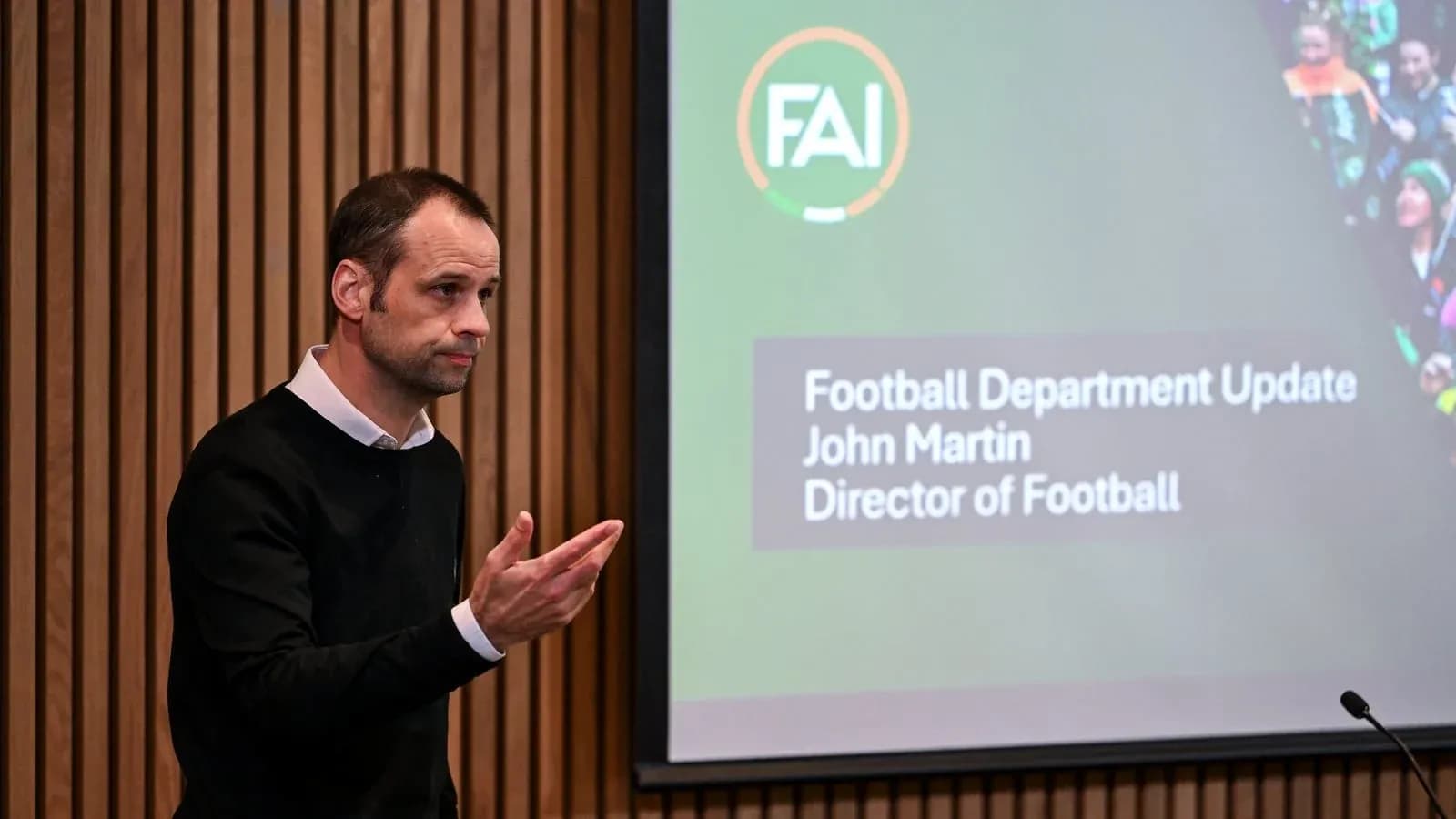
John Martin, the FAI’s Director of Football, has made it clear he would rather these games were not played. But he also knows who will carry the burden when the ball is kicked in Debrecen and Bačka Topola.
“It always falls on the players in a performance environment,” he said, speaking to RTÉ Sport. This time, he insists, it should not.
Games the FAI do not want, but feel they must play
Heimir Hallgrimsson’s side are due to face Israel in Debrecen, Hungary, on 27 September in what is officially the ‘away’ tie, before hosting the return fixture on 4 October in Bačka Topola, Serbia.
The FAI’s stance has been tortured and public. In July, delegates at an extraordinary general meeting voted on whether to endorse the board’s decision to fulfil the fixtures. The motion passed by 68% to 32%. The games would go ahead.
The cost of that decision has been rising ever since. Political pressure, supporter anger, calls for a boycott. The FAI has already moved to strip the occasions of any sense of normality: no tickets for Ireland fans for either match, Ireland’s ‘home’ game behind closed doors, and only Israeli fans allowed at the September fixture.
The optics are grim. The mood around Abbottstown, even more so.
“We all agree, and the association has been on the record to say that we don't want to be playing these games. That is the reality,” Martin said. “I don't want to play the games.”
So why play them?
Because, in Martin’s view, the alternative is worse.
He fears the scale of potential UEFA sanctions if Ireland refuse to fulfil the fixtures – punishments he believes could inflict serious, long-term damage on Irish football. That, he argues, is the line he cannot cross.
“For Irish football we will play the game,” he said, framing the decision as a painful calculation rather than a moral shrug.
‘Protect the players’
If the association has decided to take the field, Martin is adamant that the players must not be left to carry the moral and political fallout.
“In this situation, the decision shouldn't fall on the players because it's not at the player's decision,” he said. “It was a decision made by the association, by the board and by the executive.
“People like me and David Courell made this decision, not the players.”
The message is blunt. Aim your anger higher.
“We need to protect the players and look after the players because we shouldn't find a situation where they’re being criticised,” Martin continued. “People can criticise me and David, that’s fine.”
He knows the reality, of course. When the national team walks out, the cameras and the headlines go with them. Whatever the FAI’s internal processes, the players’ faces will be the ones attached to the controversy.
“It’s going to be really difficult because it does fall on them naturally because they're on the pitch,” he admitted.
Martin stressed that every squad member will have a personal choice to make about whether they make themselves available for selection. There will be no public pressure from Abbottstown on those who opt out.
“It's a personal choice for the player,” he said. “We have a fantastic manager in person in Heimir who will manage that. But at all stages, we need to mind the player… We’re always mindful of the environment the player is in and we need to protect them as best as possible.”
The hope inside the FAI is that supporters recognise that distinction: players following the lead of the association, not setting it.
“I would hope people can see that they're following the lead of the association and following the decision that the association took, as opposed to putting them at the centre,” Martin said.
Shadow of Shamrock Rovers investigation
As if the Nations League storm were not enough, Martin’s name is also tied to another uncomfortable storyline in Irish football.
The Sunday Times reported that the FAI are investigating alleged third-party ownership breaches involving Shamrock Rovers players Michael Noonan and Alex Noonan. The agreements in question date back to Martin’s time as CEO at the Tallaght club.
Now, as an FAI executive, he finds himself working for the organisation that is examining a period of his own past. It is an awkward overlap, and one that naturally raises questions about conflict of interest.
Martin, though, is adamant on two points: he is not under investigation himself, and he has not been asked to step aside.
He is not part of the FAI team handling the case. The governing body is seeking documents and information to establish whether any FIFA rules were broken. The matter originated with a complaint from Michael Noonan’s mother to the English FA regarding agent agreements, before being referred back to the FAI after FIFA became involved. Shamrock Rovers have said they are working with FIFA to review two agreements and have denied that the club itself is the focus.
Martin’s public stance is one of calm detachment.
“I'm very comfortable about my time from Shamrock Rovers, exceptionally comfortable,” he said. “I can't comment. I'll leave that to other people to figure that out. It's not something I'm worried about.”
Asked directly whether there had been any request for him to stand down temporarily, his answer was unequivocal: “Absolutely not.”
He admitted the situation is “frustrating” because he cannot go into more detail, but he repeatedly returned to his insistence that he has behaved correctly and will continue to do so.
“I've been incredibly dignified, professional and respectful of the club,” he said. “I intend to continue being dignified, professional and respectful towards the law because I think someone in my role needs that.”
He does not want a public slanging match.
“I don't think Irish football needs people to be talking public negatively about each other because that damages the perception of the game,” Martin said. “I'm a naturally positive person. I've only good things to say about the club. It's a situation I can't talk about. But I'm in no way worried about it.”
Two storms, then, circling the same figure: one about where Ireland must play, the other about what happened at a club he used to run. The Nations League fixtures will arrive soon enough. When they do, the players will walk out, the whistle will blow, and the debate will flare again.
The real question is whether Irish football can emerge from this period with its players shielded, its governance trusted, and its long-term future intact.