Katie Taylor's Emotional Retirement Celebration at Croke Park
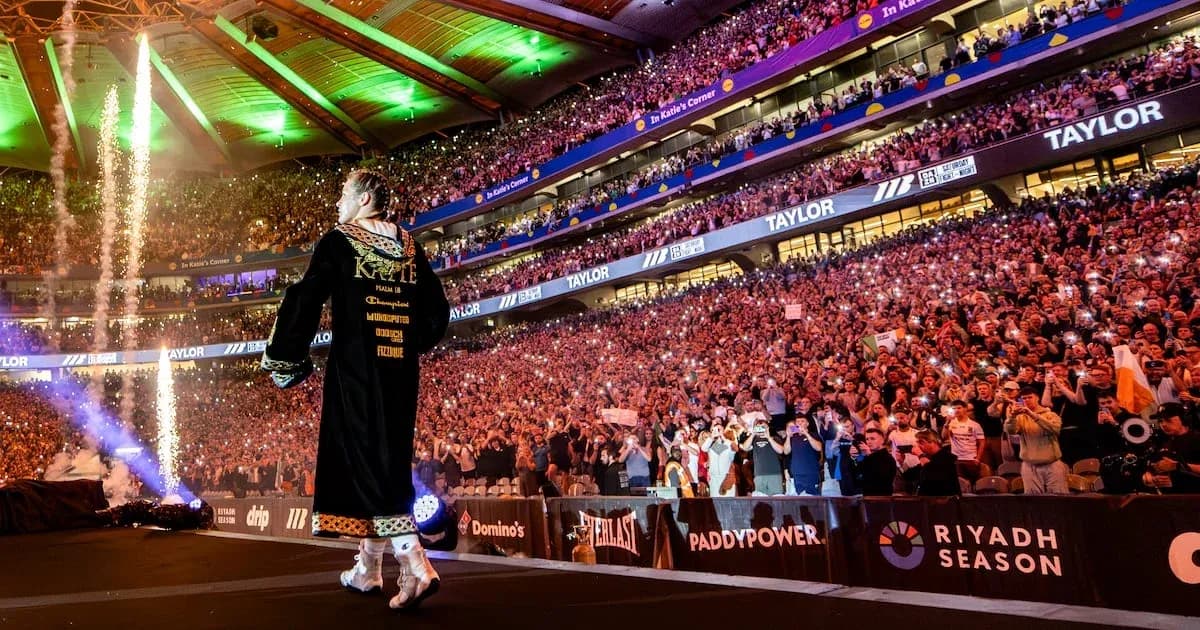
Croke Park has staged All-Irelands, rock epics and World Cup qualifiers, but it has never quite seen a retirement party like this. No gold watch. No lawnmower. Just 80,000 people on a soft September night, standing to say goodbye to Katie Taylor.
Natasha Jonas, once an opponent and now an admirer on RTÉ duty beside Bernard Dunne, watched it all with the knowing smile of someone who has seen the cult of Katie up close. She remembered a qualifying event for the 2012 Olympics, “in the middle of nowhere in China”, when a roar tore through the arena. She went to investigate. “Youse can’t be Irish?” she said to the fans. They were. They’d come from Beijing. “People just follow her wherever she goes.”
They followed her to Croke Park in extraordinary numbers. Some in the stands wondered aloud if this was the biggest fight crowd of all time, though the record books still point to Tony Zale v Billy Pryor in Juneau Park, Milwaukee, where 135,132 reportedly turned up in 1941. No giant screens then. Which means 134,132 people probably went home unsure who actually won.
No such ambiguity in Dublin. Croke Park shimmered. The lighting designer earned every cent and not nearly enough. The place throbbed with music, a stadium choir in full voice. Grace. The Fields of Athenry. Zombie. Three songs, three tragedies, belted out with the kind of gusto that leaves visitors baffled and locals oddly proud.
Try explaining it to the tourists. The love song to a man executed days after his wedding. The lament of a prisoner shipped to Australia for stealing food in the Famine. The howl about innocent lives lost during The Troubles. A farewell party wrapped in grief and melody. Only in Ireland does a sporting celebration sound like a national therapy session.
RTÉ leaned straight into the emotion. Montage after montage. Old clips, new tears. Bernard Dunne clung to composure as long as he could. “This is more than just a boxing match,” he told Jacqui Hurley. “It’s a celebration, a thanks for what Katie’s given us over the years.” Then My Way blasted over the speakers and any remaining resistance dissolved. You were either made of stone or you were gone.
The stadium lights dimmed, and 80,000 phones lit up the bowl. Three-quarters of Westlife appeared to deliver You Raise Me Up, and Croke Park duly obliged. Then came the surreal sight of Marty Morrissey dancing with Michael Flatley to Olé Olé Olé, a moment that felt like it had been plucked from a fever dream. “It’s like a rave that meets a football occasion,” Jacqui Hurley said, and that just about nailed it.
Ringside, Paul O’Flynn grabbed a word with Shane Lowry. On the big screens, tributes rolled in from Bono, Ed Sheeran, Niall Horan and Rory McIlroy, big names reduced to video messages on a night when a lightweight from Bray was the hardest ticket in town. Just before the anthem, Barry Keoghan’s voice cut through the noise with a final piece of theatre.
“All stories begin at home. The rare ones end there, too. And so, Katie returns for every fan who walked the journey beside her ... for all Ireland. When they ask you about Katie, you can begin with four simple words. Once upon a time.” Somewhere, a Kleenex executive counted the windfall.
Then came the boxing.
Flora Pili, Taylor’s final opponent, emerged into the cauldron and stopped to take it in. Her expression translated perfectly: mon Dieu. Lesser fighters might have headed straight for Rosslare and the first ferry out. She stayed, showed courage, and climbed through the ropes into the eye of a storm.
Taylor’s entrance took the spectacle up another level. All Hail King Jesus boomed around the ground, a choice that left most of the crowd humming along rather than singing. Fireworks ripped the sky apart. Taylor puffed out her cheeks as she surveyed the scene. Madison Square Garden, the old cathedral of her career, suddenly felt like a tidy little club show compared to this.
“I’m feeling pretty emotional myself here and it hasn’t even started,” admitted commentator Hugh Cahill. Beside him, Eric Donovan could only gasp: “Oh my gosh, this is extraordinary.”
The fight itself never threatened the script. Pili tried, but Taylor controlled. The challenger rarely landed cleanly, and when she did, she knew there were 80,000 unpaid bodyguards glaring back at her. Round by round, Taylor boxed with the calm authority of someone who understood that this night, this arena, this send-off, already belonged to her.
The final bell brought the inevitable. A unanimous decision. No controversy. No late twist. Just a roar of relief and gratitude that rolled down from the stands and washed over the ring.
Then came the moment that will live longest.
Taylor took off her gloves and walked to the centre of the ring. She placed them gently on the canvas, right on top of the Lidl logo, a marketing department’s dream shot to rival Nike’s famous swoosh on the lip of Tiger Woods’s Masters putt. Somewhere in a rival boardroom, Aldi executives winced.
The symbolism needed no commentary. This was it. The end.
O’Flynn stepped through the ropes and asked the question hanging in the air. “What now?”
Taylor didn’t talk about legacy or future roles or what comes next for Irish boxing. She went simple. Human. Honest. “I’m just going to enjoy the fruits of my labour,” she said. “I’m going to eat chocolate.”
After everything she has given, a Time Out feels about right. And this time, nobody in Ireland will argue that she hasn’t earned it.