Katie Taylor's Retirement: What Comes Next for the Champion
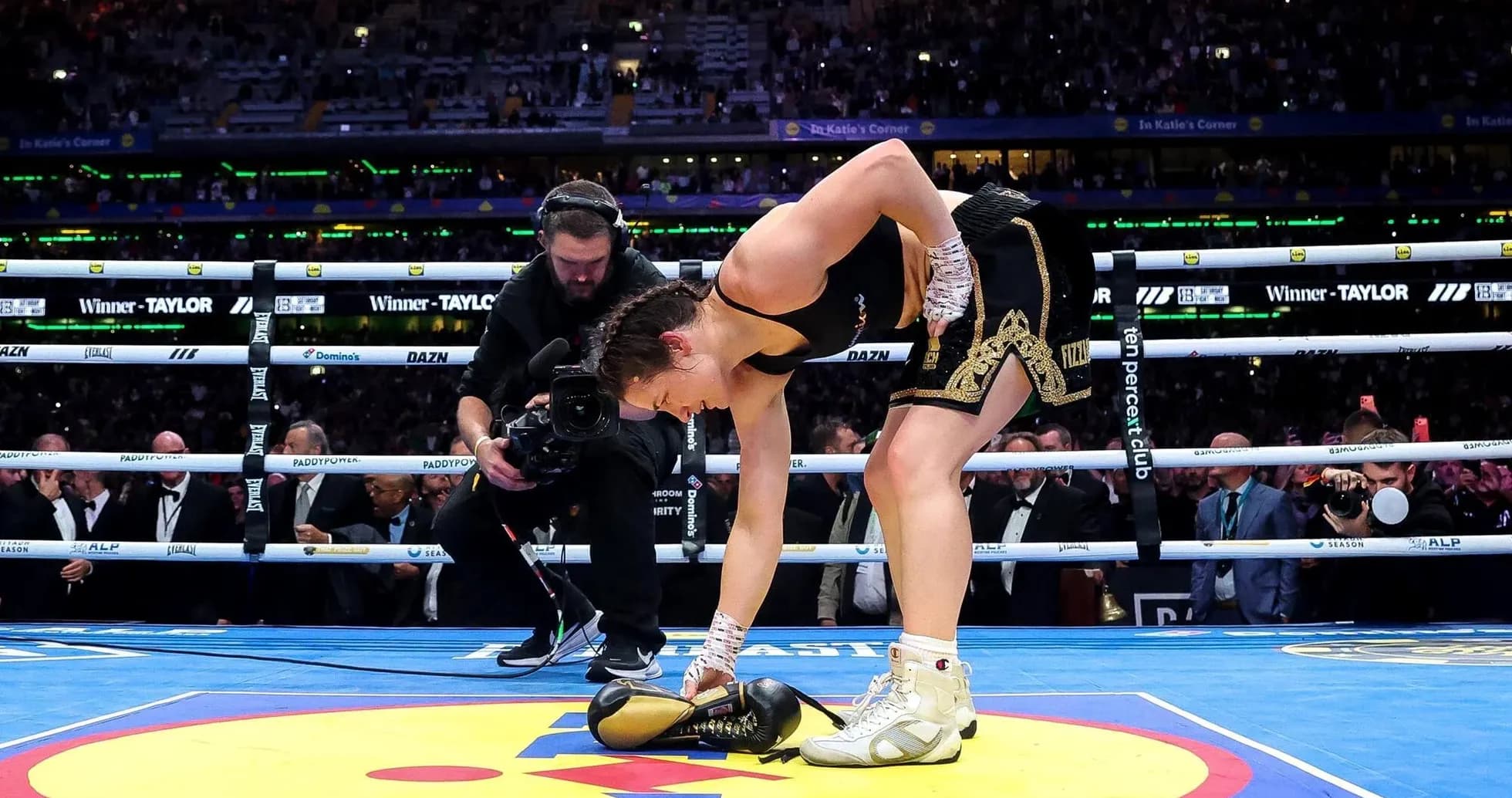
Katie Taylor stood on the canvas at Croke Park on Saturday night and looked out into something every great fighter eventually has to face: the void after the final bell.
Boxers talk about retirement as their first death. The numbers back it up – careers end, then come the bankruptcies, the divorces, the drifting. The roar goes quiet and the silence can crush. Eddie Arcaro, the great American jockey, once put it bluntly: when a jockey retires, he becomes “just another little man”. Ray ‘Boom Boom’ Mancini, a former WBA lightweight champion, joked that in retirement he eats less, weighs less, trains less and cares less. Both men built good second lives. Both still struggled.
Now it’s Katie Taylor’s turn to find out what comes next.
A send-off like no other
Alan Minter used to say there were only two reasons a boxer came back: “they were either broke, or they needed the money.” Taylor should fall into neither camp. Not even close.
A purse of roughly €3m is due from her Croke Park farewell. She earned over €7m from just the last of her three fights with Amanda Serrano. The numbers alone would let her disappear quietly if she chose. But nothing about this goodbye felt quiet.
As Irish sporting exits go, this one sits alone at the summit. Brian O’Driscoll’s long, emotional farewell in 2014 – capped with a Six Nations title – now looks like a distant runner-up. Taylor’s final walk, framed by the horseshoe of Croke Park and a September sky, felt like something else entirely: a nation trying to say thank you all at once.
The performance matched the stage. A classy, controlled defeat of Flora Pili, followed by a rare glimpse of a more talkative Taylor. Eddie Hearn even joked about how long she spoke in the ring afterwards. For once, she let the words flow.
From the ring to the stage
If her promoter Brian Peters gets his wish, the next time most people see Taylor will not be in a gym or at ringside, but on a stage in some parish hall on Inisbofin, or in a community centre in a town that never thought it would host a world champion.
The project is called ‘Her Story’, a nationwide stage play with Taylor alongside Steve Bunce. Peters promised it will be “quite magical”. The idea of Katie Taylor criss-crossing Ireland, telling stories about herself, jars with the woman the public thought they knew – guarded, private, almost allergic to self-promotion.
Then again, second acts rarely follow the script.
Who predicted Roy Keane would become a media star and advertisers’ favourite? Who saw Bill Belichick’s public image unravelling so quickly once he stopped being the Patriots coach? The afterlife of sporting greatness tends to surprise.
Taylor herself admitted on Sunday that her plan, from the very start, was simple: say as little as possible and let the boxing speak.
“I determined very, very early on in my career not to talk but to show my boxing skills and just to let my excellence do the talking and let my talent do the talking,” she said. “And I've kept to that throughout my whole career.”
Now the gloves are off. The question is what she does with that voice.
A legacy already in the ring
Whatever path she chooses, boxing will not be far away. It can’t be. Her impact on Irish fighters – men and women – is already baked into the sport’s DNA.
She inspired a generation simply by existing at the level she did. They have said it over and over. The image of her sparring with ten-year-old Clodagh Keating last week captured it perfectly: the icon in headgear, moving lightly, the child grinning through a gumshield, throwing punches at her hero. One era passing something precious to the next.
Coaching is the obvious avenue, though that single word covers a world of options: national teams, pro camps, mentoring roles, advisory positions. Each door she opens will close another.
She was asked whether she might take on an official role in Irish boxing. Her answer came with a smile and a nod to real life. Convincing her husband to swap their home in Connecticut for a permanent move to Ireland, she joked, had not “gone down very well”. There are six children to think about. Any decision now is bigger than belts and banners.
Faith, family and an uncertain spotlight
If boxing remains a constant, so will two other pillars: family and faith.
Her walk to the ring at Croke Park to ‘All Hail King Jesus’ was not subtle. Nor was what followed. Asked about her beliefs after the fight, she spoke of clinging to faith, and to what she sees as the word of God, through the darkest moments of her career – not least the heartbreak of Rio 2016.
“Look what God's done. He's done the impossible in my lifetime and he's came through time and time again,” she said. “And that's what I was saying in the ring afterwards and giving him all the glory and the honour for all that I've achieved.”
That kind of open declaration slots easily into the sporting culture of the United States, where she now lives. In Ireland, where the relationship with religion is more complicated, it could have jarred. It never really did.
Her popularity has proved almost bulletproof. The faith, the privacy, the occasional awkwardness in front of a microphone – none of it dented the bond. The affection that spilled down from the stands at Croke Park and out into the night spoke to something deeper than medals and titles.
Taylor occupies a space in the Irish consciousness that no other athlete quite shares. It is not just that she is successful. Others have been. It is not just that she is humble. Others are. The connection is harder to pin down, more fragile and yet somehow stronger for it.
She struggles to explain it herself.
“I don't know, to be quite honest,” she admitted. “I think people, the whole country, has seen me and my good times and they have also seen me during my devastations as well. I think people really resonate with your vulnerabilities as much as your successes.
“They see me cope with the heartbreak of Rio. They see me cope with the heartbreak of the shadow of loss. They see me in the, just, personal difficulties as well. So yeah, I think my story is the story of everybody in the whole country.”
The belts are packed away now. The training camps, the weight cuts, the lonely runs in the dark – all of that is over. But the story she talks about so often, the one she insists belongs to everyone, still has chapters unwritten.
Retirement, the toughest opponent of all, is in front of her.
Katie Taylor has gone the distance with everyone else. What happens when she finally has to fight time, and only time, will define the rest of her legend.