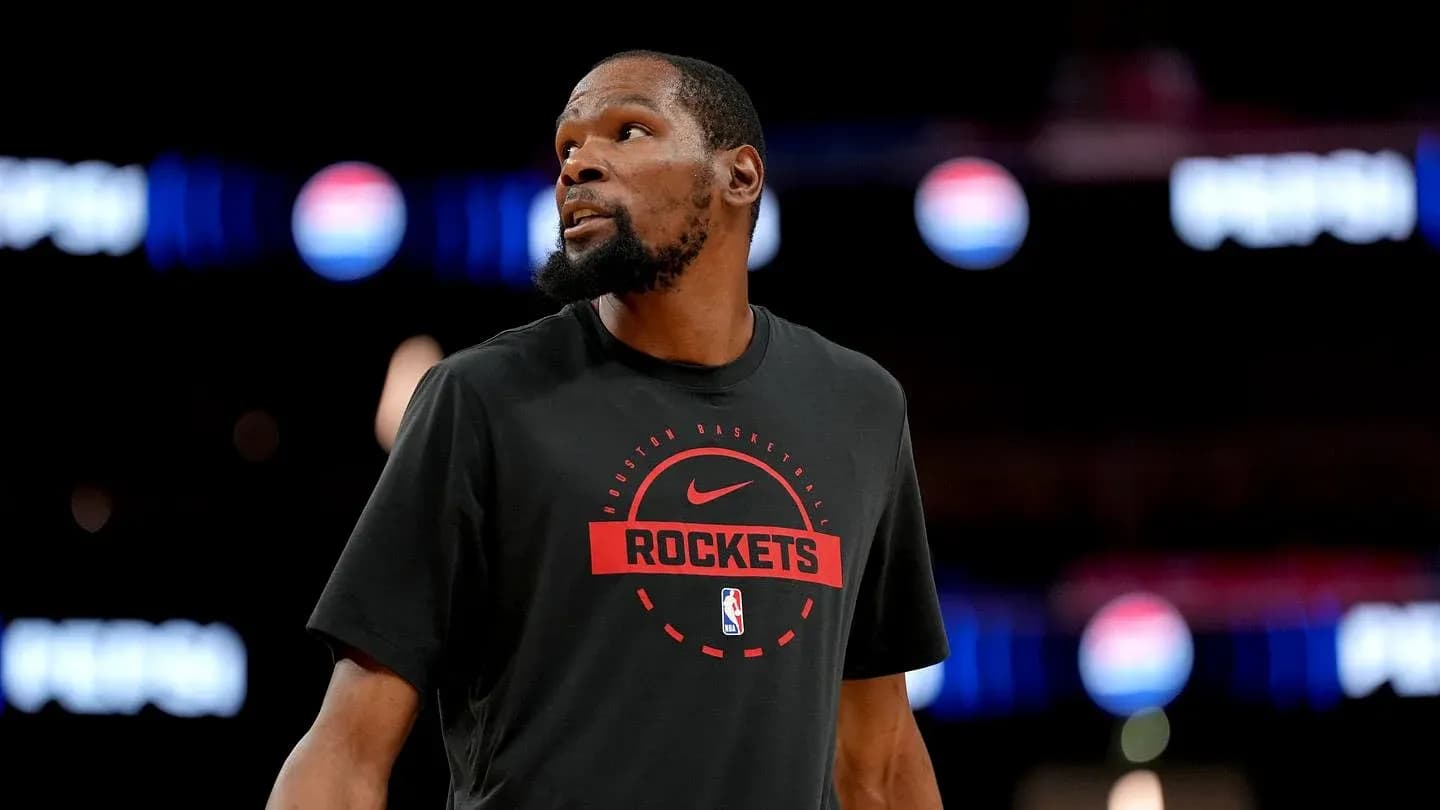
Kevin Durant's Legacy Beyond Banners in Houston
Kevin Durant’s résumé has been argued over for a decade. At this point, it mostly reads like a closed case.
Two NBA championships. Two Finals MVPs. The 2014 league MVP. Six All-NBA First Team nods. Four scoring titles. Sixteen All-Star appearances. Stack that against almost any forward in history and he stands comfortably in Hall of Fame territory.
Yet Durant, now deep into the second half of his career, is chasing something that doesn’t fit neatly into a trophy cabinet.
“I Don’t Care About Legacy” — Except He Does
Durant has long pushed back against the way fans and media obsess over “legacy.” But when he spoke during a Zoom seminar hosted by O.U.R. Mothers, he peeled back the curtain a little.
“I like to say that I don’t care about legacy, but I actually do,” he told Houston Rockets OnSI. “I want to be known for actually impacting lives in a positive way. It’s that simple. It don’t really matter if the masses know it or a few people do. I just want to know internally that I made sure that we try to do the right things every time that we step up.”
That’s the part of his career that doesn’t show up in the box score.
Through the Durant Family Charitable Foundation, he’s poured time and resources into at-risk youth from low-income backgrounds. The mission is direct: enrich lives, expand opportunity. The work stretches beyond basketball courts, into entrepreneurship, STEM, and college readiness programs. It’s a deliberate attempt to widen the lane for the next generation.
Away from the charity arm, Durant’s business brain is just as active. His sports, entertainment, and media platform, Boardroom, has become a vehicle for storytelling, deal-making, and influence. He’s not just participating in the modern athlete-entrepreneur era; he’s helping define it.
Still One of the League’s Killers
For all the off-court ventures, Durant’s day job still matters. A lot.
He remains one of the NBA’s most polished scorers, and last season with the Houston Rockets he reminded everyone that his game hasn’t dulled. Over 78 games, he averaged 26.0 points, 5.5 rebounds, and 4.8 assists. That production, at this stage of his career, earned him a place on the All-NBA Second Team.
Houston finished 52-30 in Durant’s first season with the franchise. Respectable. Competitive. But not yet terrifying.
The postseason exposed the gap. The Rockets bowed out in the first round, and the narrative could have been brutal. Instead, context mattered: Durant missed the bulk of the series against the Los Angeles Lakers. Houston’s early exit said more about availability than potential.
The Rockets know it. The rest of the Western Conference does too.
A Young Core, a Narrow Window
What makes this chapter of Durant’s career so intriguing is the cast around him.
Alperen Sengun, already a two-time All-Star and still under 25, is blossoming into one of the most skilled big men in the league. Amen Thompson, a defensive menace with length and instincts, gives Houston a stopper who can swing playoff series.
Both are still growing. Both can still make a leap.
If they do, Houston doesn’t just become dangerous. The Rockets become a problem.
The challenge is brutal and obvious: the Western Conference runs through the San Antonio Spurs and the Oklahoma City Thunder. Those two are the current benchmarks, the teams everyone else measures themselves against. Houston’s task is to close that gap quickly, before Durant’s prime finally eases into memory.
He’ll be chasing a third NBA championship in 2027. For the Rockets, it would be their first title in more than 30 years. For Durant, it would be something different entirely.
What One Ring in Houston Would Mean
Durant has already secured his place in the game’s history. That part is done. The numbers and accolades alone guarantee Springfield.
But leading Houston to a championship would shift his story again.
It would elevate him from superstar import to franchise icon. It would stitch his name into Rockets history alongside the legends who built the banners that already hang. And it would do so in the twilight of his career, in partnership with a young core that represents the league’s future.
Durant talks about legacy now in terms of impact, of doing “the right things every time that we step up.” The irony is that on-court and off-court, those paths are starting to merge.
If he can deliver one more title — in a new city, with a new generation at his side — how much louder will his legacy speak then?