Karen Khachanov Advances as Alexander Blockx Retires in US Open Quarterfinals
Karen Khachanov is into the US Open semi-finals, but this one did not end the way anyone wanted.
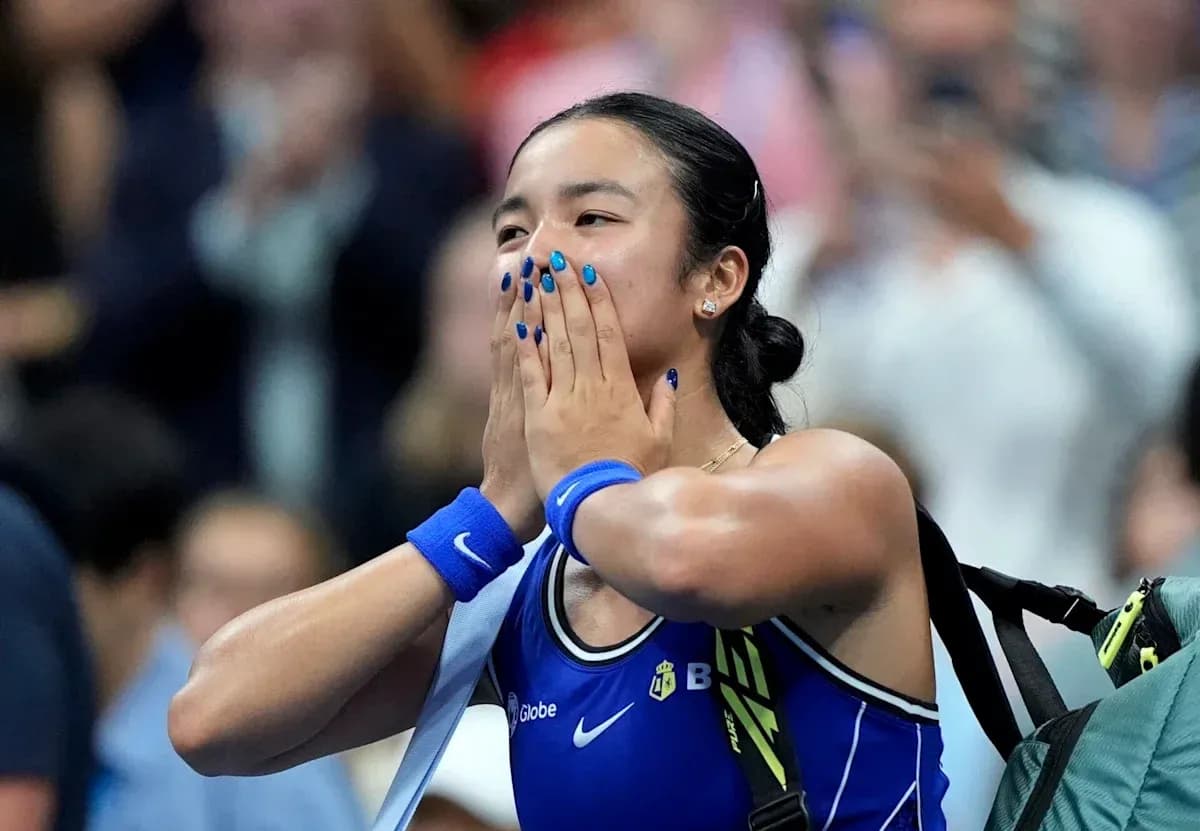
Midway through the third set, Alexander Blockx walked to the net, extended his hand and called it. The 21-year-old Belgian, on his main-draw debut in New York and already into a quarterfinal, simply had nothing left to give.
“Blockx has nothing left,” Nick Lester said in commentary as the players met at the net, the match ending not with a winner, but with a concession.
A young star pushed to breaking point
This tournament has been a coming-out party for Blockx. He arrived with promise, leaves with a reputation, and in between produced the sort of tennis that forces the locker room to sit up and take notice.
Robbie Koenig captured the mood. Tennis fans, he said, will be seeing plenty more of the Belgian. He pointed back to the win over Flavio Cobolli, a performance he described as “mesmerising” from a player who has already stacked some impressive scalps in his first big run at a major.
“We are going to see a lot more of this young man in the years to come – fingers crossed that he can stay healthy for long periods of time,” Koenig said on commentary. “He's got such an exciting game, he's got such a great attitude out on the court and he's got a big time mentality.”
The attitude was never in doubt. Blockx came into the match with a rib issue, then battled blisters and a back problem that required repeated treatment at the change of ends. Between sets he took another medical timeout for more work on his back. His support box, once buoyant, grew increasingly anxious, the conversation turning from tactics to risk: how much more could his body take?
Still he refused to fold. At 1-1 in the third set, he was clearly hurting but not capitulating, moving well enough that Khachanov had to earn his points. This was no farewell lap.
Dokic hails a fighter
From the commentary box, Jelena Dokic saw more than a talented shot-maker. She saw a message being sent.
"We can see what a great competitor he is … I give him so much credit for (continuing) competing because he doesn't want to retire and he wants to stay out here on the court and finish the match," she said on Nine.
Then came the harder truth. “But then if you've got this many injuries and depending on also what they are, especially the rib as well … you've got to think, 'can I do more damage here as well?'”
That was the dilemma. The heart wanted to stay. The body was calling time.
“He’s showing incredible competitive spirit. This also actually sends a big message to the locker room as well – everyone is always watching,” Dokic added. “He's going to stay out there, that he's a great competitor. He's just 21! To stay out here and keep playing is an incredible effort."
In the end, the pain won. Khachanov, who had already taken the second set and was tightening his grip on the match, advanced to the last four. For Blockx, the scoreboard shows a retirement. The fortnight tells a different story.
Earlier, Lester had summed up the mood as the Belgian’s movement deteriorated.
"It's looking ominous for the Belgian on his US Open debut. It's been a memorable, but the clock is ticking," he said.
The clock finally hit zero. His tournament stopped, his reputation did not.
A night that went on forever
While Blockx and Khachanov were grinding through their quarterfinal, another storyline was unfolding above them in the corridors of power.
New USTA chief executive Craig Tiley has promised a fresh look at scheduling after the latest-ever finish in US Open history. On Wednesday (AEST), Carlos Alcaraz and Ben Shelton did not step onto court for their men’s quarterfinal until after 11pm local time. Shelton’s winning ace landed at 3.33am.
Tiley, who moved into the role after a long stint running Tennis Australia and the Australian Open, pointed out that all four matches on the day card went the distance, with three of them decided by a 10-point match tiebreak.
"If you look back at schedules, you don't get that ever. So that was particularly special," he told Stan Sports.
“The stadium was full. Everyone was loving it. We had people watching from all around the world. It was a great time for many people – not necessarily for everyone having to stay up here late and watch it – but it’s just one of those things.
"One thing we always do at the end of every event, we have a look and see what's worked best. Scheduling is also on that list. We'll always look at our options."
The numbers from that marathon day were staggering. In the day session, Aryna Sabalenka edged Linda Noskova 7-6 (1), 3-6, 7-6 (10-7) in 2 hours 22 minutes. Frances Tiafoe then staged a remarkable escape against Alex Michelsen, winning 5-7, 3-6, 7-5, 6-3, 7-6 (10-6) in 4 hours 39 minutes.
The night session was pushed back by almost two hours. When it finally began, Jess Pegula needed 2 hours 21 minutes to outlast Emma Navarro 3-6, 6-4, 6-3. Only then did Alcaraz and Shelton take the stage, with the American coming through an epic 6-7 (5), 6-1, 6-3, 1-6, 7-6 (10-7) in 4 hours 28 minutes.
By the time the last ball was struck, New York was asleep. The debate about late finishes was wide awake.
Gauff channels Tiafoe’s escape act
Those long hours on Arthur Ashe Stadium did more than stretch the schedule. They inspired.
Coco Gauff admitted she drew directly from Tiafoe’s comeback against Michelsen as she turned her own match around against Mirra Andreeva. Gauff dropped the first set and stared down match points in the second-set tiebreak, yet somehow found a way to wrestle the contest into a deciding set and then take it.
"I came out not feeling the ball, giving her too many free points, and Mirra is playing at a great level," she said in her on-court interview.
Her mind went back to Tiafoe, two sets down and facing Michelsen serving for the match before flipping the script.
"To be honest I was thinking about Frances Tiafoe and how he came back yesterday. We all want to do well in front of this crowd.
“I was just trying to leave this court with no regrets, I didn’t know how the outcome would go, but really, really thank you to you guys. You really pulled me through.”
The reward for that escape is a semifinal on Friday (AEST) against the new standard-bearer of the women’s game.
A new No.1 rises
The WTA has a new world No.1, and her name is Elena Rybakina.
Aryna Sabalenka’s reign at the top has been extraordinary – 99 weeks as the sport’s leading woman since Ash Barty’s sudden retirement in 2022. For more than two years, only Sabalenka and Iga Swiatek have occupied that throne.
That duopoly ends now. By beating Qinwen Zheng in three sets, Rybakina locked up the top ranking, a change that will become official when the lists update on Monday, even though Sabalenka remains alive in the tournament.
“It’s just a number right now and of course I’m in the semis so my goal is to win the tournament,” Rybakina said. “It’s an amazing achievement but you know how quick everything can change in tennis, ranking-wise, during the match, so I feel like I just need to focus on my game, try to recover and enjoy tomorrow.”
A new No.1, a young fighter in Blockx announcing himself despite breaking down, and a tournament wrestling with its own limits on time and endurance. The bodies are creaking, the clock is unforgiving, but in New York the bar just keeps getting higher.