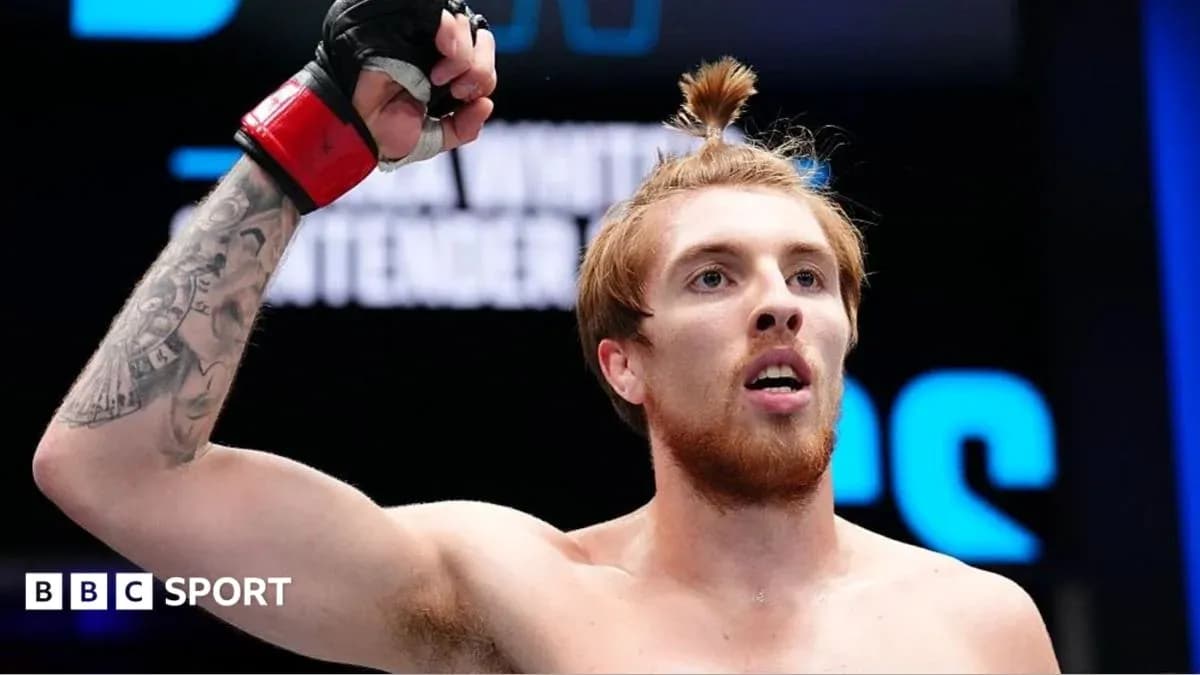
Kurtis Campbell's Journey from Bullying to UFC Fighter
Kurtis Campbell remembers being seven years old and realising something had to change – even if he didn’t quite understand it at the time.
At primary school in Liverpool, he became a target. The bullying chipped away at him, and his parents, Jay and Michelle, watched their son shrink under the weight of it. They decided enough was enough.
Their answer wasn’t a quiet word with the teachers. It was Muay Thai.
They signed him up so he could learn to defend himself, to walk into secondary school with a little more steel. It was meant to be practical, temporary, a shield rather than a calling.
It turned into his life.
“From there, I've never looked back,” Campbell told BBC Sport. “I've been in love with the sport ever since.”
Seventeen years on, that shy boy is a 24-year-old UFC lightweight, days away from his second appearance in the promotion, facing American Trevor Peek at UFC Paris on Saturday. The stakes are different now, the arenas bigger, but the engine behind it all hasn’t changed.
Without his parents, he knows he wouldn’t be here. Wouldn’t be chasing the dream of becoming a UFC champion. Wouldn’t be talking about changing his family’s life.
“I'm not going to stop until my mum and dad are on a beach somewhere, sipping cocktails and doing nothing else for the rest of their lives,” he said. “They can enjoy it, knowing that they've created this monster. That's my plan.”
The “monster” did not arrive fully formed. At first, Campbell didn’t even like fighting.
“I was quite a soft kid, in the sense that I didn't really like the violence or the fighting,” he admitted.
The gym, though, offered something school never did. Structure. Focus. An escape. As the sessions piled up and the techniques became instinct, something in him flipped.
“I felt like when I did fight, and when I really did go into it, everything changed and I never looked back.”
He started entering amateur competitions. Weekends that might have been spent worrying about school became tournaments, pads, rings, and scorecards. The more he competed, the more obsessed he became. The noise from the classroom faded; the noise from the crowd took its place.
By 15, Campbell had his first international Muay Thai title. A teenager from Merseyside, standing on a podium, realising that this thing that began as self-defence might actually be his way out.
Combat sports stopped being a hobby. With his parents’ blessing, it became the plan.
School, by contrast, never truly clicked.
“I was never the cleverest kid. I was always in the bottom sets at school, so I wasn't really focused,” he said. “All of the teachers told me, ‘you need to do something else. You have to have a plan B.’”
He heard them. He just didn’t agree.
As his reputation grew across Merseyside, his commitment hardened. While others drifted between subjects and social circles, Campbell ran. Literally. Almost five miles to school. Almost five miles back. Day after day.
He bent everything towards fighting. There was even a point, in the middle of his GCSE preparation, when he skipped school altogether to attend a coaching seminar in Liverpool led by John Kavanagh, the man behind former two-weight UFC champion Conor McGregor. Most teenagers were revising past papers. Campbell was taking notes from one of the sport’s most influential coaches.
After finishing his GCSEs at 16, he did what was expected on paper: he enrolled on a college course that combined a sports qualification with playing football.
On paper.
In reality, he cut a deal. He would show up for the classroom work, then slip away while his classmates laced up their boots and headed for the pitch. They chased a ball. He chased a fight career.
“I was always avoiding anything just for fighting,” he said. “I really didn't like school. It wasn't me. But I made a good few mates there, so you've got to take the pros with the cons.”
Those choices – the skipped sessions, the long runs, the unwavering refusal to entertain a “plan B” – have led him to this week in Paris, to Trevor Peek, to a second step on a stage he once watched only on television.
The bullies from that Liverpool playground are long gone. The doubt from those school reports has been drowned out by the sound of pads and punches. Now the question is simple: how far can the kid who “didn’t really like fighting” take the sport he fell in love with?