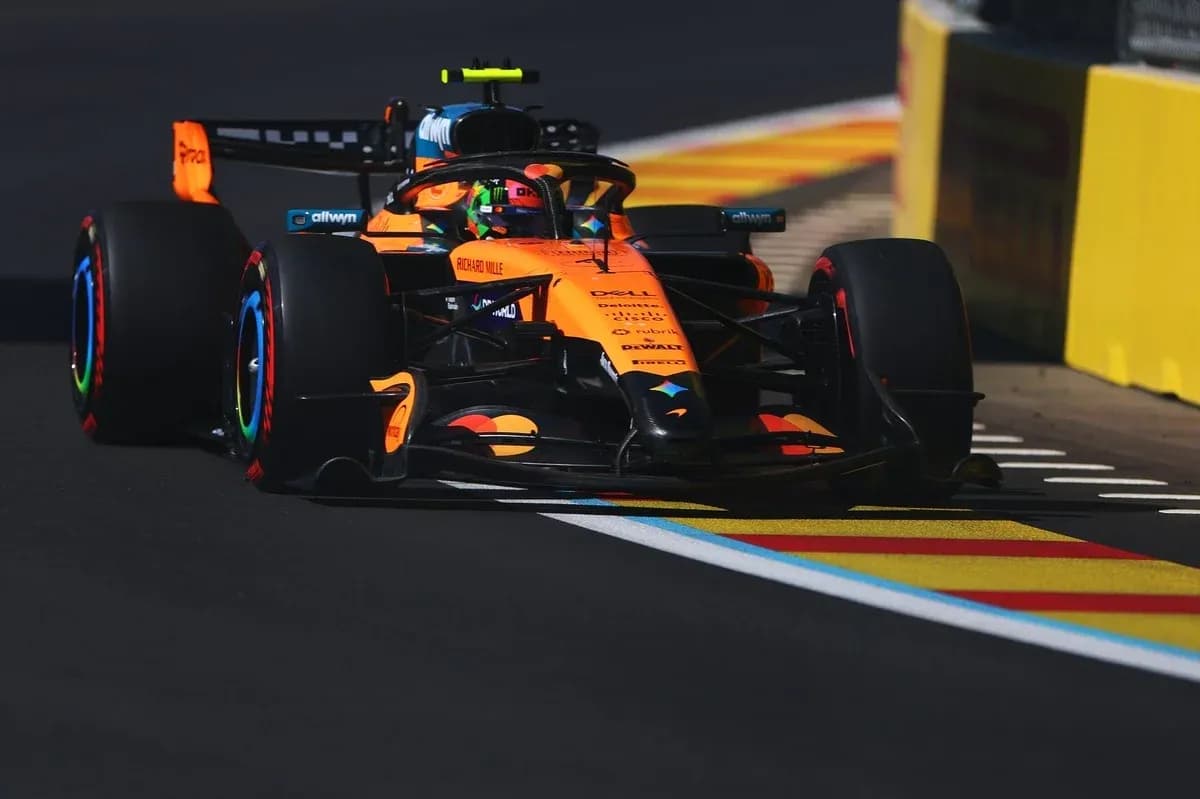
Lando Norris Secures Unbelievable Pole Position in Barcelona
Lando Norris walked back into the McLaren garage in Barcelona convinced he’d thrown away his shot.
“Sorry, I fucked up man,” he told race engineer Will Joseph over the radio, sure that a wild slide at the final corner had wrecked the lap.
On the timing screens, though, a different story was being written. By 0.011s – the blink between despair and delirium – Norris had snatched pole from Kimi Antonelli for the Spanish Grand Prix. A lap that began as a rescue mission ended as a masterpiece.
Andrea Stella didn’t hesitate to call it exactly that.
A pole that came from nowhere
Nothing about McLaren’s weekend suggested this was coming.
Mercedes ruled every practice session, Ferrari sat in the slipstream, and Red Bull lurked as usual. In Q1 and Q2, the Silver Arrows traded blows with Red Bull at the top. McLaren were there, but always a couple of tenths short, stuck in that frustrating zone of being competitive without ever truly threatening.
Even in Q3, the script seemed set. After the first runs, Lewis Hamilton led the way. Norris was only sixth, 0.446s off the benchmark. The papaya cars looked tidy, but not terrifying.
Then Norris went again.
He found 0.701s on his final attempt – a monstrous gain at a track that punishes overreach – and dragged the car to a lap Stella would later rank among the very best he has seen in 450 grands prix of poring over telemetry.
The margin over Antonelli? Eleven thousandths. Just enough. Barely believable.
“I thought I was in the wall”
The irony is that the lap Norris delivered was so ferocious that, inside the cockpit, it felt like failure.
By the time he reached the final corner, he had pushed the tyres to the edge of their life. He turned in with the same aggression he’d used earlier in the lap, and the rear snapped. From the outside it looked like a heart-stopping slide; from the inside, it felt like the end.
“By the last corner, I just had a bit of a, I don’t know, a little moment,” Norris explained. “I think I got a bit excited in the car and I just overpushed the entry and, honestly, I thought I was in the wall.”
He gathered it up, somehow. The run to the line at Barcelona is short. The time loss was brutal but not fatal.
On the radio, Joseph tried to calm him, hinting that the lap might still be good enough. Norris, convinced he’d blown it, snapped back: “Fucking idiot.”
Then the cars finished. The times locked in. And the “idiot” was on pole.
“It wasn’t your best final corner, but it’s still pole, so well done,” Joseph told him. It took a moment for Norris to accept that nobody was joking.
Precision under pressure
The raw numbers underline how extraordinary the lap was.
Oscar Piastri, in the same machinery, will start only seventh, 0.470s slower than Norris. McLaren had been wrestling all weekend with a car that struggled in the first sector, in low-speed corners and over kerbs. It was quick in flashes, but viciously hard to string together over a full lap.
“We were not honestly performing to the level of scoring a pole position,” Stella admitted. “At no stage during the weekend we demonstrated that the car was performing at the level of being the best car.
“We were lacking quite significantly in the first sector, low-speed [corners] and kerbing, and for the drivers it was a very difficult car to nail a lap. We saw that there were spells of potential, but it's always very difficult to put it together.”
Norris did exactly that – and then some.
Stella revealed that his driver lost “three-and-a-half tenths in the last quarter” of the lap thanks to that wild moment at the final corner. Take that away, and this wouldn’t just have been a narrow pole. It would have been emphatic.
“At the same time, this issue is a consequence of pushing to the level that Lando managed to push,” Stella said. Everyone in Q3 was on the limit; Norris simply found a way to live there for longer.
What impressed Stella most wasn’t the headline time, but how Norris built it.
“The thing that makes the lap unique, when you look especially at the telemetry, is the precision, the braking, the speed you carry in entry, the striking of the kerb, the going on power. Everything is executed with a pretty unique level of precision.
“For me, that's if anything the main attribute that I would associate to this lap: just incredible precision in the metre-by-metre execution.”
Tyres on the edge, driver beyond it
Stella linked the final-corner drama directly to the ferocity of the rest of the lap. Norris had been so aggressive earlier on that the tyres were, in his words, “tired” by the time he reached the last turn.
“He just paid the price of the fact that the lap was coming, like, one second faster than any other lap, therefore there was quite a lot more that was extracted from the tyres,” Stella explained.
“I mean, the tyres were tired and somehow Lando did not take this into account and he entered the corner with the same impetus that he had in some other corners.
“He oversteered in entry, and this means that he loses completely the racing line, and like I said, he lost more than three tenths. It's nothing calculated; if anything, he's not taking enough into account that the tyres were tired.
“I don't think he knew [he was going to be in trouble]. I think he just was in attacking mode, but it was a bit too much for what the tyres had left.”
Attacking mode. Too much for the tyres. Exactly enough for pole.
On a weekend when McLaren never truly looked like the fastest car, Norris found a lap his team boss will remember out of hundreds of grands prix. It arrived on the edge of control, balanced between genius and disaster, and it leaves one question hanging over Sunday:
If this is what he can do with a “mistake”, what happens when the lap – and the race – are truly clean?