Lionel Messi’s Final Moments in Albiceleste
Lionel Messi stood alone in the heat, silver medal hanging heavy, eyes wet, boots still tied. No tantrum. No rage. No grand speech. Just silence and a 39-year-old man absorbing the final seconds of a life he has lived in sky blue and white.
Then he sat down on the grass.
The same grass he once left convinced this dream might never come true for him. This time, he bent over and slowly unlaced his boots, knowing he would never wear them for Argentina again.
No farewell tour. No cameras following his every move. No carefully choreographed “Last Dance.” Messi walked away from international football exactly as he lived it: letting the ball, not his voice, carry the story. From the days in Rosario when he was told he was too small to play with the older boys, his answer has always been the same – play better than everyone else.
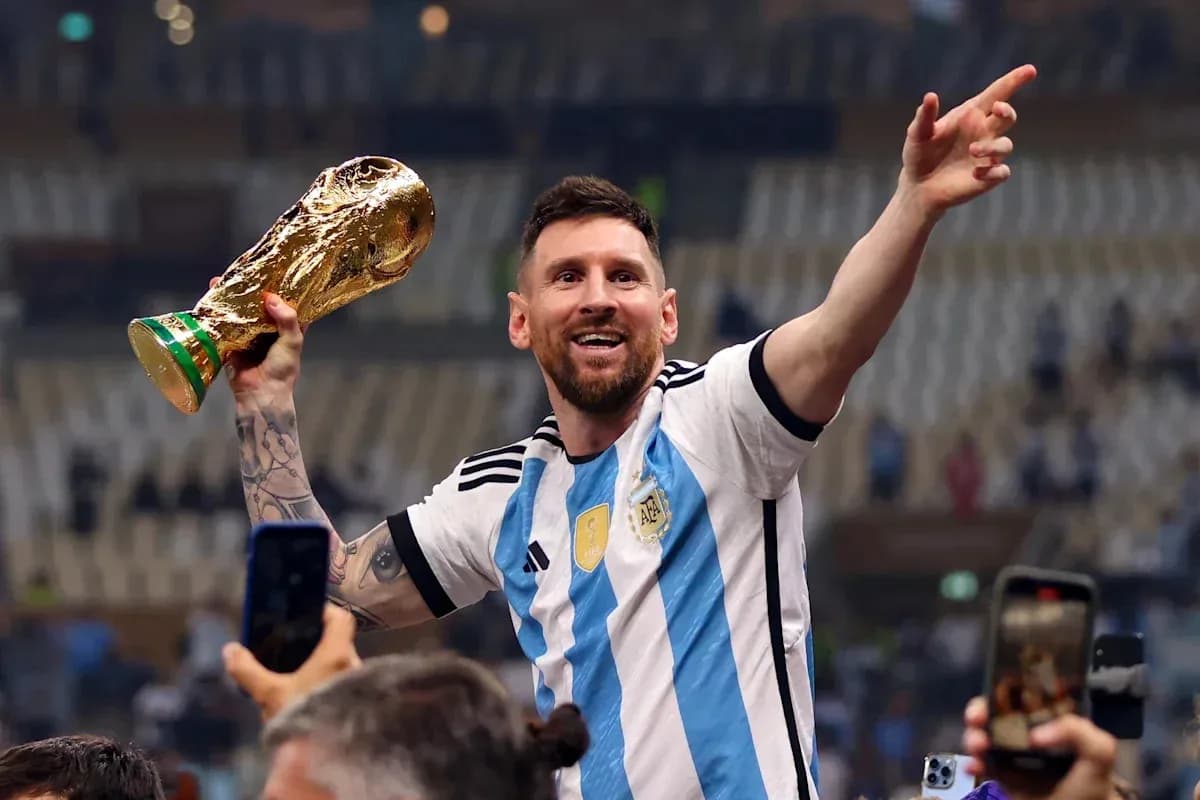
After more than two decades, 207 caps, nine finals and four major trophies, the greatest of them all in Qatar in 2022, Messi has called time on his Argentina career. The last chapter ends with defeat to a superior Spain, but that closing line cannot rewrite the book. It cannot erase another remarkable tournament from a 39-year-old who still bent matches to his will, or the fairytale that came before.
The Old Wound That Drove Him
It is easy, in 2026, to forget how long that fairytale looked broken.
For years, Messi carried a stain he never deserved. “He does it for Barca, why not for Argentina?” It was the chant of rivals, but also the murmur from within his own country. He and his family absorbed abuse, suspicion, outright hostility. Some of the same voices now calling him a god once questioned whether he even felt Argentine enough.
Four lost finals carved that narrative into his back. Copa América heartbreaks, the 2014 World Cup final in Rio, the penalty shootout defeat to Chile in 2016 that drove him to briefly walk away from the national team. He retired once, then returned. The pain stayed. So did he.
The Turning of the Tide
Then came a different Argentina.
Lionel Scaloni, Rodrigo De Paul, Cristian Romero, Emiliano Martínez. The old guard of Ángel Di María and Nicolás Otamendi. A group that did not just play with Messi, but for him. In 2021, at the Maracanã, against Brazil, the dam finally burst. Messi lifted the Copa América on enemy soil and, with it, years of suffocating doubt.
The flood did not stop.
Enzo Fernández and Julián Álvarez arrived. La Scaloneta turned into a machine. Apart from that jolt against Saudi Arabia, Argentina rolled through opponents, collecting trophies and scars, culminating in the 2022 World Cup. They became the team nobody wanted to face, fronted by a captain who had stopped chasing ghosts and started collecting memories.
From “international failure” to the architect of Argentina’s greatest era. Before this final, a generation of schoolchildren had never seen their country lose a knockout match with him on the pitch. Once accused of not doing enough, he ended with so much silverware that his critics flipped the script and claimed international football was rigged in his favour.
The Numbers – and What They Miss
The sport is losing its brightest light on the international stage.
Ninety-one goals in a calendar year. Eight Ballons d’Or, four before he turned 25. 1,348 goal contributions. Forty-four trophies. Records that will stand, or at the very least terrify anyone who dares chase them.
Yet none of those numbers come close to explaining why his departure feels like a piece of football’s soul being torn away. The game is not a lab experiment. It is an art form, and no one painted it like Messi.
At this tournament, he dragged Argentina back to the World Cup’s summit match yet again, outplaying stars closer to his children’s age than his own, while his father lay on his deathbed. Talent alone cannot explain that. Nor can it explain why a man who has conquered every peak still played every game as if it might be his last.
Everyone Tried to Capture Him. Nobody Could.
Writers have spent years trying to define Messi and kept coming up short. Maybe that is the point. His legacy does not live in the numbers, or even in the trophies. It lives in how he made people feel.
Each fan has their own Messi.
For some, he is the teenager slaloming through Getafe, the solo assassin against Real Madrid and Athletic Club. For others, he is the one-two with Jordi Alba, the chaos of MSN, the conductor in front of the greatest midfield trio the club game has seen. For many, he is the man hoisting Champions League trophies, lifting La Liga titles, and finally kissing the World Cup.
La Pulga gave the world thousands of images. But his greatest gift was the sense of watching someone who had fully mastered his craft. A player who saw spaces others never knew existed, who processed the game a fraction of a second faster than everyone else.
Billions have kicked a ball. He made the act feel transcendent.
The Touch That Changed Everything
Sometimes it was not even the goals.
A first touch that killed a 40-yard pass and rolled it into space. A wall pass played with the wrong foot at the perfect angle. A body feint that sent a defender stumbling into a different postcode. A dummy that froze three players at once.
He made the impossible look routine. The pass only he could see. The angle only he could find. The defence only he could unlock.
And on top of that, he became the most prolific scorer the sport has known.
The Child in All of Us
His retirement from international football feels like one of those rare moments when a toddler’s tears make complete sense to adults. Growing up, graduating, building careers – none of it prepares you for the day the player you built your footballing life around walks away from the biggest stage.
Football is a kids’ game dressed up in adult money. One man perfected it. Behind the tactics, the GPS vests, the data departments and the private jets, the core of the sport never changed. Messi reminded everyone of that. He turned elite competition back into the schoolyard, and in doing so, he reawakened that childlike awe in those who watched him.
Nobody wants him to stop, because nobody wants that feeling to end. In some corner of every fan, there is still that kid begging him not to go.
The Generation He Raised
Very few players have combined the talent to be an icon with the emotional intelligence to lead like one. Messi did both.
An entire generation shaped their lives around him. Fans sold possessions to cross continents just to see him once. Children sprinted home from school to catch his latest exhibition at Camp Nou. Others watched him from cramped living rooms in Argentina, then pulled on their boots and tried to follow his path.
Those kids grew up. They made the youth teams. They fought their way into the senior squad. And when the time came, they ran themselves into the ground to help their idol lift the trophy so many believed the sport “owed” him.
Football did not owe Messi anything. His teammates understood that. They had watched him move heaven and earth for Argentina, watched him cry, watched him come back again and again. When the chance finally came, they did not repay a debt. They honoured a standard.
The Man Behind the Genius
Perhaps the most telling tribute to Messi is that, as the messages pour in from teammates and rivals, the focus keeps drifting away from the goals and towards the man.
They talk about the captain who listened, the leader who never raised his voice just to be heard, the teammate who celebrated others’ success as if it were his own. In a sport that devours egos and inflates myths, he stayed remarkably small in the ways that mattered.
His selflessness did not just make him easy to love. It made him impossible to resent inside a dressing room built around him. That, as much as his left foot, is why he leaves international football as an undisputed champion.
The Stage Grows Smaller
His career is not over. Not yet.
He will keep playing in Miami, scoring – he hit four last week – and sharing a pitch with close friends as he winds down the final years. But the World Cup final appears to have been his last truly high-stakes occasion. That feels cruel in its own way, because even at 39, he reminded the world he is still the best f*****g player on any pitch.
He does not need another final to prove it. Not to anyone, least of all himself.
What comes next belongs to club football, to Inter Miami, to those who can still see him live before he finally walks away for good. International football, though, has lost its north star.
Messi’s boots are off. The shirt is folded away. Argentina will move on, as nations always do. But every player who pulls on that jersey from now on will know they are stepping into a space once occupied by a man who turned criticism into coronation and doubt into the greatest era their country has ever known.
The question is no longer whether he did enough for Argentina.
The question now is who will dare to follow.