London City Lionesses Begin New Era with Victory Against Manchester United
London City’s new era began under the floodlights at Hayes Lane with a statement, not a soft launch.
A 2-1 scoreline against Manchester United looks tight on paper. It wasn’t. Not in the ways that matter.
Putellas draws the crowd, but an own goal breaks it open
All eyes, naturally, went first to Alexia Putellas. Two Ballons d’Or, a summer of headlines, and now a London City Lioness. She walked out into a sell-out crowd, the symbol of a club that has decided mid-table is no longer its ceiling.
Yet the first roar of the new season came from something far less glamorous.
On nine minutes, Julia Zigiotti tangled with Alanna Kennedy in the box. It was scruffy, awkward, the kind of duel that usually ends with a hopeful clearance and a reset. Instead, Zigiotti’s header flew the wrong way, past her own goalkeeper and into the net. The first goal of the 2026/27 campaign belonged to London City, via a United shirt.
From there, the pattern hardened quickly. London City didn’t just lead; they took hold.
London City in control, United chasing shadows
Eder Maestre’s side stepped into the game with the swagger of a team that knew exactly what it wanted to be. The press was coordinated, the passing angles sharp, the tempo theirs. United were held at arm’s length, reduced to chasing, reacting, surviving.
The new faces didn’t look new for long. Rosa Kafaji, stationed high and busy, nearly produced a highlight of her own just after the break. On 49 minutes she let fly from distance, forcing a strong save from Phallon Tullis-Joyce and underlining the territorial dominance London City had built.
Behind her, Mapi Leon’s authority in possession and Janni Thomsen’s work rate gave the hosts a spine that United struggled to disrupt. Putellas, the marquee name, knitted moves together with the kind of calm that makes everything around her look slower, simpler.
United, by contrast, never found a rhythm. Eva Olid admitted as much. “We were not us,” she said, and it showed. The patterns they had drilled in pre-season never surfaced in that ragged first half. Passes went astray, distances between lines stretched, and London City happily occupied the gaps.
Even when the visitors finally started to see more of the ball after the interval, the threat was minimal. Possession arrived, penetration did not.
Corrales injury, then Van de Donk’s touch of class
There was a moment of concern on 64 minutes as Lucia Corrales went down clutching her shoulder and had to be withdrawn. It broke the flow, but not London City’s grip on the match.
If anything, it set the stage.
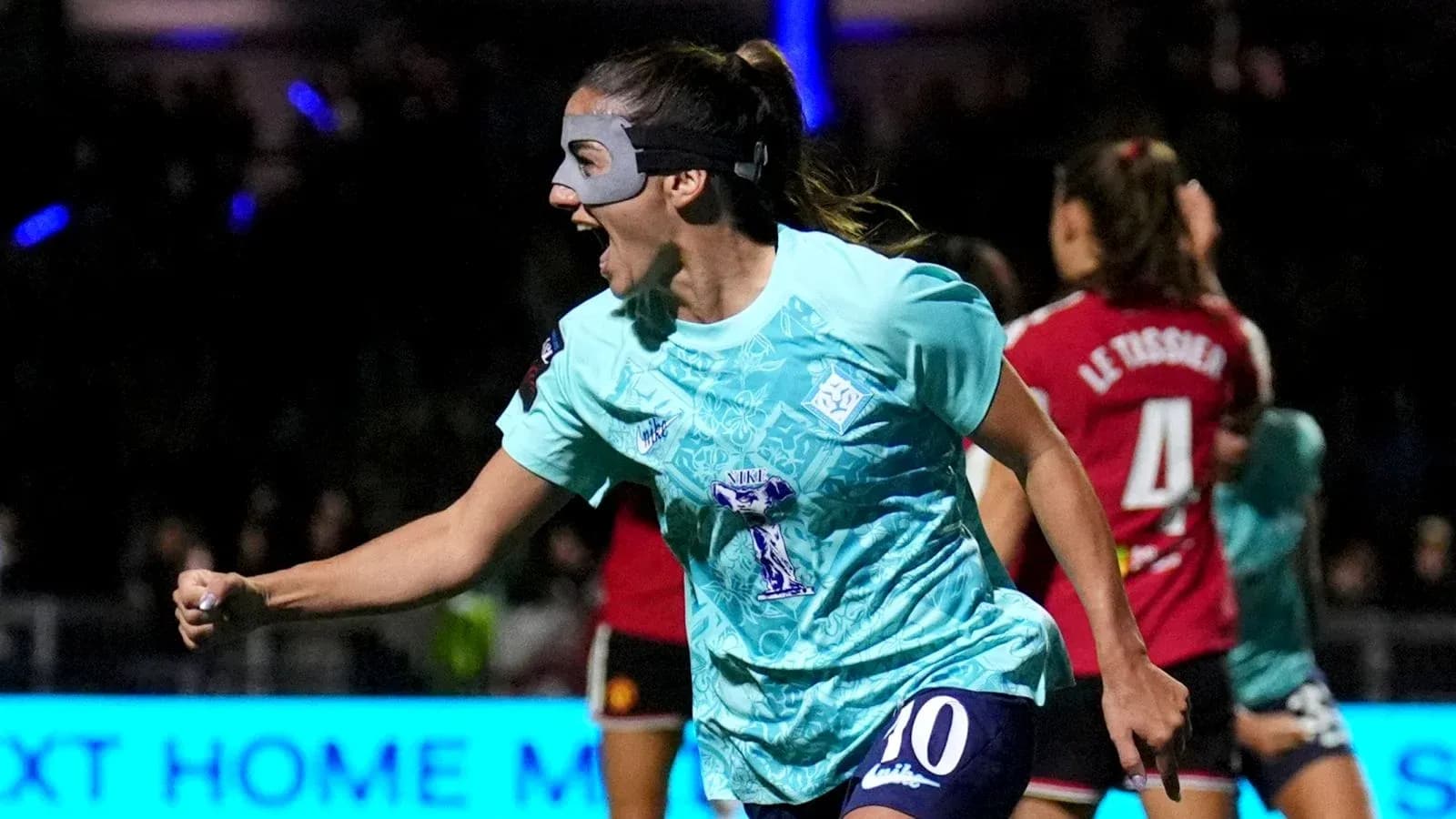
With eight minutes of normal time left, the pressure finally told in the most stylish way possible. Danielle van de Donk, always alive to space, ghosted into the box. A sharp ball came her way, and with a deft, instinctive flick she turned half a chance into a decisive goal. 2-0. Game done.
It was the kind of finish that underlines the difference between a team hoping to compete and one built to dictate. London City had been superior; Van de Donk’s moment of improvisation put a flourish on the performance.
From the stands, owner Michele Kang watched a vision begin to take shape. On the bench, Mary Earps and Kadidiatou Diani – both unused – underlined just how much firepower this squad now has in reserve.
A late sting, and a gap laid bare
United finally registered a shot on target deep into stoppage time. It went in.
Substitute Simi Awujo found herself in the right place with virtually the last kick of the match, tucking away a consolation that did little to alter the story of the night. One shot on target. One goal. No real argument about the better side.
Olid’s frustration was clear. The response after half-time offered a glimpse of what United want to be, but it arrived too late and too briefly. “It’s not enough just 40 minutes trying to have the ball,” she said. Over 90, the gulf in sharpness and cohesion was stark.
Maestre, by contrast, could lean on more satisfying truths. “We were very dominant through the whole game,” he said, and the evidence backed him. London City’s identity – front-foot, brave, collective – looked less like a slogan and more like a functioning blueprint.
A new heavyweight taking shape?
Putellas, Leon, Kafaji, Thomsen. Van de Donk deciding it. Earps and Diani still to come. This didn’t feel like a one-off opening-day surge. It felt like the soft launch of a new heavyweight.
One win does not define a season. But on a night when a star signing drew the cameras and an own goal lit the fuse, London City Lionesses looked every bit like a club ready to crash the established order – and to make results like this their new normal.